 critical cactus
Radiacode 102 Geiger Counter is our top choice for the Best Home Radiation Detectors because it offers rapid isotope identification and high-resolution spectral visualization. The Radiacode Zero provides a high-range scintillation sensor for extreme environments, while the Aranet Radiation Detector delivers long-term monitoring with an impressive four-year battery life.
Selecting a reliable device requires balancing sensitivity with the specific type of radiation you intend to monitor. While some units focus on quick, real-time detection of gamma and beta particles, others are engineered for long-term environmental tracking or specialized gas detection like radon.
Understanding the difference between a general-purpose Geiger counter and a dedicated dosimeter is essential for home safety. We evaluate these devices based on their sensor technology, data logging capabilities, and the clarity of their user interfaces to ensure you can interpret readings accurately without needing a background in nuclear physics.
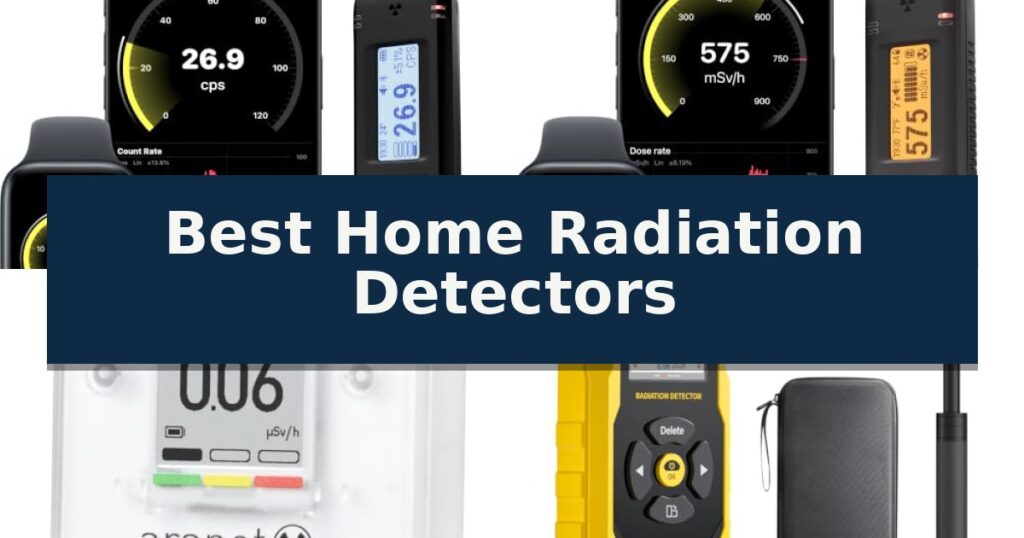
9 Best Home Radiation Detectors in 2026 Reviews
Quick Comparison
| Product | Best For | Key Strength | Score |
|---|---|---|---|
| Radiacode 102 Geiger Counter | Best Overall | Game-changing detection speed that operates 20 times faster than typical devices. | 4.9 |
| Radiacode Zero Radiation Detector | High-Range Scintillation Sensing | High-range measurement up to 9 Sv/h. | 4.8 |
| Aranet Radiation Detector | Four-Year Battery Life | 4-year battery life for long-term, uninterrupted operation. | 4.5 |
| AKSTEST HFS-50-CsI Radiation Detector | Stable Scintillator Accuracy | CsI scintillator sensor provides superior stability and interference resistance. | 4.8 |
| GQ GMC-800 Geiger Counter | Comprehensive Data Logging | Comprehensive data logging with up to 10 years of storage capacity. | 4.7 |
| GQ GMC-300S Geiger Counter | Budget-Friendly Digital Monitoring | Real-time data logging every second to internal memory. | 4.5 |
| APOWER RD-3 Geiger Counter | Portable Handheld Dosimeter | Multi-ray detection capability covering Gamma, Beta, and X-rays. | 4.7 |
| POROMETISTO ND01 Geiger Counter | Simple Three-Mode Detection | Three-mode detection system for versatile monitoring | 4.7 |
| Kidde Radon Detector | Dedicated Indoor Gas Monitoring | Continuous, real-time monitoring provides immediate air quality insights. | 4.7 |
How We Chose
When evaluating the Best Home Radiation Detectors, we focus on technical precision and practical utility for non-professional users. An experienced reviewer must distinguish between devices designed for quick spot-checks and those intended for continuous environmental monitoring, ensuring that sensor sensitivity, data logging features, and alert reliability align with the specific safety requirements of a residential setting.
- Sensor technology, prioritizing scintillation sensors over standard Geiger-Muller tubes for higher sensitivity.
- Measurement range and accuracy, ensuring the device can handle both low-level background radiation and higher intensity fields.
- Data logging and connectivity, evaluating the utility of mobile applications for mapping and long-term trend analysis.
- Alert systems, checking for multiple, customizable alarm types including audio, visual, and vibration indicators.
- User interface and display clarity, focusing on readability in various lighting conditions and ease of navigation.
1 Radiacode 102 Geiger Counter — Fastest Isotope Identification
Identifying radioactive isotopes in real-time is a complex task, yet the Smart Geiger Counter Radiacode-102 with Free Mobile App. Nuclear Radiation Detector simplifies this by offering radiation source spectrum visualization. This device goes beyond basic detection, allowing users to recognize specific isotopes like Cs-137, Ra-226, Th-232, and U-238, as well as decay products of Radon-222, with a spectral resolution (FWHM) of 9.5% (+/- 0.4%).
Engineered for high-speed performance, the unit features game-changing detection speed that measures up to 20 times faster than standard devices. This capability is particularly beneficial for users on the move, significantly reducing the likelihood of missing localized radioactive spots. With a reference count rate of 1 μSv/h equating to 1800 CPM on Cs-137, the device provides precise, actionable data.
Usability is enhanced through seamless integration with free mobile and desktop apps available for iOS, Android, macOS, and Windows. These applications unlock advanced functionality, including dose rate graphs, spectrum analysis, and radiation GPS tracking. Users can generate real-time radiation maps with GPS-logged readings, which can be saved and shared via Google Maps or Open Street Maps.
The hardware is designed for versatility, featuring up to seven alarm modes that include two adjustable sound levels, an LED indicator, vibration, and app-based alerts. It supports measurements in CPS, CPM, μSv/h, and μR/h, and is capable of detecting gamma, X-ray, and hard beta radiation. The device is equipped with a transflective blue-backlit display for clear visibility in various lighting conditions.
Best for: Users who require rapid, precise isotope identification and GPS-mapped radiation tracking for field or professional applications.
Skip if: Individuals looking for a simple, low-cost dosimeter without the need for advanced spectrum analysis or mobile app connectivity.
- Game-changing detection speed that operates 20 times faster than typical devices.
- Advanced radiation source spectrum visualization for isotope identification.
- Comprehensive GPS-logged radiation mapping via mobile application integration.
- Versatile seven alarm modes including vibration and LED indicators.
- Requires mobile or desktop app connectivity to access the full suite of analytical features.
- Higher technical complexity compared to basic Geiger counters.
2 Radiacode Zero Radiation Detector — High-Range Scintillation Sensing
The Radiacode Zero Radiation Detector distinguishes itself from conventional Geiger counters by utilizing an organic scintillator, which is engineered to measure radiation with absorption properties closely mimicking human tissue. This design choice moves beyond standard metal and gas-filled tubes, providing a more biological perspective on ambient dose equivalent rates.
Equipped with advanced energy-compensated measurement technology, the device accurately estimates H*(10) dose rates even in complex fields containing varied photon energies. Unlike many consumer-grade detectors that cap out at 10 mSv/h, this unit maintains functionality up to a 9 Sv/h measurement ceiling, ensuring it remains operational during extreme radiation events.
Portability and connectivity are central to its design, with the device weighing just 76 grams and featuring an IP64-rated enclosure. Users can monitor data via a sunlight-readable display or pair the unit with a mobile app for real-time charting, accumulated dose tracking, and GPS-integrated radiation mapping.
With a battery life reaching up to 200 hours, the Radiacode Zero Radiation Detector is built for extended field use. It functions as a standalone tool for everyday discovery or as a connected sensor for more rigorous data collection, offering a versatile solution for those requiring high-range sensitivity in a compact form factor.
Best for: Users requiring high-range radiation detection and precise energy-compensated measurements in a portable, smartphone-connected device.
Skip if: Users who prefer a traditional, non-digital Geiger counter interface or those who do not require the high-range measurement capabilities of an organic scintillator.
- High-range measurement up to 9 Sv/h.
- Tissue-equivalent detection using organic scintillator technology.
- Energy-compensated for accurate dose equivalent estimation.
- Compact and durable design with IP64 protection.
- Long battery life of up to 200 hours.
- Requires smartphone connectivity for advanced features like GPS mapping.
- Higher complexity compared to basic, single-setting Geiger counters.
3 Aranet Radiation Detector — Four-Year Battery Life
Monitoring ionizing radiation levels requires a reliable instrument, and the SAF Aranet Radiation Detector offers a specialized approach by combining long-term data tracking with a highly efficient E-Ink display. This device is designed to measure both the ambient equivalent dose rate and the total accumulated dose, providing a comprehensive view of radiation exposure over time.
The unit differentiates itself through its 4-year battery life, which minimizes the need for frequent maintenance or power interruptions during extended monitoring periods. Its ability to track radiation levels up to 1000 mSv or 100 rem over a two-year span makes it a practical tool for users who require consistent, long-term environmental analysis.
Connectivity is a core component of this detector, as it features built-in Bluetooth to sync with a dedicated mobile application. This app transforms the raw data into visual graphics, allowing users to monitor particle counts and radiation trends more intuitively than a standard screen might permit.
Safety is addressed through an integrated alarm system that alerts users when radiation levels exceed scientifically recommended thresholds. The portable, wireless design ensures the device can be placed in various environments, making it a versatile option for those who need to maintain awareness of their surroundings.
Best for: Users who require long-term, continuous radiation monitoring with wireless data logging and extended battery performance.
Skip if: Those who need a simple, standalone Geiger counter without app integration or who prefer a traditional LCD screen over E-Ink technology.
- 4-year battery life for long-term, uninterrupted operation.
- Comprehensive analysis of gamma, beta, and x-ray radiation.
- Bluetooth connectivity for detailed data visualization via a mobile app.
- Integrated alarm system for immediate notification of high radiation levels.
- App-dependent features may be less convenient for users who prefer purely standalone hardware.
- E-Ink display refresh rates are slower than standard digital screens.
4 AKSTEST HFS-50-CsI Radiation Detector — Stable Scintillator Accuracy
Monitoring environmental radiation levels requires precision, and the AKSTEST HFS-50-CsI Radiation Detector distinguishes itself by utilizing a CsI scintillator sensor paired with an energy compensation mechanism. This design choice provides greater stability and resistance to interference compared to standard Geiger-Müller tube configurations, making it a reliable tool for detecting gamma and X-ray radiation.
The device is built for intuitive data management, featuring a color screen that displays a 200-second dynamic waveform curve and a dose rate indicator bar. It automatically logs data every second and can store up to 100 records, ensuring that cumulative dose and time data remain preserved even after the unit is powered off. Users can also utilize the timed measurement function for specific monitoring tasks.
Safety and portability are central to its design. The detector includes a handheld telescopic rod to help maintain a safe distance from potential radiation sources, such as during checks for hospital X-ray or CT scan intensity. For alerts, it employs a triple alarm system that combines sound, flashing lights, and on-screen numerical warnings, with a rapid response time of under 3 seconds.
Efficiency is a notable strength, as the scintillation sensor allows for a long battery life of up to 1700 hours in screen sleep mode. The integrated 2000mAh lithium battery is rechargeable via a Type-C port, reaching a full charge in approximately 3 hours. The unit's compact dimensions of 5.43" x 2.36" x 1.02" ensure it remains portable for environmental monitoring.
Best for: Individuals requiring a portable, high-precision instrument for monitoring gamma and X-ray radiation in environmental or medical contexts.
Skip if: Users who do not require the specific sensitivity of a CsI scintillator sensor and would prefer a more basic, lower-cost Geiger-Müller counter.
- CsI scintillator sensor provides superior stability and interference resistance.
- Long battery life of up to 1700 hours in sleep mode.
- Triple alarm system ensures immediate notification of radiation thresholds.
- Telescopic rod included for safe distance monitoring.
- Higher complexity compared to basic entry-level radiation monitors.
5 GQ GMC-800 Geiger Counter — Comprehensive Data Logging
The GQ GMC-800 Geiger Counter distinguishes itself through its versatile, multi-functional design that allows for both instantaneous radiation flux detection and long-term dosimeter monitoring. Engineered to meet USA national standards (NIST and NRC), this device provides a reliable way to measure ionizing radiation, including Beta, Gamma, and X-ray sources, in a portable, user-friendly format.
Equipped with a large, clear TFT color LCD display, the unit offers multiple viewing modes, including graphic and large font options, to ensure readability in various lighting conditions. Users can navigate through four function screens using simple shortcut keys, making it accessible for both personal and group monitoring applications. The interface is designed to shorten the learning curve, featuring customizable light and dark modes for visual comfort.
Data management is a core strength of this device, which includes built-in memory capable of storing data for up to 10 years. It supports free data processing software, firmware updates, and online data storage, allowing for comprehensive history previews. The GQ GMC-800 Geiger Counter is powered by an easily accessible, rechargeable, and replaceable battery, with Type C connectivity for charging and data transfer.
Safety and accessibility are prioritized through five distinct alarm types: visual LED, audio, vibration, and voice alerts. These features are particularly beneficial for users with vision or hearing impairments, and the alarm thresholds are fully user-adjustable. The device is built to be light, thin, and anti-drop, with a versatile design that allows it to be held, stood upright on either side, or laid flat on a surface.
Best for: Individuals and groups requiring a portable, highly configurable device for monitoring and logging ionizing radiation levels over time.
Skip if: Users who require a specialized, industrial-grade laboratory instrument for highly specific scientific research beyond standard dosimeter and flux monitoring.
- Comprehensive data logging with up to 10 years of storage capacity.
- Five distinct alarm types including vibration and voice for enhanced accessibility.
- Compliant design meeting NIST and NRC national standards for accuracy.
- Versatile interface with customizable color schemes and display modes.
- Portable design may be less suitable for permanent, fixed-position industrial installations.
6 GQ GMC-300S Geiger Counter — Budget-Friendly Digital Monitoring
The GQ GMC-300S Geiger Counter provides a specialized approach to monitoring by offering real-time data logging that records information every second directly into its internal memory. This capability allows users to track radiation levels over extended periods, making it a practical tool for those who need to maintain a continuous record of environmental exposure.
Designed for versatility, the device features multiple operating modes including Dosimeter mode, CPM count mode, and Graph mode. These settings allow the user to toggle between immediate visual feedback and historical data analysis. The inclusion of a rechargeable battery ensures the unit can remain operational for longer durations without frequent power interruptions.
For users interested in deeper analysis, the GQ GMC-300S Geiger Counter supports data management through its free data Viewer PC software. By connecting the device to a computer, you can download historical logs for detailed review. Its compact physical dimensions—measuring 4.75 inches in length and 2.75 inches in width—ensure it remains portable enough for various monitoring environments.
While the unit is equipped with advanced logging features, it is important to note that its primary utility is focused on digital monitoring and data collection. Users should ensure they are comfortable with the software interface to fully utilize the logging and graphing capabilities provided by this specialized radiation detection tool.
Best for: Users who require continuous, long-term radiation data logging and the ability to analyze historical trends via PC software.
Skip if: Users who prefer a simple, analog-only device without the need for digital data management or software connectivity.
- Real-time data logging every second to internal memory.
- Includes free data Viewer PC software for analysis.
- Equipped with a rechargeable battery for extended use.
- Features multiple modes including Dosimeter, CPM, and Graph.
- Requires computer connectivity to access and manage historical data logs.
7 APOWER RD-3 Geiger Counter — Portable Handheld Dosimeter
Monitoring environmental radiation levels requires a device capable of detecting multiple particle types with precision. The APOWER RD-3 Geiger Counter distinguishes itself with a built-in sensor engineered to identify Gamma, Beta, and X-rays, providing a versatile solution for home improvement checks, geological surveys, and laboratory environments.
This handheld device features a clear LCD color display that provides real-time readings across a range of 0.05uSv-50.0mSv. Users can customize their experience through adjustable settings, including alarm thresholds, measurement units, and screen brightness. Its compact, lightweight design allows for convenient portability, fitting easily into a shirt pocket for on-the-go monitoring.
Safety is prioritized through a triple alarm system that combines audible alerts, visual screen color changes, and flashing red indicators when radiation levels exceed preset thresholds. For long-term tracking, the unit includes a timed measurement function that automatically stores historical data, enabling users to review radiation trends over time.
Power management is handled by a rechargeable lithium battery, which supports up to 8 days of operation on a single charge when the particle sound is disabled. The device utilizes a Type-C charging interface for modern convenience. To maintain accuracy, the manufacturer recommends handling the unit with care to avoid internal damage from accidental impacts and storing it in its box when not in use.
Best for: Individuals needing a portable, multi-functional device for monitoring Gamma, Beta, and X-ray radiation in home or professional environments.
Skip if: Users who require a ruggedized, industrial-grade detector capable of withstanding heavy impacts or harsh, high-vibration field conditions.
- Multi-ray detection capability covering Gamma, Beta, and X-rays.
- Triple alarm system providing immediate visual and audible feedback.
- Long battery life of up to 8 days on a single charge.
- Historical data storage for tracking radiation levels over time.
- Sensitive internal components require careful handling to prevent damage or abnormal readings.
8 POROMETISTO ND01 Geiger Counter — Simple Three-Mode Detection
The POROMETISTO ND01 Geiger Counter utilizes a specialized Geiger-Muller counter to detect ionizing radiation, including beta particles, gamma rays, and x-rays, by measuring the ionization of gases. This device provides a dose equivalent rate range of 0.00-50000μSv/h and a cumulative dose equivalent of 0.00μSv-5000mSv, making it a technical tool for monitoring environmental radiation levels.
Designed for versatility, the unit features three distinct detection modes: accurate value detection for health protection, average value detection to filter interference, and real-time value detection for immediate safety alerts. The interface includes a 3-level color-coded alarm system—green for safe (0.00-0.52 μSv/h), yellow for remind (0.52-2.28 μSv/h), and red for danger (>2.28 μSv/h)—providing clear visual feedback on radiation intensity.
The POROMETISTO ND01 Geiger Counter is engineered with a compact, portable form factor suitable for pocket or backpack storage. It features a multi-value LCD screen designed for readability in varying light conditions and includes an automatic power-off function to conserve energy. The device is powered by two AAA batteries and includes a low battery warning to ensure continuous operation during monitoring tasks.
This detector is intended for a wide range of applications, including laboratory settings, antique and jewelry assessment, and customs screening. The system is calibrated to remove natural background radiation from its readings, allowing for more focused detection of specific sources. Users should place the sensor back toward the radiation source and maintain a parallel position for 15 seconds to achieve stable measurements.
Best for: Individuals requiring a portable, multi-mode radiation detector for monitoring environmental, laboratory, or consumer goods radiation levels.
Skip if: Users who require professional-grade, high-precision laboratory instrumentation with advanced data logging or specific isotope identification capabilities.
- Three-mode detection system for versatile monitoring
- Color-coded alarm for immediate safety status identification
- Compact and portable design for field use
- Background radiation filtering for improved measurement accuracy
- Requires manual positioning for 15 seconds to ensure accurate readings
- Battery-dependent operation necessitates carrying spare AAA batteries
9 Kidde Radon Detector — Dedicated Indoor Gas Monitoring
Monitoring indoor air quality for invisible gas hazards is a critical step for home safety, and the Kidde Radon Detector provides a dedicated, battery-powered solution for this task. Unlike single-use test kits that require mailing samples to a lab, this device offers continuous, real-time monitoring to track both short- and long-term radon levels directly in your living space.
The unit is engineered for accessibility, featuring a backlit display that remains readable in low-light environments like basements or crawl spaces. Users receive immediate feedback through a color-coded status bar, and the system includes audio and visual alerts that trigger a 20-second audible warning every hour if radon concentrations exceed safe thresholds.
Installation is straightforward due to the compact design and reliance on 3 AAA batteries, which eliminates the need for proximity to electrical outlets. This portability allows for flexible placement throughout a home, making it a practical tool for families and property managers who require ongoing awareness of their indoor environment without recurring professional service costs.
By providing initial insights in as little as 12 hours, the Kidde Radon Detector serves as an efficient tool for those seeking immediate data on their home's air quality. While it is highly effective for monitoring, users should note that this device is intended for indoor use and requires periodic battery maintenance to ensure uninterrupted, long-term operation.
Best for: Homeowners and property managers who need a continuous, battery-operated monitoring solution for indoor radon levels without the recurring costs of lab-based testing.
Skip if: Users who require a hardwired power connection or those looking for a device that integrates with smart home automation systems for remote data logging.
- Continuous, real-time monitoring provides immediate air quality insights.
- No recurring costs associated with professional lab services or single-use kits.
- Battery-powered design allows for flexible installation in areas without electrical outlets.
- Audio and visual alerts ensure clear, timely warnings when levels exceed safety limits.
- Requires battery maintenance to ensure consistent, long-term operation.
- Limited to battery power, lacking an option for a permanent AC power source.
Best Home Radiation Detectors Buying Guide
Understanding Scintillation vs. Geiger-Muller Sensors
Most consumer-grade radiation detectors utilize either a Geiger-Muller tube or a scintillation crystal. Geiger-Muller tubes are common and cost-effective, providing reliable counts for general detection, but they often lack the sensitivity required to distinguish between different types of radioactive isotopes.
Scintillation sensors, such as those found in the Radiacode series, offer superior sensitivity and energy resolution. These devices can identify the specific source of radiation, making them more effective for users who need to understand exactly what they are measuring rather than just knowing that radiation is present.
The Importance of Measurement Range
A detector's measurement range determines its versatility in different scenarios. A device that maxes out at low levels may be sufficient for checking household items or natural background radiation, but it will fail to provide accurate data if exposed to higher intensity fields.
For those concerned with emergency preparedness, selecting a model with a high measurement ceiling is critical. Devices that can track radiation up to several Sv/h ensure that the equipment remains functional and provides meaningful data even in extreme, unexpected conditions.
Data Logging and Software Integration
Modern radiation detectors frequently pair with mobile applications to enhance functionality. These apps allow users to visualize radiation trends over time, log GPS-tagged data points, and perform complex spectrum analysis that would be impossible on a small, built-in screen.
When choosing a device, consider the quality of the software ecosystem. Reliable apps that receive regular updates and offer offline map support or cloud data storage significantly increase the value of the hardware, turning a simple monitor into a comprehensive diagnostic tool.
Alert Systems and User Safety
An effective radiation detector must provide clear, immediate feedback when thresholds are exceeded. Look for devices that offer multiple alert modalities, such as audible alarms, visual LED indicators, and vibration, to ensure you are notified regardless of your environment.
Customization is also a key factor. The ability to set specific alarm thresholds allows users to tailor the device to their specific safety standards, preventing unnecessary alerts while ensuring that genuine risks are communicated promptly.
Battery Life and Portability
For continuous monitoring, battery life is a non-negotiable specification. Devices that offer months or even years of operation on a single set of batteries are ideal for stationary home use, whereas rechargeable units are better suited for portable, active surveying.
Portability also involves the physical design of the unit. A compact, lightweight detector that fits easily into a pocket or bag is more likely to be used regularly. Ensure the device has a durable build and, if intended for outdoor use, an appropriate ingress protection rating.
Frequently Asked Questions
Can these devices detect all types of radiation?
Most consumer detectors are designed for gamma, beta, and X-ray radiation. They are generally not capable of detecting alpha radiation due to the limited penetration power of alpha particles.
Do I need to calibrate my radiation detector?
Many modern digital detectors come factory-calibrated. However, for professional or high-stakes use, periodic professional calibration is recommended to ensure ongoing accuracy.
What is the difference between a Geiger counter and a dosimeter?
A Geiger counter typically measures the instantaneous radiation flux at a specific moment, while a dosimeter tracks the cumulative dose of radiation an individual has received over time.
Are these devices suitable for detecting radon gas?
Standard Geiger counters are not designed for radon detection. If your primary concern is radon, you should purchase a dedicated radon monitor, as radon requires specific sensor technology to measure accurately.
How do I interpret the readings on the screen?
Readings are usually displayed in units like CPM (counts per minute) or µSv/h (microsieverts per hour). Most devices include manuals that explain what these values mean relative to normal background radiation levels.
Conclusion: Our Top Pick
Our top pick is Radiacode 102 Geiger Counter. Selecting the right radiation detector depends on your primary use case, whether it is for occasional home safety checks or continuous environmental monitoring. Prioritizing devices with high-quality sensors and robust software support will provide the most reliable data for your needs.
Always consider the specific radiation types you need to monitor and the importance of data logging in your decision. By focusing on these core criteria, you can invest in a tool that offers both peace of mind and actionable information.