 critical cactus
Honeywell Home Aube TH140-28-01-B Thermostat earns our recommendation for the Best Hydronic Thermostat because it offers specialized pump protection and precise temperature control for hydronic systems. This model prevents pump seizure by cycling the system daily, ensuring long-term reliability for water-based heating setups.
Selecting the right controller for a hydronic system requires balancing precise temperature management with the specific electrical requirements of your boiler or pump. While some models focus on simple, non-programmable operation for basic radiant floors, others provide advanced scheduling to optimize energy usage throughout the week.
Experienced buyers should prioritize compatibility with their existing wiring, particularly when moving between millivolt or 24-volt systems. Understanding the difference between ambient air sensing and floor slab sensing is also vital for achieving consistent comfort in radiant heating applications.
For those specifically looking to optimize radiant floor setups, our guide on Best Hydronic Radiant Heat Thermostats provides further insight into specialized sensing and control.
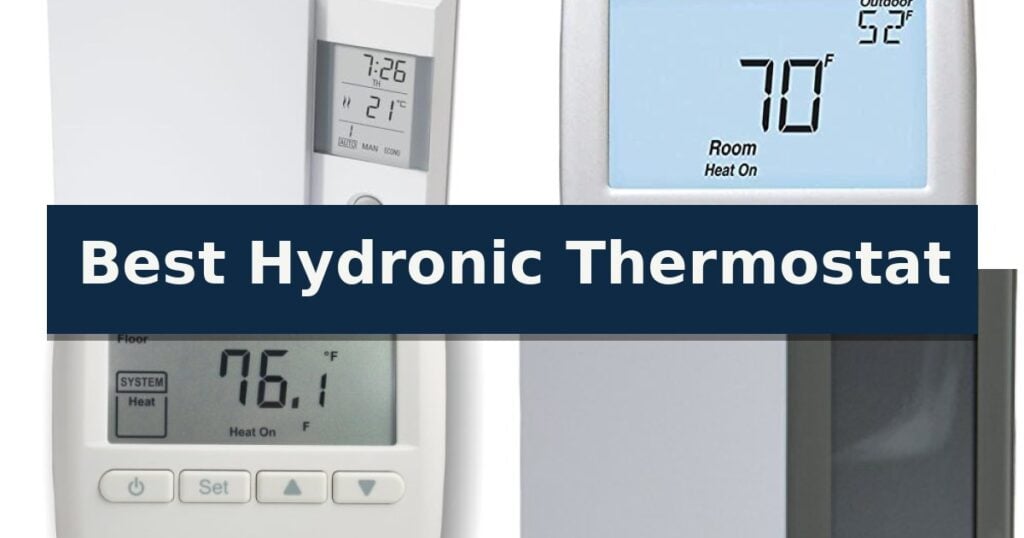
6 Best Hydronic Thermostat in 2026 Reviews
Quick Comparison
| Product | Best For | Key Strength | Score |
|---|---|---|---|
| Honeywell Home Aube TH140-28-01-B Thermostat | Best Overall | Pump protection feature prevents mechanical seizure by cycling the pump daily. | 4.9 |
| tekmar 519 Radiant Heating Thermostat | Includes Slab Sensor | Direct drop-in replacement for legacy tekmar 507 and 508 models. | 4.3 |
| AosBet D-508F Digital Slab Thermostat | Dual Floor Sensing | Dual-sensor monitoring for ambient and floor temperatures. | 4.3 |
| Honeywell TL8100A1008 Hydronic Thermostat | Seven-Day Programmable | 7-day programmable scheduling for customized heating cycles | 4.3 |
| Uponor A3100101 Heat-only Thermostat | Radiant Floor Optimized | Optimized for radiant floor heating with specialized PWM control. | 4.9 |
| LUX PSD010B Heat-only Thermostat | Simple Radiant Control | Large illuminated display for easy reading | 4.9 |
How We Chose
When evaluating the best hydronic thermostat options, we focus on technical compatibility and system longevity. An experienced reviewer looks beyond basic temperature adjustment, prioritizing units that protect mechanical components like pumps while providing the specific sensing accuracy required for the slow-response nature of radiant heating systems.
- System Compatibility: Verification of voltage requirements including millivolt, 24V, and line voltage support.
- Control Precision: Evaluation of temperature swing management and display accuracy.
- Installation Requirements: Analysis of wiring complexity and physical mounting constraints.
- Specialized Features: Presence of pump protection cycles or dedicated floor-sensing capabilities.
- Programming Versatility: Assessment of scheduling options versus simple manual control.
1 Honeywell Home Aube TH140-28-01-B Thermostat — Prevents Pump Seizure
Maintaining consistent temperature in hydronic heating systems requires precise control to prevent energy waste and ensure comfort. The Honeywell Home Aube TH140-28-01-B Hydronic Heating 7-Day Programmable Thermostat addresses these needs with advanced temperature regulation that minimizes swings, providing a stable environment for your home.
Designed for versatility, this unit is compatible with systems ranging from millivolt to 240 V, including hot water heating and electric heat applications when used with a relay. It features selectable cycles that allow the thermostat to be optimized for your specific heating system, ensuring efficient operation. The precise LCD screen displays room temperature in increments of 0.1°C or 0.1°F, offering clear feedback on your current settings.
A standout feature for hydronic setups is the pump protection function. This utility automatically activates the pump for one minute every 24 hours during periods of inactivity, which helps prevent mechanical seizure. Programming is managed by removing the faceplate from the base, where instructions are conveniently located inside the front panel for quick access.
The device is built for reliability, including a low battery indicator that provides a 60-day warning before power is lost. It supports a variety of configurations, including 5-Ampere resistive loads at 24V, 120V, and 240V, as well as 2-Ampere inductive loads. With its SPDT dry contact relay output, it serves as a robust control solution for diverse heating configurations.
Best for: Homeowners with hydronic heating systems who require pump protection and precise, programmable temperature control.
Skip if: You are looking for a smart thermostat with Wi-Fi connectivity or mobile app integration, as this model relies on manual faceplate programming.
- Pump protection feature prevents mechanical seizure by cycling the pump daily.
- Versatile compatibility with millivolt, 120V, and 240V systems.
- Precise temperature display with 0.1-degree increments.
- 7-day programming allows for customized heating schedules.
- Manual programming requires removing the faceplate rather than using a smartphone app.
- No Wi-Fi or remote access capabilities.
2 tekmar 519 Radiant Heating Thermostat — Includes Slab Sensor
Maintaining precise floor temperatures requires reliable hardware that bridges the gap between simple operation and consistent thermal regulation. The tekmar 519 One-Stage Radiant Heating Thermostat addresses this by integrating a dedicated slab sensor, ensuring that your radiant heating system responds accurately to actual floor conditions rather than just ambient air temperature.
Designed for straightforward utility, the unit features a large, clear display and intuitive up-and-down buttons. This interface allows for quick adjustments, making it a practical choice for those who prefer a reliable, manual-style control scheme over complex smart-home integrations. Its operational range of 32 to 122°F (0 to 50°C) covers standard indoor heating requirements, while the included NTC thermistor sensor provides the necessary feedback for stable floor heating performance.
Installation is simplified for those upgrading older systems, as this model serves as a direct drop-in replacement for previous tekmar 507 and 508 units. This design choice eliminates the need for extensive rewiring, saving significant time and labor during the setup process. For mounting versatility, an optional Adaptor Plate 012 is available, which facilitates installation onto standard single-gang electrical boxes.
While the device is built for indoor use with a maximum operating humidity of 90% non-condensing, it is important to note its specific focus on one-stage radiant control. By prioritizing a clean, functional design that avoids unnecessary digital complexity, the tekmar 519 One-Stage Radiant Heating Thermostat offers a focused solution for residential radiant floor applications.
Best for: Homeowners looking for a reliable, direct-replacement thermostat for existing radiant floor heating systems that utilize a slab sensor.
Skip if: Users who require advanced smart-home connectivity, Wi-Fi remote access, or multi-stage HVAC system integration.
- Direct drop-in replacement for legacy tekmar 507 and 508 models.
- Includes a dedicated slab sensor for accurate floor temperature monitoring.
- Intuitive interface with a large, easy-to-read display.
- Optional adaptor plate available for flexible mounting on standard electrical boxes.
- Limited to one-stage heating applications.
- Lacks modern smart features like Wi-Fi or remote app control.
3 AosBet D-508F Digital Slab Thermostat — Dual Floor Sensing
Managing hydronic radiant floor heating requires precise temperature regulation to ensure comfort while protecting floor coverings from excessive heat. The AosBet D-508F Digital Slab Thermostat addresses this by providing a dedicated multi-display that simultaneously tracks both ambient and floor sensor temperatures.
This unit offers three distinct control modes to suit different heating configurations. The A Mode manages ambient temperature, while the F Mode focuses on floor temperature. For more complex setups, the AF Mode allows users to control ambient temperature while maintaining floor temperature within specific minimum and maximum limits, which is essential for protecting sensitive flooring materials.
Usability is enhanced by the QuickSet feature, which permits instant setpoint adjustments without navigating through complex menus. The thermostat is powered by a 24VAC source and includes EEPROM memory, ensuring that all control settings are retained even if a power failure occurs. For added security, an integrated On/Off switch allows the user to shut off relay output or completely power down the system at the end of the heating season.
The device comes equipped with a P-01 floor sensor featuring a 10-foot lead for flexible placement. Users can toggle between °F or °C displays, and the backlit screen offers adjustable settings, including an Auto (60 sec.) mode, to ensure the display remains readable in various lighting conditions.
Best for: Users requiring precise dual-sensor control for hydronic radiant floor heating systems with floor covering protection needs.
Skip if: Users looking for a battery-operated thermostat or a wireless smart-home integrated solution.
- Dual-sensor monitoring for ambient and floor temperatures.
- AF Mode provides safety limits for floor coverings.
- EEPROM memory protects settings during power outages.
- QuickSet feature allows for rapid adjustments.
- Requires 24VAC power and is not battery-operated.
- Non-programmable design lacks automated scheduling.
4 Honeywell TL8100A1008 Hydronic Thermostat — Seven-Day Programmable
Managing home climate systems requires a reliable interface that balances precision with ease of use. The Honeywell TL8100A1008 Programmable Hydronic Thermostat offers a dedicated solution for homeowners seeking to maintain consistent temperatures through a 7-day programmable interface. By allowing users to define specific heating cycles for every day of the week, this unit provides a structured approach to energy management that can be tailored to individual household schedules.
This electronic thermostat is engineered for broad compatibility, supporting baseboards, convectors, radiant ceilings, and central heating systems. Its compact physical footprint, measuring 4.9 inches in height and 3.8 inches in length, ensures a low-profile installation on interior walls. The lightweight construction of 0.25 pounds makes it suitable for standard wall-mount applications where space and aesthetics are primary considerations.
The white finish provides a neutral aesthetic that integrates seamlessly into most residential interiors. Beyond its visual design, the device serves as a functional control center for various heating setups. Because it is an electronic control unit, users must verify that their existing wiring and heating system voltage are compatible with this specific model prior to installation to ensure proper operation.
While this model provides a robust, programmable interface, it is a specialized tool designed for manual control. It lacks modern smart home or Wi-Fi connectivity, which represents a trade-off for users who prioritize remote app access or automated integration with broader home ecosystems. For those who prefer a direct, physical interface for their hydronic or electric heating systems, this unit offers a straightforward and reliable method of climate management.
Best for: Homeowners looking for a 7-day programmable control interface for baseboard, convector, or radiant ceiling heating systems.
Skip if: Users requiring smart home integration, Wi-Fi connectivity, or advanced remote app control will find this manual-interface model insufficient.
- 7-day programmable scheduling for customized heating cycles
- Compatible with baseboards, convectors, and radiant ceilings
- Compact and lightweight white design
- No warranty provided by the manufacturer
- Lacks modern smart home or Wi-Fi connectivity
5 Uponor A3100101 Heat-only Thermostat — Radiant Floor Optimized
Maintaining precise climate control in radiant heating systems requires a specialized interface, and the Uponor A3100101 Heat-only Thermostat with Touchscreen is engineered specifically for this purpose. Unlike standard HVAC thermostats, this unit focuses on the unique requirements of hydronic setups, utilizing fully automatic differential and pulse width modulation (PWM) to manage heat delivery. This technical approach aims to keep each zone comfortable while optimizing energy efficiency.
The device features a simple, intuitive display that prioritizes readability with large, clear numbers, making temperature adjustments straightforward. Its design is focused on utility, providing a clean interface that avoids unnecessary complexity for the user. The unit is compact, measuring 5 inches in height and 3.25 inches in width, allowing it to integrate discreetly into most wall spaces.
Installation is designed to be efficient, utilizing a fast and easy two-wire connection. This simplified wiring requirement is a significant advantage for those retrofitting or installing new radiant floor heating systems, as it reduces the complexity often associated with more advanced climate control hardware. By focusing on essential hydronic functions, the thermostat provides a direct, reliable method for managing floor-based heating zones.
While the unit excels in its specific application, it is a dedicated heat-only controller. It does not include features for cooling or multi-stage HVAC systems, making it a specialized tool for hydronic environments. Its reliance on PWM technology ensures that the heat output is modulated effectively, preventing the temperature swings often associated with basic on-off cycling.
Best for: Homeowners or installers seeking a dedicated, easy-to-read control interface for radiant floor heating systems.
Skip if: You require a multi-stage thermostat that supports cooling, fan control, or smart home connectivity features.
- Optimized for radiant floor heating with specialized PWM control.
- Simple two-wire installation process.
- Intuitive touchscreen interface with large, easy-to-read digits.
- Limited to heat-only applications, lacking cooling or fan support.
6 LUX PSD010B Heat-only Thermostat — Simple Radiant Control
Maintaining consistent warmth in specialized heating setups requires a controller that prioritizes simplicity and reliability. The LUX PSD010B Heat-only Thermostat is designed specifically for these environments, featuring a large illuminated display that ensures clear visibility of temperature settings in various lighting conditions. This interface provides a dedicated, unobtrusive way to manage supplemental heating sources without the distraction of complex menus.
Engineered for versatility, this unit is compatible with a range of heat-only systems, including fireplaces, stoves, and in-floor radiant heating. Because it does not require a fan switch, it serves as a streamlined solution for users who need precise, efficient control without the complexity of multi-stage or cooling-integrated systems. This focus on heat-only functionality ensures that the device remains dedicated to its primary purpose.
Installation is designed to be quick and straightforward, supported by clear instructions that facilitate home improvement projects. The device operates on a battery-powered system, which simplifies the wiring process and allows for flexible placement without needing a constant hardwired power source. This design choice is particularly useful for retrofitting older heating systems where traditional wiring might be limited or unavailable.
By focusing on essential functionality, this thermostat offers a practical approach to climate management. Its traditional design and compact dimensions, measuring 5.13 inches in height and 3.5 inches in length, make it an unobtrusive addition to any room. While it lacks programmable features for automated temperature changes, its simplicity is a trade-off that favors ease of use and long-term reliability for manual heating control.
Best for: Homeowners seeking a simple, battery-operated control solution for fireplaces, stoves, or in-floor radiant heating systems.
Skip if: Users who require a programmable schedule, fan control, or a hardwired power connection for their heating system.
- Large illuminated display for easy reading
- Simple installation process with clear instructions
- Battery-powered operation eliminates complex wiring
- Optimized for heat-only systems like radiant floor heating
- No programmable features for automated temperature changes
- Lacks fan control capabilities
Best Hydronic Thermostat Buying Guide
Understanding System Compatibility
Hydronic systems operate on various electrical configurations, ranging from low-voltage 24V setups to line-voltage applications. Before purchasing, confirm whether your system requires a dry contact relay or a specific voltage output to avoid damaging your boiler or pump.
Always check the thermostat's technical specifications against your existing wiring. Some units are designed exclusively for heat-only systems and may lack the common wire or power requirements found in more complex HVAC controllers.
The Importance of Pump Protection
Hydronic pumps can seize if they remain idle for extended periods, such as during the off-season. Thermostats that include a built-in pump protection feature automatically cycle the pump for a short duration every 24 hours to keep internal components moving.
This feature is a significant advantage for long-term system maintenance. It reduces the likelihood of mechanical failure and ensures that your heating system is ready to function immediately when the first cold snap arrives.
Ambient vs. Floor Slab Sensing
Radiant floor heating often benefits from dual-sensing capabilities. While ambient air sensors control the room temperature, floor sensors prevent the surface from becoming uncomfortably hot or protect delicate flooring materials from excessive heat.
Consider whether your installation requires a remote floor probe. Models that support both ambient and floor sensing provide the most granular control, allowing you to maintain a comfortable room temperature while staying within safe floor-temperature limits.
Programming and Ease of Use
Programmable thermostats allow you to lower temperatures during sleeping hours or when the house is empty, which can improve energy efficiency. Look for interfaces that make it easy to adjust these schedules without needing to consult the manual repeatedly.
For those who prefer simplicity, non-programmable models offer a straightforward interface with simple up-and-down buttons. These are often more intuitive for users who do not require complex daily or weekly heating cycles.
Installation and Mounting
Physical dimensions and mounting patterns vary between models. If you are replacing an existing unit, check if the new thermostat fits your current wall box or if you will need an adapter plate to cover the footprint of the previous device.
Ease of installation is also influenced by the terminal block design. Units with clearly labeled, accessible terminals simplify the wiring process and reduce the risk of connection errors during the setup phase.
Frequently Asked Questions
Can I use a standard HVAC thermostat for my hydronic system?
Not necessarily. Hydronic systems often require specific switching capabilities, such as dry contacts or millivolt compatibility, which standard forced-air thermostats may not provide.
What is the benefit of a floor sensor?
A floor sensor allows the thermostat to monitor the actual temperature of the radiant floor, preventing overheating and protecting flooring materials like hardwood or tile.
Do I need a battery-powered thermostat?
Battery-powered units are useful if your system lacks a common wire (C-wire) at the thermostat location, though some models can operate on system power if available.
How often should I replace my thermostat batteries?
Most modern digital thermostats include a low-battery indicator. Many models provide a warning several weeks in advance, allowing ample time for replacement before power is lost.
Are these thermostats compatible with smart home systems?
The models listed here are primarily dedicated, standalone controllers. If smart home integration is a priority, you would need to look for specific Wi-Fi-enabled hydronic controllers.
Conclusion: Our Top Pick
Our top pick is Honeywell Home Aube TH140-28-01-B Thermostat. Choosing the right hydronic thermostat depends on your specific heating setup and whether you require advanced scheduling or simple, reliable control. Prioritizing features like pump protection and correct voltage compatibility will ensure your system operates efficiently for years to come.
By evaluating your existing wiring and determining if floor sensing is necessary for your radiant installation, you can select a model that provides consistent comfort while protecting your boiler and pump components.