 critical cactus
Zimaspace ZimaBoard SE Home Server is our top choice for the Best Linux Cloud Storage Services thanks to its versatile x86 architecture that simplifies self-hosting and personal cloud management. For users prioritizing a plug-and-play experience, the AMBER X Personal Cloud Storage offers a streamlined, ready-to-use interface for private backups. Meanwhile, the BUFFALO LinkStation 720 NAS provides a more traditional, centralized storage solution with robust RAID configurations for those needing reliable, pre-configured data security.
Selecting the right hardware for a Linux-based cloud environment requires balancing raw computing power with ease of maintenance. While some users prefer the flexibility of a bare-metal board for custom Docker containers and specialized Linux distributions, others require a dedicated appliance that minimizes setup time while maintaining full data ownership.
Understanding the trade-offs between open-platform tinkering and appliance-based stability is essential for building a private cloud. Factors such as storage expandability, processor efficiency, and compatibility with common self-hosting software like Plex or Home Assistant dictate how well a device will serve your long-term data management needs.
If you are looking to move your data to a permanent home, you might also be interested in Best Lifetime Cloud Storage Plans to compare the costs of local hardware versus one-time payment cloud services.
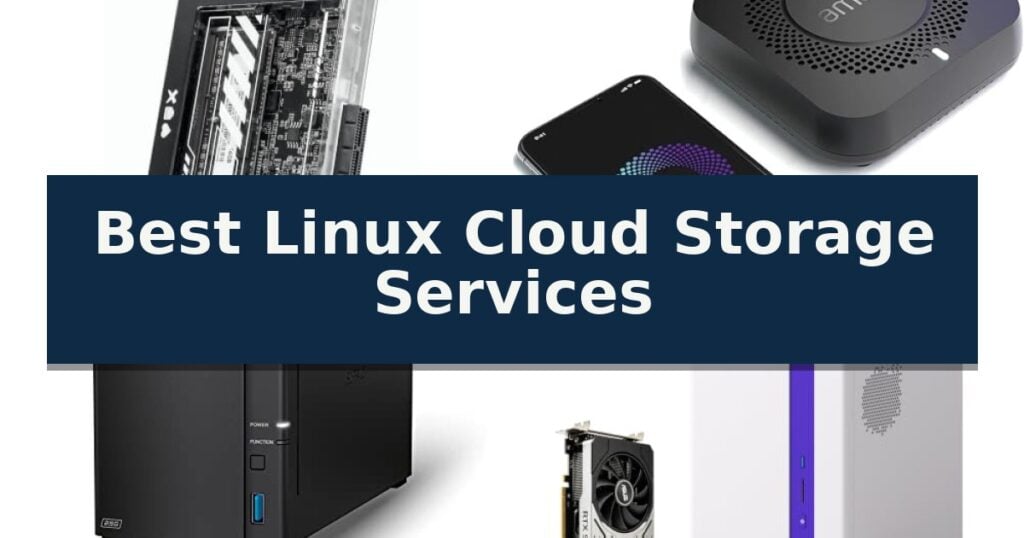
4 Best Linux Cloud Storage Services in 2026 Reviews
Quick Comparison
| Product | Best For | Key Strength | Score |
|---|---|---|---|
| Zimaspace ZimaBoard SE Home Server | Best Overall | Pre-installed ZimaOS and 16GB RAM allow for immediate deployment. | 4.9 |
| AMBER X Personal Cloud Storage | Simple Private Data Backup | Total data ownership with no required membership fees. | 4.8 |
| BUFFALO LinkStation 720 NAS | Secure Centralized File Storage | Subscription-free access to personal cloud storage. | 4.9 |
| NIMO AI NAS Server | High-Performance Local AI Hosting | High-performance processing with AMD Ryzen 7 PRO 8845HS and support for dedicated RTX 5060 GPU. | 4.4 |
How We Chose
Evaluating hardware for private cloud storage requires a focus on technical flexibility and long-term reliability. As an experienced reviewer, I assess these devices based on their ability to handle continuous Linux workloads, their capacity for physical storage expansion, and how effectively they balance user-friendly management tools with the deep customization potential required for a robust self-hosted environment.
- Processor architecture compatibility for Linux-based distributions and Docker containers.
- Storage expansion options including SATA ports and PCIe interface availability.
- Ease of initial configuration versus the depth of customization available to the user.
- Hardware efficiency for always-on, low-power home server applications.
- Integration capabilities with common self-hosted media and automation software.
1 Zimaspace ZimaBoard SE Home Server — Best for Linux Self-Hosting
Managing your own data infrastructure requires a reliable, low-power foundation that can handle continuous operation without the overhead of traditional desktop hardware. The Zimaspace ZimaBoard SE Home Server provides this through a compact x86 platform specifically engineered for experimentation and self-hosting, making it a distinct alternative to standard cloud storage subscriptions.
At the core of this device is a quad-core Intel processor paired with 16GB of factory-installed RAM, ensuring sufficient resources for running Docker containers, media libraries, or file servers. The system arrives with ZimaOS preinstalled on a 64GB eMMC drive, allowing users to bypass complex initial operating system configurations and begin deploying services immediately.
Hardware expansion is handled through two SATA ports for adding high-capacity HDDs or SSDs, alongside a PCIe 2.0 x4 interface for future-proofing your setup as project requirements grow. Its small footprint, measuring just 4 by 3 inches, allows for easy integration into existing home network environments without demanding significant desk or shelf space.
By utilizing an open x86 architecture, this server offers broad compatibility with various Linux distributions and self-hosted applications. This flexibility is essential for users who prioritize data sovereignty and want a dedicated, always-on machine for their personal cloud needs rather than relying on third-party storage providers.
Best for: Users seeking a compact, low-power x86 platform for self-hosting personal cloud services and Docker applications.
Skip if: Users who require high-performance processing for intensive tasks like 4K video transcoding or those who prefer a pre-configured, plug-and-play cloud storage service without hardware maintenance.
- Pre-installed ZimaOS and 16GB RAM allow for immediate deployment.
- Dual SATA ports and PCIe 2.0 x4 expansion provide flexible storage and hardware upgrades.
- Compact x86 architecture supports a wide range of Linux-based self-hosting projects.
- Limited system storage (64GB eMMC) necessitates external drives for significant data capacity.
- Requires user configuration for specific network and storage management tasks.
2 AMBER X Personal Cloud Storage — Simple Private Data Backup
Maintaining total data sovereignty without recurring subscription fees is the primary appeal of the AMBER X Personal Cloud Storage. This compact device functions as a private, home-based server, allowing users to consolidate backups from multiple smart devices into a single, secure location. By keeping your data on a physical drive within your own network, you eliminate the privacy concerns and monthly costs associated with third-party cloud providers.
The unit comes equipped with a built-in 512GB high-speed SSD, providing immediate storage capacity out of the box. For those requiring more space, the hardware includes a USB port to facilitate expandable storage options. This design choice ensures that users can scale their storage needs as their personal media libraries grow, though it does mean that the initial internal capacity is fixed and cannot be upgraded internally.
Beyond simple file storage, the device supports advanced home-server functionality through one-click Plex and Home Assistant installation. This enables users to manage media streaming and smart home automation directly from their private cloud, bridging the gap between basic backup and a comprehensive home media hub. This integration allows the device to serve as a central intelligence point for your digital ecosystem.
Compatibility is broad, supporting iOS, Android, Windows, and Mac environments. The system is engineered to provide anywhere cloud access and file sharing, ensuring that your data remains accessible remotely while keeping the physical storage under your direct control at home. A key trade-off is that remote access depends entirely on the stability and upload speed of your home internet connection, which may impact performance when accessing large files away from home.
Best for: Users who want to eliminate monthly cloud subscription fees by hosting their own private, secure media and data backup server at home.
Skip if: Users who require massive multi-terabyte storage arrays or those who lack a stable home internet connection for remote file access.
- Total data ownership with no required membership fees.
- Integrated 512GB high-speed SSD for immediate use.
- Supports one-click installation for Plex and Home Assistant.
- Expandable storage via external USB connectivity.
- Fixed internal storage capacity of 512GB requires external drives for larger datasets.
- Relies on home-based infrastructure for remote accessibility.
3 BUFFALO LinkStation 720 NAS — Secure Centralized File Storage
The BUFFALO LinkStation 720 NAS offers a streamlined approach to private data management by providing a subscription-free personal cloud that eliminates monthly fees for remote access. This 2-bay network attached storage device is designed for home office environments, allowing users to store, back up, and manage photos, music, and videos across multiple computers and mobile devices.
Engineered for performance, this unit delivers up to 7x faster transfer speeds compared to previous generations, ensuring efficient file handling. It ships with 8TB of total capacity, configured by default in RAID 1 for automatic data redundancy, though users can switch to RAID 0 if they prioritize maximum storage volume over fault tolerance.
Security is a primary focus of the system, which utilizes a closed-system architecture to minimize vulnerabilities often found in third-party applications. Data integrity is further supported by SSL encryption for secure file transfers, and the device allows for granular control through individual folder access restrictions, making it suitable for shared environments.
Integration with public cloud services like Dropbox, Azure, and OneDrive enables the creation of a hybrid cloud setup for added flexibility. The unit is compatible with both Windows and MacOS 26, and it includes the NAS Navigator utility to simplify the setup of automated backup schedules across your network.
Best for: Home office users who require a secure, subscription-free centralized backup solution with integrated RAID redundancy.
Skip if: Users who require high-performance hardware for intensive virtualization tasks or those who prefer a platform with an extensive library of third-party application packages.
- Subscription-free access to personal cloud storage.
- RAID 1 configuration included for automatic data backup.
- Enhanced performance up to 7x faster than previous models.
- Closed-system design for increased data security.
- Limited third-party app support due to the closed-system security architecture.
- Fixed 2-bay capacity may not be sufficient for users needing massive future storage expansion.
4 NIMO AI NAS Server — High-Performance Local AI Hosting
Managing high-performance AI workloads and massive datasets locally requires hardware capable of sustained, intensive computation. The NIMO AI NAS Server addresses this by integrating an AMD Ryzen 7 PRO 8845HS processor with support for an Asus RTX 5060 GPU, creating a dedicated environment for deploying 70B large language models and complex AI programming tasks without relying on external cloud infrastructure.
Designed for professional studios and data-heavy environments, this system supports up to 132TB of ZFS hybrid storage, providing the capacity needed for multi-track 4K/8K video editing and high-resolution rendering. The inclusion of dual 10GbE connectivity ensures that data transfer remains fluid, even when handling large media files or running multiple virtual machines and Docker containers simultaneously.
Beyond its raw processing capabilities, the server functions as a robust multimedia hub, utilizing hardware transcoding to stream content via Plex or Jellyfin to any device. It balances this power with enterprise-grade security, allowing administrators to manage user permissions and automated backups while maintaining full data privacy through local hardware-based security protocols.
With dimensions of approximately 7.6 by 8.6 by 14.6 inches, the unit is engineered to fit into professional workspaces while maintaining the thermal and electrical overhead required for 24-hour agentic AI operations. Its architecture is specifically optimized to eliminate lag during intensive multitasking, making it a comprehensive solution for users who require both high-speed storage and local AI compute power.
Best for: Professional creators and AI developers who require high-performance local compute, massive storage capacity, and 24/7 reliability for AI agent deployment.
Skip if: Users seeking a basic, low-power network-attached storage device for simple file backup who do not require dedicated GPU acceleration or high-end virtualization capabilities.
- High-performance processing with AMD Ryzen 7 PRO 8845HS and support for dedicated RTX 5060 GPU.
- Massive storage scalability supporting up to 132TB ZFS hybrid configurations.
- Enterprise-grade connectivity featuring dual 10GbE ports for high-speed data throughput.
- Enhanced privacy by keeping sensitive AI models and data entirely local.
- Significant hardware footprint and power requirements compared to standard consumer NAS units.
- Requires additional GPU purchase as the RTX 5060 is listed as a supported component rather than an included base feature.
Best Linux Cloud Storage Services Buying Guide
Processor Architecture and Compatibility
Choosing between x86 and ARM architectures significantly impacts your ability to run specific Linux software. x86 platforms like the ZimaBoard SE provide broader compatibility for standard desktop-grade Linux distributions and complex Docker containers, making them ideal for users who want to replicate enterprise-level services at home.
Conversely, many dedicated NAS appliances utilize ARM-based processors to maximize energy efficiency. While these are excellent for simple file serving and basic media streaming, they may encounter limitations when attempting to run resource-heavy applications or specialized virtualization environments that require x86-specific instruction sets.
Storage Expandability and Redundancy
A primary advantage of a private cloud is the ability to scale storage as your data footprint grows. Look for devices that offer multiple SATA ports or PCIe expansion slots, which allow you to add high-capacity hard drives or fast NVMe SSDs without replacing the entire unit.
Redundancy is equally important for data protection. Devices supporting RAID configurations, such as the two-bay setup found in the Buffalo LinkStation, provide automatic data mirroring. This ensures that a single drive failure does not result in the loss of your personal files, a critical feature for any reliable storage service.
Self-Hosting and Software Ecosystems
The software stack pre-installed on your hardware determines how much time you spend maintaining the system versus using it. Some devices come with proprietary operating systems that simplify tasks like Plex installation and mobile app syncing, while others provide a blank canvas for installing your preferred Linux stack.
For those who enjoy tinkering, a device that supports standard Linux kernels and containerization allows for a truly bespoke experience. You can manage your own security patches, firewall rules, and backup scripts, ensuring that your cloud environment is tailored exactly to your security and performance requirements.
Power Efficiency and Physical Footprint
Since a personal cloud server is typically an always-on device, power consumption is a key consideration. Low-power processors and efficient cooling designs help keep electricity costs down and reduce the noise profile of your home office or media center.
The physical size of the unit also matters for placement. Compact, fanless, or low-profile designs are easier to integrate into existing setups, such as near a router or inside a media cabinet, without requiring dedicated rack space or extensive cable management.
Data Ownership and Privacy
Moving away from public cloud providers is often driven by a desire for total data sovereignty. By hosting your own files on a local Linux server, you ensure that your data remains physically within your control, protected by your own encryption and access policies rather than a third-party service provider.
This approach eliminates recurring monthly subscription fees, though it shifts the responsibility of maintenance to the owner. A successful self-hosted setup requires a commitment to regular updates and backups, but it provides a level of privacy that is difficult to achieve with standard commercial cloud storage.
Frequently Asked Questions
Do I need advanced Linux knowledge to set up these devices?
It depends on the device. Some, like the AMBER X, are designed for plug-and-play simplicity, while others like the ZimaBoard SE are intended for users who are comfortable with Linux commands and Docker container management.
Can I access my files remotely?
Yes, most modern personal cloud devices include remote access features, often via a secure mobile app or a web-based portal that allows you to reach your data from anywhere with an internet connection.
What happens if my home internet goes down?
Because these devices are local, your files remain accessible on your home network even if your internet connection is interrupted. You will only lose the ability to access them remotely from outside your home.
Are these devices compatible with Windows and macOS?
Yes, most personal cloud storage devices act as network-attached storage (NAS), meaning they are compatible with Windows, macOS, and Linux clients through standard network protocols like SMB or NFS.
Is it cheaper than paying for a cloud subscription?
While there is a higher upfront cost for the hardware, you avoid ongoing monthly fees. Over several years, the cost of the hardware is often significantly lower than the cumulative price of a high-capacity cloud subscription.
Conclusion: Our Top Pick
Our top pick is Zimaspace ZimaBoard SE Home Server. Building a personal cloud on Linux offers unparalleled control over your data and privacy. By selecting hardware that matches your technical comfort level—whether that is a simplified appliance or a highly customizable x86 server—you can create a reliable storage solution that grows with your needs.
Ultimately, the best choice depends on your willingness to manage the system. Prioritize devices that offer the storage capacity and expansion potential you anticipate needing in the future, ensuring your private cloud remains a functional asset for years to come.