 critical cactus
Synology BeeStation Plus NAS earns our recommendation for the Best Local Network Attached Storage Devices because it simplifies private cloud management while providing robust, subscription-free data protection for home users.
Selecting a reliable storage solution requires balancing hardware performance with software accessibility. Experienced users prioritize devices that offer seamless integration with existing operating systems, reliable automated backup routines, and the ability to manage large media libraries without relying on public cloud services.
When evaluating these systems, we focus on the efficiency of local file management and the security of your stored assets. A well-chosen device should provide consistent access speeds and intuitive tools for organizing photos, documents, and project files across all connected household or office devices.
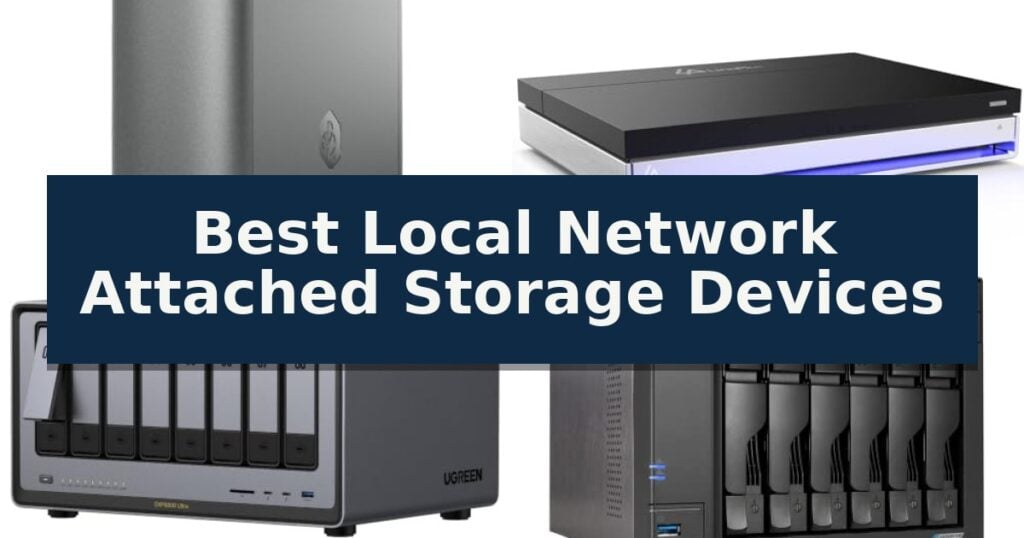
10 Best Local Network Attached Storage Devices in 2026 Reviews
Quick Comparison
| Product | Best For | Key Strength | Score |
|---|---|---|---|
| Synology BeeStation Plus NAS | Best Overall | Onboard GPU enables local AI photo recognition without cloud dependency. | 4.9 |
| LincPlus LincStation N1 NAS | Best Hybrid Storage Flexibility | Hybrid storage configuration with four dedicated M.2 NVMe slots and two SATA bays. | 4.7 |
| UGREEN NAS DXP8800 Ultra | High-Performance for Creative Teams | Dual 10GbE and Thunderbolt 4 ports for high-bandwidth data transfers. | 4.4 |
| Asustor Lockerstor 6 Gen2 NAS | Best for Heavy Media Workloads | Hybrid storage architecture with 4 dedicated M.2 NVMe SSD slots. | 4.8 |
| TerraMaster F2-212 NAS | Affordable Home Multimedia Center | Powerful 4K video hardware decoding for multimedia streaming. | 4.5 |
| Asustor Drivestor 2 Gen 2 NAS | Fast Transfers for Beginners | 2.5GbE network port for faster data transfer speeds. | 4.7 |
| KingSpec N100 NAS | Silent All-Aluminum Compact Pick | Zero subscription fees for lifetime private cloud access. | 4.5 |
| ORICO MetaBox NAS | Versatile Virtual Machine Support | Hybrid storage architecture supporting both 2.5-inch/3.5-inch HDDs and M.2 NVMe SSDs. | 4.6 |
| BUFFALO LinkStation 210 NAS | Simple Subscription-Free Storage | Subscription-free personal cloud storage. | 4.9 |
| SSK Personal Cloud NAS | Dual-Mode Local and Network Access | Dual-mode functionality allows for both network-attached and direct-attached storage usage. | 4.4 |
How We Chose
To identify the most effective local network attached storage devices, we evaluate hardware architecture against the practical demands of modern data management. We prioritize systems that offer a stable balance between high-speed connectivity, flexible storage expansion, and user-friendly software interfaces, ensuring that both casual users and creative professionals can maintain secure, private control over their digital assets.
- Processor and memory capacity for handling concurrent file transfers and background tasks.
- Drive bay configuration and support for hybrid storage setups using both HDD and NVMe SSDs.
- Network interface speed, specifically the inclusion of 2.5GbE or 10GbE ports for high-bandwidth environments.
- Software ecosystem, including ease of setup, remote access capabilities, and support for containerized applications.
- Data redundancy and recovery features such as snapshotting, RAID support, and automated backup software compatibility.
1 Synology BeeStation Plus NAS — Easiest for Personal Cloud Backups
Managing digital assets requires a balance of accessibility and security, a challenge addressed by the Synology BeeStation Plus 8TB Personal Cloud Storage Device (BST170-8T). This unit distinguishes itself by integrating an Intel Celeron J4125 processor and 4 GB DDR4 memory, providing a hardware foundation that handles intensive background tasks more efficiently than standard consumer drives.
Beyond simple storage, the device functions as a license-free NVR surveillance system, allowing users to connect up to four Synology cameras for continuous monitoring. The inclusion of local AI—powered by an onboard GPU—enables automated photo recognition and organization by subject or location, ensuring that sensitive image data remains on-site rather than in the public cloud.
Data integrity is prioritized through automated snapshots, which act as a disaster recovery mechanism by allowing users to revert to previous file versions. For Mac users, the device offers dedicated Time Machine backup space, while Windows and macOS environments are supported by a 3-year license of Acronis True Image Essentials for comprehensive system-wide backups.
The Synology BeeStation Plus 8TB Personal Cloud Storage Device (BST170-8T) is a compact solution measuring approximately 5.83 by 2.46 by 7.73 inches. While it offers robust performance for personal and home-office environments, users requiring massive multi-bay scalability or enterprise-grade RAID configurations may find its fixed-drive architecture limiting compared to modular NAS systems.
Best for: Home users and professionals seeking a plug-and-play personal cloud with integrated AI photo management and surveillance capabilities.
Skip if: Users who require a multi-bay NAS for advanced RAID configurations, hot-swappable drives, or high-capacity enterprise-level scalability.
- Onboard GPU enables local AI photo recognition without cloud dependency.
- License-free NVR support for up to four security cameras.
- Automated snapshots provide reliable protection against malware and accidental file deletion.
- Includes a 3-year license for Acronis True Image Essentials.
- Fixed storage architecture lacks the flexibility of multi-bay, user-upgradable NAS systems.
2 LincPlus LincStation N1 NAS — Best Hybrid Storage Flexibility
Managing high-performance storage and media streaming requires a robust foundation, and the LincPlus LincStation N1 NAS addresses this with a versatile hybrid architecture. By combining two 2.5-inch SATA HDD bays with four dedicated M.2 NVMe SSD slots, this device allows users to isolate high-speed cache and application data on solid-state drives while utilizing traditional hard drives for expansive, cost-effective storage.
At the heart of the system is an Intel Celeron Quad-Core processor paired with 16GB of RAM, providing the necessary overhead for demanding tasks. Whether you are running multiple Docker containers, managing large photo libraries, or performing 4K video transcoding via Plex or Jellyfin, the hardware is engineered to maintain consistent throughput without significant bottlenecks.
The unit prioritizes flexibility through its inclusion of the Unraid OS Starter License, which enables a non-RAID storage approach. This allows for the mixing of drives with varying capacities and provides robust data protection, ensuring that the system remains accessible even if a single drive fails. Users can manage these resources via a 2.5 Gigabit Ethernet (2.5GbE) connection, which facilitates faster network transfers compared to standard gigabit interfaces.
Physical connectivity and thermal management are also well-integrated. The LincPlus LincStation N1 NAS features an HDMI 2.0 port for direct 4K output, alongside USB-C and USB 3.2 Gen2 ports for external peripherals. To handle sustained workloads, the chassis utilizes a smart cooling system with user-defined fan profiles, allowing for a manual override to prioritize either silent operation or maximum thermal dissipation.
Best for: Home users and small offices requiring a flexible, hybrid storage solution for media streaming, Docker applications, and centralized backups.
Skip if: Users who require a traditional, pre-configured RAID array or those needing more than two high-capacity 3.5-inch HDD bays will find the hybrid M.2-focused design limiting.
- Hybrid storage configuration with four dedicated M.2 NVMe slots and two SATA bays.
- High-performance hardware featuring 16GB RAM and an Intel Quad-Core processor.
- Unraid OS inclusion provides flexible drive management and data protection.
- Advanced thermal control with user-defined fan profiles for sustained workloads.
- Limited to 2.5-inch HDDs, which restricts the use of standard high-capacity 3.5-inch drives.
- Diskless design requires the separate purchase of all storage media.
3 UGREEN NAS DXP8800 Ultra — High-Performance for Creative Teams
Managing massive datasets and high-bandwidth creative workflows requires more than standard storage; it demands a robust, centralized hub. The UGREEN NAS DXP8800 Ultra addresses this by integrating an Intel 150U processor with 8GB of DDR5 memory, providing the computational power necessary to act as a dedicated business file server for IT teams and large studios.
Designed for high-speed connectivity, the unit features dual 10GbE ports and two Thunderbolt 4 ports, ensuring that large-file transfers—whether for video production or complex design projects—remain fluid. The inclusion of an SD 4.0 slot and USB 3.2 Gen 2 connectivity further streamlines media ingestion, making it a practical choice for creative professionals who need to move data quickly from capture to archive.
Beyond simple storage, the device supports professional IT workloads, including Virtual Machines, Docker containers, and media services like Jellyfin. With eight SATA drive bays and two M.2 NVMe slots, it offers a total capacity of up to 272TB, allowing for flexible RAID configurations (0/1/5/6/10) to balance performance and data redundancy according to specific project requirements.
The system also incorporates local AI-powered asset management, which automates the organization of large image libraries through features like object, scene, and people recognition. This functionality reduces the time spent manually sorting through thousands of files, allowing teams to focus on production rather than administrative file maintenance.
Best for: Creative teams and IT departments requiring high-speed 10GbE connectivity and significant storage capacity for large-scale media projects.
Skip if: Home users or small offices with limited storage needs who do not require enterprise-grade features like dual 10GbE ports or extensive virtualization support.
- Dual 10GbE and Thunderbolt 4 ports for high-bandwidth data transfers.
- Scalable storage up to 272TB with support for RAID 0/1/5/6/10.
- AI-powered asset management for efficient photo and creative file organization.
- Expandable memory up to 96GB for demanding virtualization and container workloads.
- Diskless design requires separate purchase of compatible storage drives.
- Enterprise-focused feature set may be excessive for basic home file storage needs.
4 Asustor Lockerstor 6 Gen2 NAS — Best for Heavy Media Workloads
Managing high-demand data workflows requires hardware that balances raw processing power with flexible storage architecture. The Asustor Lockerstor 6 Gen2 NAS addresses this by integrating an Intel Celeron N5105 quad-core processor, providing the necessary compute resources for intensive tasks like 24/7 media streaming, virtualization, and complex file backups.
This 6-bay unit distinguishes itself through a hybrid storage design that accommodates both traditional SATA drives and four dedicated M.2 NVMe SSD slots. This configuration allows users to implement SSD caching or all-flash acceleration, significantly reducing latency for data-heavy applications. The system ships with 8GB of DDR4 RAM, which is user-upgradable to 16GB to support concurrent Docker containers and heavy multitasking.
Connectivity is a primary focus, featuring dual 2.5-Gigabit Ethernet ports that provide increased bandwidth over standard Gigabit connections. For professional environments requiring even higher throughput, the integrated PCIe slot supports upgrades to 10GbE networking or additional SSD expansion, ensuring the hardware remains relevant as storage demands evolve.
Optimized for media-centric roles, the device includes hardware transcoding capabilities suitable for 4K video playback. This makes it a capable foundation for centralized media servers, such as Plex, allowing for efficient streaming to smart TVs and other network-connected devices without taxing the primary processor.
Best for: Content creators and small businesses requiring a high-performance, expandable storage solution for 4K media streaming and virtualization.
Skip if: Users who only require basic file storage and lack the need for high-speed 2.5GbE networking or NVMe caching capabilities may find this model over-specified.
- Hybrid storage architecture with 4 dedicated M.2 NVMe SSD slots.
- Dual 2.5GbE ports for high-speed data transfer.
- Expandable memory up to 16GB DDR4 RAM.
- PCIe expansion slot for future 10GbE or SSD upgrades.
- Diskless design requires separate purchase of hard drives and SSDs.
5 TerraMaster F2-212 NAS — Affordable Home Multimedia Center
The TerraMaster F2-212 NAS provides a centralized home network storage solution built around an ARM v8 quad-core 1.7GHz processor and 1GB of RAM. This 2-bay device is optimized for home and SOHO environments, utilizing the TOS 7 operating system to manage data across various platforms.
Designed to function as a home multimedia center, the unit features 4K video hardware decoding capability and supports uPnP/DLNA protocols for seamless media streaming. It offers broad compatibility with mainstream file services including SMB, NFS, SFTP/FTP, AFP, iSCSI, and WebDAV, allowing for flexible integration into existing network infrastructures.
Data protection is handled through a suite of integrated backup applications, such as Duple Backup, TSSS, TFM Backup, and CloudSync. The system supports a total capacity of up to 64TB when using 24TB drives in a RAID 0 configuration, accommodating 3.5-inch and 2.5-inch SATA HDDs or 2.5-inch SATA SSDs.
Installation is streamlined through online tutorials and a dedicated Default mode that configures the system for immediate home use. The compact chassis measures approximately 8.74 inches in length and 4.69 inches in width, providing a space-efficient footprint for private cloud storage.
Best for: Home and SOHO users seeking an affordable, dedicated multimedia server and private cloud backup solution.
Skip if: Users requiring high-performance virtualization or memory-intensive applications will find the non-upgradeable 1GB RAM a significant constraint.
- Powerful 4K video hardware decoding for multimedia streaming.
- Comprehensive support for mainstream file services including SMB, NFS, and iSCSI.
- Robust integrated backup applications for data redundancy.
- Simple Default mode for rapid system configuration.
- The 1GB of system memory is not upgradeable.
- Requires NAS-specific hard drives for optimal reliability.
6 Asustor Drivestor 2 Gen 2 NAS — Fast Transfers for Beginners
Managing digital assets at home requires a balance of speed and accessibility, and the Asustor Drivestor 2 Gen 2 NAS addresses this with a focus on high-speed connectivity. By integrating a 2.5-Gigabit Ethernet port, this device provides significantly faster data transfer rates compared to standard Gigabit network storage, making it a practical choice for users who frequently move large photo libraries or media files.
At the heart of the system is a Realtek RTD1619B quad-core 1.7GHz processor paired with 1GB of DDR4 memory. This hardware configuration is optimized to handle background services and basic multitasking, ensuring the system remains responsive during routine file backups and personal cloud operations. The inclusion of this quad-core architecture allows for stable performance when acting as a home media server.
Usability is a primary design consideration, highlighted by the tool-free drive installation system. This mechanism allows users to mount hard drives or SSDs into the two available bays without the need for screws, simplifying the setup process for those new to network-attached storage. The compact chassis, measuring approximately 4 inches on each side, fits easily into home office environments.
The device functions as a private cloud, granting users full ownership over their stored data with the ability to access files remotely via mobile applications. While it offers robust features for personal data management, it is important to note that this is a diskless unit, meaning users must provide their own storage drives to complete the system.
Best for: Home users seeking a fast, user-friendly personal cloud storage solution with 2.5GbE network speeds.
Skip if: Users requiring high-capacity enterprise features, complex RAID configurations, or extensive virtualization support.
- 2.5GbE network port for faster data transfer speeds.
- Tool-free drive installation for quick and easy setup.
- Quad-core processor ensures stable performance for daily tasks.
- Private cloud functionality provides secure remote access and data ownership.
- Diskless design requires the separate purchase of hard drives or SSDs.
- 1GB of memory may limit performance for heavy multitasking or advanced server applications.
7 KingSpec N100 NAS — Silent All-Aluminum Compact Pick
Managing digital files often involves recurring monthly costs, but the KingSpec N100 1TB Personal Cloud NAS shifts this dynamic by offering a one-time purchase model. This device arrives with a pre-installed 1TB 2.5" SATA SSD, eliminating the need for additional drive purchases or complex assembly. Designed for immediate utility, it allows users to establish a private cloud environment within minutes, bypassing the typical configuration hurdles associated with traditional network storage.
The hardware is engineered for quiet, continuous operation, utilizing a fanless design that keeps noise levels below 0.5dB. This makes it suitable for environments where silence is a priority, such as home offices or bedrooms. The unit is constructed from a single piece of all-aluminum with thermal silicone, which provides efficient heat dissipation to prevent performance throttling during 24/7 use.
Functionality extends beyond local storage, as the system supports remote access from any location and integrates with existing third-party cloud services like Google Drive, OneDrive, and Dropbox. This allows for centralized management of data across multiple platforms without incurring extra subscription fees. The device is also highly energy-efficient, drawing less than 3W in standby and under 8W at full load.
Durability and long-term reliability are supported by a 3-year full warranty that covers the pre-installed SSD. The compact, 250g unibody design includes a dust cover to protect internal components, ensuring the system remains operational over time while maintaining a minimal physical footprint.
Best for: Users seeking a silent, plug-and-play private cloud solution to consolidate data and eliminate recurring monthly storage subscription fees.
Skip if: Users requiring high-capacity RAID configurations, multi-bay expandability, or advanced enterprise-grade networking features.
- Zero subscription fees for lifetime private cloud access.
- Pre-installed 1TB SATA SSD for immediate out-of-the-box use.
- Fanless, silent operation ideal for quiet environments.
- Efficient all-aluminum thermal design prevents performance throttling.
- Fixed storage capacity limited to the pre-installed 1TB drive.
- Single-bay design lacks the redundancy options found in multi-drive NAS systems.
8 ORICO MetaBox NAS — Versatile Virtual Machine Support
Managing a high-capacity home media library requires more than just storage; it demands a versatile platform capable of handling virtualization and high-bitrate streaming. The ORICO MetaBox NAS distinguishes itself by offering a hybrid storage architecture that combines two mechanical hard drive slots with two dedicated M.2 NVMe SSD slots, providing a flexible foundation for both bulk data and high-speed caching.
Beyond simple file hosting, this device functions as a comprehensive server environment. It comes preloaded with support for multiple operating systems, including TrueNAS, Windows 11, and Ubuntu 24, allowing users to deploy virtual machines or containerized applications via Docker with a single click. This capability enables users to run specialized tools like Plex for 4K@60Hz media playback or MySQL for database management directly on the hardware.
Connectivity is robust, featuring dual 2.5GbE ports that support up to 500MB/s LAN speeds, alongside USB-A and USB-C ports for external expansion. The system includes intelligent features such as an AI-powered album organizer that performs facial recognition and semantic image searching, as well as an auto-scraping engine that transforms raw video files into a structured, poster-rich media library.
Maintenance and thermal management are handled through an integrated monitoring system that allows for manual or automatic fan speed adjustments based on real-time temperature data. With support for up to 64TB of internal capacity and two-way synchronization with cloud services like Google Cloud, the ORICO MetaBox NAS provides a scalable solution for users who require both local performance and remote accessibility.
Best for: Users who want a versatile, virtualization-ready NAS that supports both high-capacity mechanical drives and high-speed NVMe caching for media and server applications.
Skip if: Users who require a simple, plug-and-play external hard drive without the complexity of managing virtual machines, Docker containers, or network-based OS environments.
- Hybrid storage architecture supporting both 2.5-inch/3.5-inch HDDs and M.2 NVMe SSDs.
- Preloaded virtual machine support for flexible OS deployment including TrueNAS and Windows 11.
- Dual 2.5GbE connectivity for high-speed local network data transfer.
- Integrated AI album features for automated facial recognition and image categorization.
- Advanced configuration requirements due to the multi-OS and Docker-based feature set.
- Diskless design necessitates separate purchase of storage media.
9 BUFFALO LinkStation 210 NAS — Simple Subscription-Free Storage
Managing digital assets across multiple devices often leads to fragmented storage, but the BUFFALO LinkStation 210 NAS provides a centralized solution by acting as a subscription-free personal cloud. By connecting directly to your router, this device allows you to store, back up, and manage videos, music, and photos without recurring monthly fees.
The unit comes equipped with a 4TB hard drive pre-installed in its single-drive bay, simplifying the setup process for those who want immediate network-attached storage. It is designed with a closed system to minimize vulnerabilities from third-party applications, incorporating SSL encryption to ensure that file transfers remain secure across your local network.
Usability is supported by the included NAS Navigator management utility, which facilitates automated backups for computers on your network. Users can configure individual access restrictions for specific folders, providing a layer of privacy when sharing storage space with family or friends. The device is compatible with Windows and macOS (up to version 15/Sequoia).
While this model offers a straightforward entry point for centralized storage, it is a single-bay device, meaning it does not support RAID redundancy for drive failure protection. For users requiring higher performance or advanced cloud capabilities, the manufacturer offers the LS 700 series, which provides up to 7x faster data throughput.
Best for: Home users seeking a simple, subscription-free way to centralize and back up files across multiple computers without monthly cloud fees.
Skip if: Users who require RAID-based data redundancy for drive failure protection or those needing high-performance throughput for intensive media streaming.
- Subscription-free personal cloud storage.
- 4TB HDD included for immediate use.
- Secure file sharing with individual folder access restrictions.
- Closed system architecture for enhanced data security.
- Single-bay design lacks RAID redundancy.
- Limited performance compared to higher-tier series.
10 SSK Personal Cloud NAS — Dual-Mode Local and Network Access
Centralizing digital files requires a reliable storage solution that bridges the gap between local speed and remote accessibility. The SSK Personal Cloud NAS simplifies this by offering a 4TB built-in storage capacity that functions as a personal cloud, allowing users to manage data from mobile devices or PCs without geographical restrictions.
This device offers versatile connectivity through two distinct working modes. In NAS mode, it utilizes a 1000M Ethernet port to facilitate network-wide access, while the USB 3.0 port enables DAS (Direct-attached storage) mode for high-speed file transfers. An integrated LED indicator system provides clear visual feedback on the current operating state.
Designed for multi-user environments, the system supports Samba and DLNA protocols, enabling seamless content sharing across smart TVs, laptops, and mobile devices within a local network. Users can partition the drive into Private and Public Areas, ensuring that sensitive information remains secure while shared folders remain accessible to others.
To enhance efficiency, the unit features one-click backup functionality for photos and videos, alongside an auto-sleep mode that adjusts power consumption based on usage patterns. This combination of automated maintenance and flexible access modes makes it a practical choice for home office data management.
Best for: Users seeking a dual-purpose storage solution that functions as both a network-accessible cloud drive and a high-speed direct-attached backup device.
Skip if: Users who require a wireless-enabled NAS or those who need a high-performance multi-bay array for advanced RAID configurations.
- Dual-mode functionality allows for both network-attached and direct-attached storage usage.
- 4TB built-in storage capacity provides immediate out-of-the-box utility.
- Private and Public partition options enhance data security and organization.
- Automated backup and power-saving sleep modes simplify long-term maintenance.
- No integrated Wi-Fi connectivity requires a wired Ethernet connection for network mode.
- Browser-specific limitations for web-based downloads may require using specific browsers like IE or Safari.
Best Local Network Attached Storage Devices Buying Guide
Processor and Memory Requirements
The central processing unit and available RAM dictate how effectively a NAS handles multiple tasks simultaneously. For basic file storage and backups, an entry-level quad-core processor is sufficient, but users planning to run media servers or virtual machines should look for higher-tier Intel Celeron or equivalent chips.
Memory is equally critical for multitasking performance. While 1GB to 4GB is standard for home-focused units, professional-grade devices often support expansion up to 16GB or more to ensure smooth operation when running Docker containers or intensive data-indexing applications.
Hybrid Storage Configurations
Modern NAS units often utilize hybrid storage designs that combine traditional SATA hard drives with M.2 NVMe SSD slots. This allows users to dedicate fast SSDs for frequently accessed files or system caching, while using high-capacity HDDs for long-term storage.
When choosing a device, consider the total number of bays and the flexibility to mix drive types. This configuration is particularly beneficial for creative professionals who need rapid read/write speeds for active project files without sacrificing the massive capacity required for final archiving.
Network Connectivity Standards
The network interface is the primary bottleneck for data transfer speeds. Standard Gigabit Ethernet is often insufficient for modern workflows, making 2.5GbE or 10GbE ports essential for users who frequently move large video files or perform high-volume backups.
Check that your existing network infrastructure, including switches and routers, supports these higher speeds. If your environment is limited to Gigabit, a 2.5GbE-capable NAS still provides a future-proof foundation that can be fully utilized once you upgrade your local network hardware.
Software and Remote Access
The operating system defines the user experience, from initial setup to daily management. Look for platforms that offer intuitive mobile apps for remote access, as well as robust web interfaces for advanced configuration and user permission management.
Security features like two-factor authentication, encrypted file transfers, and automated snapshotting are vital for protecting data against accidental deletion or malware. Ensure the device supports the specific backup protocols required by your devices, such as Time Machine for macOS or Acronis for Windows.
Scalability and Future-Proofing
A NAS is a long-term investment, so consider how your storage needs might change. Devices with PCIe expansion slots allow you to add 10GbE cards or additional storage controllers later, extending the lifespan of your hardware.
Evaluate the manufacturer's software support and update frequency. A device that receives consistent firmware updates is more likely to remain secure and compatible with new operating systems and mobile devices over the coming years.
Frequently Asked Questions
Do I need to buy hard drives separately?
Many NAS devices are sold as 'diskless' units, meaning you must purchase compatible 3.5-inch or 2.5-inch drives separately. Some models, like the Synology BeeStation or KingSpec N100, come with pre-installed storage for a plug-and-play experience.
Can I access my files while away from home?
Yes, most modern NAS devices provide secure remote access features through the manufacturer's proprietary apps or web portals, allowing you to manage your files from anywhere with an internet connection.
What is the benefit of using SSDs in a NAS?
SSDs offer significantly faster read and write speeds compared to mechanical hard drives. In a NAS, they are best used as a cache to speed up system responsiveness or for storing active project files that require quick access.
Is it difficult to set up a NAS for the first time?
Setup complexity varies by model. Many consumer-focused units feature simplified, wizard-based installations that take only a few minutes, while professional-grade models may require more technical configuration regarding network settings and RAID arrays.
How does a NAS differ from a standard external hard drive?
A NAS connects directly to your network, making files accessible to multiple devices simultaneously. An external hard drive typically requires a direct USB connection to a single computer, limiting its use to one user at a time.
Conclusion: Our Top Pick
Our top pick is Synology BeeStation Plus NAS. Choosing the right local network attached storage depends on your specific performance requirements and the volume of data you need to manage. For most home users, a simple, pre-configured device offers the best balance of convenience and security, while power users and creative teams should prioritize models with high-speed networking and expandable storage options.
Ultimately, the best device is one that integrates seamlessly into your existing workflow. By focusing on hardware that supports your current needs while providing room for future growth, you can ensure your digital files remain organized, accessible, and protected for years to come.