 critical cactus
Midea U Smart Inverter Air Conditioner is our top choice for the Best HomeKit Air Conditioner because its U-shaped design allows for secure window operation while providing efficient, quiet cooling.
For those looking to integrate existing units into an Apple ecosystem, smart controllers offer a bridge to Siri and HomeKit functionality. These devices translate standard infrared signals into smart commands, enabling geofencing and automated scheduling for older hardware.
When selecting a cooling solution, prioritize models that offer native smart integration or reliable bridge compatibility. Balancing cooling capacity with smart features ensures that your home environment remains comfortable and responsive to your specific climate needs.
When upgrading your cooling hardware, you may also want to explore the Best Home Window Air Conditioner options to ensure your physical unit meets your performance needs. For those with larger spaces or different layouts, our guide to the Best Home Split Air Conditioner provides alternatives that offer high-efficiency cooling for multiple rooms.
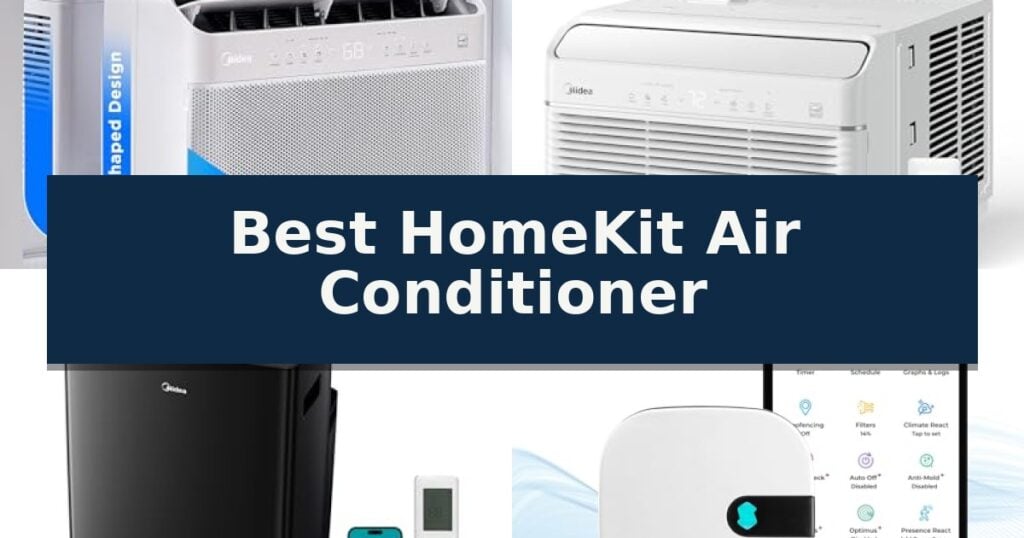
6 Best HomeKit Air Conditioner in 2026 Reviews
Quick Comparison
| Product | Best For | Key Strength | Score |
|---|---|---|---|
| Midea U Smart Inverter Air Conditioner | Best Overall | Ultra-quiet operation as low as 32 dBA due to the U-shaped design. | 4.9 |
| Midea Smart Inverter Window Air Conditioner | Efficient heating and cooling | Variable-speed inverter technology for up to 35% energy savings. | 4.4 |
| Midea Duo Inverter Portable Air Conditioner | Fast dual-hose cooling | Dual hose-in-hose design prevents hot air infiltration and improves cooling efficiency. | 4.7 |
| Sensibo Air Smart Controller | Adds HomeKit to existing units | Universal compatibility with any remote-controlled AC or heat pump system. | 4.6 |
| Sensibo Sky Smart AC Controller | Budget-friendly smart upgrade | Broad compatibility with most remote-controlled window, mini-split, and portable AC units. | 4.7 |
| Cielo Breez Max Smart Controller | Advanced AI climate management | Universal compatibility with over 20,000 IR-controlled AC models. | 4.6 |
How We Chose
Selecting the right air conditioning solution requires balancing hardware performance with smart home interoperability. We evaluate these units based on their cooling efficiency, noise output, and the reliability of their smart connectivity. An experienced reviewer focuses on how these systems integrate into an existing Apple Home environment to ensure consistent, responsive climate control.
- Native HomeKit or Matter compatibility for seamless integration
- Energy efficiency ratings and inverter technology performance
- Noise level output measured in decibels
- Installation flexibility for various window types
- Smart features including geofencing and scheduling accuracy
1 Midea U Smart Inverter Air Conditioner — Ultra-quiet window cooling
Maintaining a comfortable indoor climate while integrating smart home technology is simplified by the Midea 10,000 BTU U Shaped Window Air Conditioner, which features a unique U-shaped design that allows windows to close around the unit. This configuration effectively uses the window sash to block outside noise, resulting in operation as low as 32 dBA.
The unit utilizes advanced DC Inverter technology, which contributes to over 37% energy savings compared to traditional models. It holds the distinction of being the first window air conditioner to achieve ENERGY STAR Certification, emphasizing its efficiency in cooling spaces up to 450 square feet.
For connectivity, the device is Wi-Fi enabled and integrates with the SmartHome app for remote management. Users can also utilize voice commands through Alexa or Google Assistant to adjust settings from anywhere in the home. The inclusion of an Anti-Theft Mechanism provides added security by locking the window when the unit is in use.
Installation is streamlined through a quick-snap bracket system, designed for single-hung or double-hung windows with widths between 22 and 36 inches and a minimum height of 13.75 inches. This robust mounting approach ensures the unit remains stable while maintaining the ability to open the window for fresh air when desired.
Best for: Homeowners seeking a quiet, energy-efficient cooling solution that integrates with smart home voice assistants and maintains window functionality.
Skip if: Users with window dimensions outside the 22-36 inch width range or those requiring a non-window mounted cooling solution.
- Ultra-quiet operation as low as 32 dBA due to the U-shaped design.
- Advanced DC Inverter technology provides over 37% energy savings.
- Smart connectivity via Wi-Fi, Alexa, and Google Assistant.
- Flexible window opening allows for fresh air and maintains exterior views.
- Specific window size requirements (22-36 inches wide) may limit installation in non-standard window frames.
2 Midea Smart Inverter Window Air Conditioner — Efficient heating and cooling
The Midea Smart Inverter Window Air Conditioner distinguishes itself through its variable-speed inverter technology, which provides efficient climate control while consuming significantly less electricity than standard units. This model is engineered to handle multi-season needs, offering both powerful cooling and supplemental heating for spaces up to 350 square feet.
Designed for versatility, the unit features five operating modes and three speed settings, all manageable via an LED display, remote control, or the SmartHome App. Users can also integrate the unit with voice commands through Alexa and Google Assistant, allowing for seamless adjustments from anywhere. The inclusion of an adjustable louver swing ensures airflow is directed exactly where needed.
Operational comfort is a priority, with the unit achieving ultra-low noise performance as quiet as 45 dBA. This makes it suitable for bedrooms or home offices where maintaining a quiet environment is essential. The washable front-panel filter simplifies routine maintenance, ensuring the system continues to operate at peak efficiency throughout the year.
Installation is straightforward for compatible double-hung windows, requiring an opening width between 24 and 38.5 inches and a vertical clearance of 14.5 inches. By combining cooling, dehumidification, and heating in one package, this Energy Star certified appliance serves as a comprehensive solution for year-round indoor comfort.
Best for: Users seeking a versatile, energy-efficient window unit that provides both cooling and supplemental heating for medium-sized rooms.
Skip if: Those with window types other than double-hung or openings that do not meet the specific 24 to 38.5-inch width requirements.
- Variable-speed inverter technology for up to 35% energy savings.
- Multi-season functionality including cooling, heating, and dehumidification.
- Ultra-low noise operation as quiet as 45 dBA.
- Smart connectivity via app and voice assistant integration.
- Heat pump function is limited to outdoor temperatures above 41°F.
- Specific window size requirements may limit installation options.
3 Midea Duo Inverter Portable Air Conditioner — Fast dual-hose cooling
Maintaining a comfortable indoor climate while minimizing energy consumption is a primary challenge for portable cooling solutions. The Midea Duo Inverter Portable Air Conditioner addresses this through an industry-first dual hose-in-hose design, which creates a balanced air circulation system that prevents hot outdoor air from infiltrating the room through gaps. This structural innovation is designed to maximize cooling efficiency, allowing the unit to reach desired temperatures significantly faster than traditional single-hose models.
Engineered with variable-speed inverter technology, this unit is capable of cooling spaces up to 550 square feet while consuming considerably less electricity. According to manufacturer data, this technology enables energy savings of more than 40% compared to standard portable air conditioners. The optimized air duct system works in tandem with the dual-hose configuration to lock in cooling, providing a more consistent and powerful performance for residential environments.
Usability is a core focus, as the unit is fully Wi-Fi enabled for remote operation. Users can manage settings through the SmartHome App on iOS and Android devices or integrate the unit into a smart home ecosystem using voice commands via Alexa and Google Assistant. This connectivity ensures that climate control is accessible from anywhere, providing a modern interface for managing the unit's various modes and power levels.
Despite its 14,000 BTU cooling capacity, the Midea Duo Inverter Portable Air Conditioner is designed for unobtrusive use. It features an 42dB ultra-quiet operation mode, which is engineered to minimize noise levels to that of a library environment. This makes it a practical choice for bedrooms or living areas where maintaining a quiet atmosphere is as important as the cooling output itself.
Best for: Users seeking an energy-efficient, quiet, and smart-controlled portable cooling solution for rooms up to 550 square feet.
Skip if: Those who require a window-mounted unit or lack the space to accommodate the dual-hose installation requirements.
- Dual hose-in-hose design prevents hot air infiltration and improves cooling efficiency.
- Variable-speed inverter technology provides over 40% energy savings compared to federal standards.
- 42dB ultra-quiet operation allows for use in bedrooms without significant noise disruption.
- Smart control integration via Wi-Fi, app connectivity, and voice assistants.
- Dual-hose installation requires more complex window venting than standard single-hose units.
- Heavy physical footprint at nearly 75 pounds may limit portability for some users.
4 Sensibo Air Smart Controller — Adds HomeKit to existing units
Integrating legacy climate control hardware into a modern smart home ecosystem is often a challenge, but the Sensibo Air Smart Air Conditioner Controller simplifies this by bridging the gap between traditional remote-controlled units and Apple HomeKit. By acting as a central hub, this compact device allows you to manage your existing air conditioner or heat pump through the same interface as your other smart home appliances.
The Sensibo Air Smart Air Conditioner Controller stands out for its universal compatibility, as it functions with virtually any air conditioner or heat pump that utilizes a standard infrared remote. Installation is straightforward, requiring no specialized tools; you simply plug in the unit, connect it to your local WiFi, and pair it via the smartphone app to begin controlling your environment remotely.
Beyond simple on-off functionality, the device features Climate Zone Technology, which utilizes built-in sensors to monitor both temperature and humidity. This data allows the controller to adjust settings automatically to maintain an optimal 'real feel' environment. Additionally, the system includes Geofencing and Climate React capabilities, which can automatically trigger your cooling or heating based on your proximity to the home or specific environmental thresholds.
While the device excels at adding intelligence to older systems, it is important to note that it relies on infrared signals to communicate with your AC unit. This means the controller must be placed in a direct line of sight to the air conditioner's receiver to ensure reliable operation. For those seeking to modernize their home comfort without replacing functional hardware, this controller offers a practical, energy-saving solution.
Best for: Users looking to integrate existing, non-smart infrared-controlled air conditioners or heat pumps into an Apple HomeKit or broader smart home environment.
Skip if: Users whose air conditioner does not use a standard infrared remote control or those unable to maintain a direct line of sight between the controller and the AC unit.
- Universal compatibility with any remote-controlled AC or heat pump system.
- Easy setup process using WiFi or Bluetooth without requiring tools.
- Advanced automation features including Geofencing and Climate React for energy efficiency.
- Integrated smart sensors that monitor both temperature and humidity levels.
- Line-of-sight requirement necessitates careful placement relative to the air conditioner's infrared receiver.
5 Sensibo Sky Smart AC Controller — Budget-friendly smart upgrade
Integrating legacy climate control into a modern smart home environment often requires a bridge between infrared-based hardware and digital ecosystems. The Sensibo Sky Smart AC Controller addresses this by acting as a wireless interface that translates commands from your smartphone or voice assistant into the infrared signals your existing air conditioner recognizes.
This compact, wall-mounted device measures just 3.2” x 2.2” x 0.8”, making it an unobtrusive addition to any room. Once connected to your local WiFi, it enables remote operation of window units, mini-split systems, and portable air conditioners. By utilizing the Sensibo Mobile or web-based applications, you gain the ability to manage temperature and humidity settings from anywhere, effectively turning a standard remote-controlled unit into a connected appliance.
Advanced functionality includes Climate React, which monitors both temperature and humidity to maintain a specific 'real feel' environment, and geofencing capabilities that can trigger your system based on your proximity to the home. These features are designed to optimize energy usage, with the manufacturer noting potential cooling bill reductions of up to 40% through more precise scheduling and automated control.
Installation is designed for a straightforward DIY approach, requiring only a power connection and a brief setup process within the app. While the unit offers broad compatibility with various remote-controlled systems, it is important to note that it relies on infrared communication and does not support Bluetooth connectivity. It integrates with major platforms including Amazon Alexa, Google Assistant, and Siri, providing a centralized point of control for your home's cooling needs.
Best for: Users looking to add smart, app-based scheduling and remote control to existing infrared-operated air conditioning units.
Skip if: Users whose air conditioning units do not utilize a standard infrared remote control or those requiring a native, hardwired smart thermostat solution.
- Broad compatibility with most remote-controlled window, mini-split, and portable AC units.
- Energy-saving features like geofencing and 7-day scheduling to reduce cooling costs.
- Climate React technology that automatically adjusts settings based on humidity and temperature sensors.
- Compact, wall-mounted design that facilitates a quick DIY installation.
- No Bluetooth support, limiting connectivity options to WiFi only.
- Relies on infrared line-of-sight, requiring the device to be positioned where it can communicate with the AC unit.
6 Cielo Breez Max Smart Controller — Advanced AI climate management
Integrating legacy climate control hardware into a modern smart home ecosystem often requires a bridge, and the Cielo Breez Max Smart Controller serves as a sophisticated intermediary. By utilizing AI-based technology to manage mini-split, window, and portable air conditioners that rely on IR remotes, this device effectively digitizes traditional cooling systems without requiring a full HVAC replacement.
The Cielo Breez Max Smart Controller stands out for its broad compatibility, boasting support for over 20,000 models via an auto-detection algorithm. Once connected to a 2.4 GHz Wi-Fi network, the unit provides granular control through a dedicated app, enabling features like weekly scheduling, geofencing, and energy usage tracking. The inclusion of built-in temperature and humidity sensors allows for precise environmental monitoring, which can be calibrated directly through the interface.
For users managing complex environments, the device offers Multi-Zone Mini-Split Control to prevent mode conflicts across multiple indoor units. Its Comfy Max AI feature is designed to optimize runtime, preventing the common pitfalls of overcooling or overheating, which contributes to long-term energy savings. The controller maintains functionality even during internet outages, ensuring that pre-set schedules remain active.
Installation is straightforward, requiring only a line-of-sight placement within 6-12 feet of the target air conditioner. While it offers extensive integration with platforms like Alexa, Google Assistant, and Home Assistant, users should ensure their home network supports the 2.4 GHz band. The Cielo Breez Max Smart Controller is a practical solution for those seeking to automate climate management while maintaining compatibility with existing, non-smart cooling hardware.
Best for: Homeowners looking to integrate existing IR-controlled mini-split, window, or portable air conditioners into a unified smart home ecosystem.
Skip if: Users who require native HomeKit support without additional bridges or those whose air conditioning units do not utilize IR remote controls.
- Universal compatibility with over 20,000 IR-controlled AC models.
- AI-based Comfy Max technology for automated energy-efficient climate management.
- Multi-zone synchronization to prevent operational mode conflicts.
- No subscription fees for app-based control and energy tracking.
- Requires 2.4 GHz Wi-Fi connectivity for network integration.
- Line-of-sight placement is necessary for reliable IR signal transmission.
Best HomeKit Air Conditioner Buying Guide
Native Smart Cooling vs. Smart Controllers
Native smart air conditioners feature built-in Wi-Fi and direct Apple HomeKit support, allowing for simplified setup and deeper integration. These units provide real-time feedback on energy usage and precise temperature control without requiring additional hardware or hubs.
Smart controllers serve as an alternative for existing, non-smart units. By mimicking the infrared signals of a standard remote, these devices add connectivity to older hardware, though they may lack the granular energy monitoring found in native smart appliances.
Understanding Inverter Technology
Inverter technology allows an air conditioner to adjust its compressor speed dynamically rather than simply cycling on and off. This results in more consistent temperatures and significantly higher energy efficiency over time.
Beyond energy savings, inverter-equipped units typically operate with less vibration and noise. This makes them particularly suitable for bedrooms or home offices where a quiet environment is a priority.
Installation and Window Compatibility
Window-mounted units require careful measurement of the window opening and sash height. U-shaped designs offer the unique advantage of allowing the window to remain partially open, which can improve airflow and maintain a clearer view.
Always verify the minimum and maximum width requirements for your specific window frame. Some units include quick-snap brackets or specialized sidearms to ensure a secure, weather-tight fit that prevents drafts.
Climate Control and Automation
Modern smart air conditioners offer advanced automation features like geofencing, which triggers cooling based on your proximity to home. This ensures your space is comfortable upon arrival while saving energy when you are away.
Scheduling capabilities allow for customized temperature profiles throughout the day. By aligning your cooling cycles with your daily routine, you can maximize comfort during peak hours and reduce usage during sleep or work periods.
Maintenance for Peak Performance
Regular maintenance of the air filter is essential for maintaining airflow and cooling efficiency. Most modern units feature easily accessible front panels that allow for quick removal and cleaning of the filter.
Keeping the exterior of the unit free from debris and ensuring the drainage system is unobstructed will extend the lifespan of the compressor. Consistent care prevents common issues like icing or reduced cooling capacity.
Frequently Asked Questions
Do all smart air conditioners work with Apple HomeKit?
No, compatibility varies by manufacturer. Always check for the 'Works with Apple Home' badge or specific HomeKit support in the product specifications before purchasing.
Can a smart controller make any air conditioner work with HomeKit?
Most smart controllers work with any unit that uses an infrared remote control. However, the level of integration depends on the controller's software and its ability to map the specific functions of your AC unit.
What is the benefit of a U-shaped window air conditioner?
The U-shaped design allows the window to close down into the unit, which helps block external noise and provides a more secure installation compared to traditional box-style window units.
How does inverter technology save energy?
Inverter technology adjusts the compressor speed to maintain a steady temperature, avoiding the energy-intensive start-stop cycles of traditional air conditioners.
Do I need a hub for smart air conditioner controllers?
Most modern smart controllers connect directly to your 2.4 GHz Wi-Fi network and do not require a separate hub, though some systems may offer optional bridges for improved range or stability.
Conclusion: Our Top Pick
Our top pick is Midea U Smart Inverter Air Conditioner. Choosing the right cooling solution depends on whether you prefer a dedicated smart unit or a controller to upgrade your existing hardware. Prioritizing native HomeKit support or reliable IR-based controllers ensures a smooth experience within your smart home.
By considering factors like inverter efficiency, installation requirements, and automation capabilities, you can select a system that provides both comfort and energy savings. Focus on units that align with your specific window setup and connectivity needs.