 critical cactus
Honeywell Home Aube Hydronic Thermostat is our pick for the Best Hydronic Heating Thermostats because it offers essential pump protection and precise temperature control for diverse heating systems. For those requiring specialized floor monitoring, the Azel Digital Slab Sensing Thermostat provides dual-sensor capabilities, while the tekmar Radiant Heating Thermostat serves as a reliable, straightforward replacement for existing radiant setups.
Selecting the right control for a hydronic system requires balancing compatibility with your specific boiler or pump configuration. Hydronic systems often rely on precise switching to maintain comfort, making the choice of thermostat a critical factor in both energy efficiency and the longevity of your heating equipment.
When evaluating these devices, consider how each model handles your specific zone requirements and whether it supports the voltage or sensor inputs your current installation demands. Our recommendations focus on units that offer clear, actionable data and reliable relay performance to ensure your home remains comfortable throughout the heating season.
When planning a major upgrade to your home's climate control, it is helpful to understand the Best Hydronic Heating System to ensure your new thermostat integrates perfectly with your existing setup.
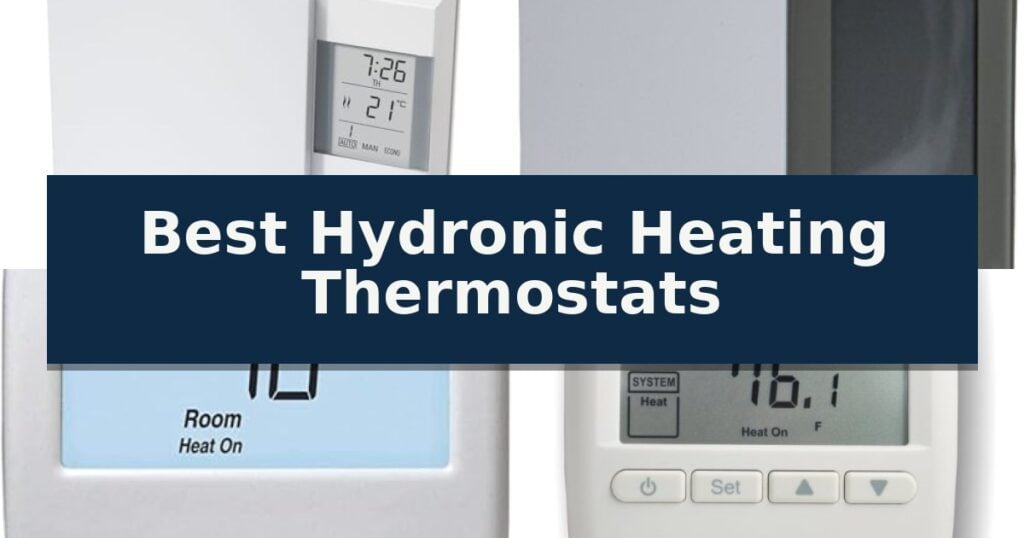
6 Best Hydronic Heating Thermostats in 2026 Expert Reviews
Quick Comparison
| Product | Best For | Key Strength | Score |
|---|---|---|---|
| Honeywell Home Aube Hydronic Thermostat | Best Overall | Pump protection feature prevents seasonal seizure | 4.9 |
| Honeywell Programmable Hydronic Thermostat | Versatile Multi-System Control | 7-day programmable scheduling for customized heating cycles. | 4.9 |
| tekmar Radiant Heating Thermostat | Precise PWM Temperature Control | Direct drop-in replacement for legacy tekmar 507/508 models. | 4.6 |
| Azel Digital Slab Sensing Thermostat | Dual-Sensor Floor Monitoring | Dual-sensor monitoring for ambient and floor temperatures | 4.4 |
| Ouyanglong 6 Zone Switching Relay | Manages Multiple Heating Zones | Direct replacement for Taco SR506-4 systems. | 4.7 |
| tekmar Hydronic Valve Control | Optimizes Boiler Efficiency | RoomResponse signal technology optimizes boiler performance. | 4.7 |
How We Chose
To identify the most effective controls for hydronic heating, we evaluate each unit based on its ability to manage specific system demands like pump cycling and zone control. An experienced reviewer prioritizes technical compatibility, sensor accuracy, and the practical ease of installation, ensuring that the chosen thermostat effectively bridges the gap between the boiler and the living space.
- Compatibility with system voltage and relay types
- Precision of temperature sensing and display increments
- Availability of pump protection or anti-seizure features
- Ease of programming and user interface accessibility
- Sensor integration for ambient and floor temperature monitoring
1 Honeywell Home Aube Hydronic Thermostat — Prevents Pump Seizure
Maintaining consistent temperatures in hydronic systems requires precise equipment, and the Honeywell Home Aube TH140-28-01-B Hydronic Heating 7-Day Programmable Thermostat offers a specialized solution for this task. Designed to minimize temperature swings, this unit provides advanced control to ensure steady comfort throughout the home.
A standout feature for hydronic users is the pump protection function, which automatically activates the pump for one minute every 24 hours to prevent seizure during periods of inactivity. This proactive maintenance capability helps protect the longevity of your heating system components.
The thermostat features a precise LCD screen that displays room temperature in increments of 0.1°C or 0.1°F, allowing for granular monitoring. Programming is simplified by a removable faceplate design, which gives users access to instructions directly on the front panel for quick setup.
Versatility is a core design choice, as the unit is compatible with systems ranging from millivolt to 240 V. It also includes a low battery indicator that provides a 60-day warning, ensuring you have ample time to replace power sources before the system loses functionality.
While highly capable for hot water heating, users should note that the unit is designed for specific electrical configurations, including SPDT dry contact relay output. Its ability to optimize heating through selectable cycles makes it a technically robust choice for those managing complex hydronic setups.
Best for: Homeowners seeking a programmable thermostat with built-in pump protection for hydronic heating systems.
Skip if: You require a smart, Wi-Fi-enabled thermostat for remote mobile app control or voice assistant integration.
- Pump protection feature prevents seasonal seizure
- Precise temperature display in 0.1-degree increments
- Versatile compatibility with millivolt to 240 V systems
- Easy programming via removable faceplate design
- Lacks smart connectivity features like Wi-Fi or app control
2 Honeywell Programmable Hydronic Thermostat — Versatile Multi-System Control
Maintaining consistent indoor temperatures requires precise control, and the Honeywell TL8100A1008 Programmable Hydronic Thermostat offers a versatile solution for managing various heating systems. This electronic thermostat is designed to handle multiple applications, including baseboards, convectors, radiant ceilings, and central heating systems, making it a flexible choice for diverse residential setups.
The unit features a 7-day programmable interface, allowing users to establish specific heating schedules that align with their daily routines. By automating temperature adjustments, the device helps manage heating output efficiently across different zones or system types. Its clean, white design ensures it integrates unobtrusively into most interior environments.
Measuring 4.9 inches in height and 3.8 inches in length, this compact controller is built for straightforward wall mounting. The Honeywell TL8100A1008 Programmable Hydronic Thermostat provides a dedicated interface for users to monitor and adjust their climate settings directly, removing the complexity often associated with manual heating adjustments.
While this model provides robust scheduling capabilities, it is a dedicated electronic control unit without integrated smart-home or remote-access features. Users seeking mobile app connectivity or voice-command integration may need to consider alternative smart-enabled thermostats, as this device focuses on localized, programmable hardware control.
Best for: Homeowners seeking a reliable, 7-day programmable wall-mounted thermostat for baseboard, convector, or radiant ceiling heating systems.
Skip if: Users who require remote access, mobile app control, or smart-home integration will find this manual-interface model insufficient for their needs.
- 7-day programmable scheduling for customized heating cycles.
- Multi-application compatibility with baseboards, convectors, and radiant ceilings.
- Compact, low-profile design that fits standard wall installations.
- No smart-home connectivity or remote mobile app support.
- No included warranty coverage.
3 tekmar Radiant Heating Thermostat — Precise PWM Temperature Control
The tekmar Radiant Heating Thermostat is a specialized control solution engineered to provide precise temperature management for single-stage hydronic heating or cooling systems. By utilizing PWM (Pulse Width Modulation) control, this device ensures consistent and efficient heat delivery, which is essential for maintaining comfort in radiant floor applications or remote room environments. The thermostat operates within a set-point range of 32 to 122°F, offering reliable regulation for indoor climate systems.
Designed for intuitive operation, the unit features a large, clear display paired with simple up-and-down buttons, allowing users to adjust settings without navigating complex menus. Its physical dimensions of 3-11/16" H x 3" W x 15/16" D make it a compact addition to any wall, and it can be mounted onto a single-gang electrical box using the optional Adaptor Plate 012. This design focus prioritizes functional simplicity and ease of use for daily temperature adjustments.
A primary advantage of this model is its role as a direct drop-in replacement for legacy tekmar 507 and 508 thermostats. This compatibility allows contractors and homeowners to perform upgrades without the need for extensive rewiring, significantly reducing labor time and potential installation errors. The unit is built for indoor environments, supporting operation in areas with up to 90% relative humidity, provided the conditions remain non-condensing.
The system integrates an NTC thermistor sensor capable of monitoring temperatures across a broad range of -60 to 255°F. This sensor integration is central to the thermostat's ability to optimize HVAC performance through consistent control logic. By focusing on reliable, single-stage operation, the device provides a straightforward, evidence-based approach to managing hydronic heating systems without the complexity of multi-stage or smart-home connectivity requirements.
Best for: Homeowners or contractors seeking a direct, efficient replacement for existing tekmar 507 or 508 hydronic heating controls.
Skip if: Users who require multi-stage heating control or advanced smart-home connectivity features not supported by this model.
- Direct drop-in replacement for legacy tekmar 507/508 models.
- PWM control for highly accurate temperature regulation.
- Simple interface with a large, easy-to-read display.
- Quick installation process reduces labor time.
- Indoor-only design limits installation locations.
- Single-stage system compatibility only.
4 Azel Digital Slab Sensing Thermostat — Dual-Sensor Floor Monitoring
Maintaining precise climate control in radiant floor systems requires a specialized approach to sensor management. The Azel D-508F: NON-PROGRAMMABLE DIGITAL SLAB SENSING THERMOSTAT FOR HYDRONIC RADIANT FLOOR HEATING addresses this need by utilizing a dual-sensor design that monitors both ambient room temperature and floor slab temperature simultaneously.
This unit offers three distinct control modes to suit different heating requirements. The 'A' mode focuses on ambient air temperature, while the 'F' mode prioritizes floor temperature. For more complex setups, the 'AF' mode maintains the ambient temperature while enforcing minimum and maximum floor limits, which is essential for protecting sensitive floor coverings from excessive heat.
Usability is enhanced by an Easy-to-Read Digital Multi-Display that provides a constant readout of both sensor temperatures and the current setpoint. The QuickSet feature allows for immediate adjustments without navigating through deeper settings menus, and the EEPROM memory ensures that all your programmed parameters remain intact during a power failure.
Designed for 24VAC systems, this thermostat includes a P-01 floor sensor with a 10 ft. lead for flexible installation. It also features a selectable backlit display and an integrated On/Off switch to safely disable relay output at the end of the heating season.
Best for: Homeowners who require precise, dual-sensor control to manage both room comfort and floor temperature safety in hydronic radiant heating systems.
Skip if: Users seeking a Wi-Fi-enabled or smart-home integrated thermostat, as this model is a non-programmable, hardwired unit.
- Dual-sensor monitoring for ambient and floor temperatures
- AF Mode protects floor coverings with customizable temperature limits
- EEPROM memory retains settings during power outages
- QuickSet feature for rapid manual adjustments
- Non-programmable design lacks scheduling capabilities
- 24VAC power requirement necessitates specific wiring compatibility
5 Ouyanglong 6 Zone Switching Relay — Manages Multiple Heating Zones
Managing complex hydronic heating systems requires precise control over multiple zones, and the Ouyanglong 6 Zone Switching Relay provides a centralized solution for residential boiler and pump management. This unit is engineered as a direct replacement for the Taco SR506-4, offering a streamlined interface for systems that require independent control across six distinct areas.
The relay operates on a standard 120 VAC supply voltage and is built to handle significant electrical loads. Each of the six zones supports up to 1/3 HP or 6A, with the entire unit capable of managing a total maximum load of 20A. This capacity makes it suitable for a variety of configurations, including radiant floor heating and baseboard heating setups.
Installation is simplified through a standard terminal block layout featuring clearly labeled connections for thermostats, circulator pumps, and boiler controls. The panel-mounted design includes pre-drilled screw holes, allowing for a secure and straightforward setup in utility rooms or mechanical closets.
Versatility is a core feature, as the system offers universal compatibility with most hydronic circulator pumps meeting the 1/3 HP requirement. It integrates with a wide range of control devices, including 24V conventional, programmable, and smart thermostats, ensuring it fits into both legacy and modern home heating environments.
Best for: Homeowners or technicians seeking a direct, reliable replacement for a 6-zone hydronic switching relay in residential heating systems.
Skip if: Systems requiring more than six zones or those utilizing non-standard voltage requirements outside the 120 VAC specification.
- Direct replacement for Taco SR506-4 systems.
- Supports up to 20A total load across six zones.
- Compatible with smart and programmable 24V thermostats.
- Clearly labeled terminal blocks for easy installation.
- Limited to six zones of control.
- Requires 120 VAC power supply for operation.
6 tekmar Hydronic Valve Control — Optimizes Boiler Efficiency
Maintaining precise comfort in a hydronic system requires more than basic switching, and the tekmar 304V 4-Zone Hydronic Valve Control with DHW Priority addresses this by integrating directly with modulating condensing boilers. By delivering a RoomResponse signal, this controller improves overall system efficiency and response times, ensuring that the boiler operates only when necessary to meet the specific heating demands of your zones.
Designed for versatility, the unit manages up to four zones, with the first zone offering the flexibility to operate either a circulator or a zone valve for an indirect domestic hot water tank. This setup includes an optional priority feature, allowing the system to focus heating capacity on domestic hot water when needed, while the optional post purge function further enhances energy savings by utilizing residual heat.
The tekmar 304V 4-Zone Hydronic Valve Control with DHW Priority also prioritizes system longevity through optional exercising, which periodically activates circulators to prevent seizure during periods of inactivity. Its compact design, measuring approximately 8-3/16" H × 10-11/16" W × 2-3/8" D, is intended for indoor installation in residential or small commercial environments, operating reliably within a temperature range of 32 to 122°F.
Installation is streamlined for professionals and homeowners alike, supporting a wide range of HVAC accessories to expand system capabilities. Whether managing multifamily housing or a single-family home, this control unit provides a centralized, intelligent hub for managing complex hydronic layouts without the need for overly complicated wiring configurations.
Best for: Homeowners and contractors seeking to optimize boiler efficiency and manage multiple heating zones with domestic hot water priority.
Skip if: Users who require a simple, non-communicating relay or those managing systems that do not utilize modulating condensing boilers.
- RoomResponse signal technology optimizes boiler performance.
- DHW priority and post-purge functionality increase energy efficiency.
- Automatic circulator exercising prevents mechanical seizure.
- Flexible zone configuration for valves or circulators.
- Indoor-only design limits installation locations.
- Requires specific compatibility with modulating boilers for full feature utilization.
Best Hydronic Heating Thermostats Buying Guide
System Compatibility and Voltage
Before selecting a thermostat, verify that the device matches your system's voltage requirements, whether it is a low-voltage 24V setup or a line-voltage application. Mismatched voltage can lead to equipment failure or safety hazards, so always confirm the electrical specifications against your existing wiring.
Some thermostats are designed to handle a wide range of voltages, from millivolt to 240V, offering greater flexibility for older or custom systems. Always check if your installation requires a dry contact relay or a specific power source to ensure seamless integration with your boiler or zone valves.
Pump Protection and Maintenance
Hydronic systems that remain idle for long periods can suffer from pump seizure, where the circulator becomes stuck due to mineral buildup or inactivity. Thermostats with built-in pump protection features periodically activate the pump for a short duration, keeping the internal components moving and preventing costly maintenance issues.
This feature is particularly valuable for seasonal heating systems that are shut down during summer months. By ensuring the pump cycles even when there is no call for heat, you extend the life of your circulator and reduce the likelihood of mechanical failure at the start of the heating season.
Sensor Accuracy and Placement
For radiant floor heating, the placement and type of temperature sensor are paramount to achieving consistent comfort. Thermostats that support both ambient air sensing and floor slab sensing allow for more nuanced control, preventing the floor from becoming uncomfortably hot while maintaining the desired room temperature.
Look for units that provide clear, high-resolution displays of these readings. Being able to monitor the floor temperature directly helps protect sensitive flooring materials from overheating, which is a critical consideration for hardwood or laminate installations over radiant systems.
Programming and User Interface
Programmable thermostats allow you to set heating schedules that align with your daily routine, potentially reducing energy consumption when the home is unoccupied. Evaluate whether you prefer a simple, non-programmable interface for steady-state heating or a 7-day programmable model that offers granular control over different times of the day.
The physical interface should be intuitive, with clear buttons and a readable LCD screen. Features like backlit displays or easy-to-remove faceplates can significantly simplify the initial setup and any subsequent adjustments you might need to make throughout the year.
Zone Control and Expansion
In larger homes or multi-story buildings, managing multiple heating zones requires a centralized approach, often involving switching relays or valve controls. Ensure your thermostat is compatible with the zone control hardware you have installed, as some advanced thermostats are designed to communicate directly with multi-zone controllers.
If you are expanding your system, consider whether your current thermostat can accommodate additional zones or if you need to upgrade to a multi-zone switching relay. Proper zone management ensures that each area of the home receives heat only when necessary, improving overall system efficiency.
Frequently Asked Questions
Can I use a standard wall thermostat for my hydronic radiant floor heating?
Not all standard thermostats are suitable for hydronic radiant floor heating. You should look for a model that specifically supports floor-sensing or has the appropriate relay output for your system's valves or pumps.
What is the benefit of a thermostat with pump protection?
Pump protection prevents the circulator pump from seizing during periods of inactivity by automatically cycling it for a short time, such as one minute every 24 hours.
Do I need a battery-operated thermostat or one powered by the system?
This depends on your wiring. Many hydronic thermostats are designed to be powered by the 24VAC system wiring, while others may use batteries as a backup or primary power source. Check your existing thermostat's wiring to determine the requirement.
How do I know if a thermostat is compatible with my boiler?
Check the thermostat's technical specifications for its relay output type. Most hydronic systems require a dry contact or a specific voltage rating that matches the boiler's control circuit.
Can I replace an old tekmar thermostat with a newer model?
Many modern tekmar thermostats are designed as direct replacements for older models, often utilizing the same wiring and sensor configurations to simplify the upgrade process.
Conclusion: Our Top Pick
Our top pick is Honeywell Home Aube Hydronic Thermostat. Choosing the right thermostat for your hydronic heating system is a balance between technical compatibility and the specific features that protect your equipment. Prioritizing models with pump protection and accurate sensor inputs ensures your system runs efficiently and reliably for years.
By verifying your voltage requirements and zone control needs, you can select a unit that provides precise comfort. Whether you need a simple, robust controller or a more advanced sensing device, these options offer the functionality required to maintain a well-regulated home environment.