 critical cactus
Mysa Smart In-Floor Thermostat is our top choice for the Best In-Floor Heating Thermostat because it combines robust smart home integration with a user-friendly app that simplifies energy management for high-voltage systems.
Selecting an appropriate controller for radiant heat requires balancing advanced connectivity with essential safety features like built-in GFCI protection. While some homeowners prioritize seamless voice control and scheduling, others may prefer the straightforward reliability of a manual interface for their specific floor heating setup.
Our evaluation focuses on how these units handle temperature precision, compatibility with standard voltage requirements, and the clarity of their user interfaces. By examining these core functional areas, we can distinguish between models that offer genuine convenience and those that prioritize simplicity for basic heating needs.
If you are currently in the process of planning your home renovation, understanding the components of the Best In-Floor Heating System is essential for ensuring your new thermostat integrates perfectly with your heating cables.
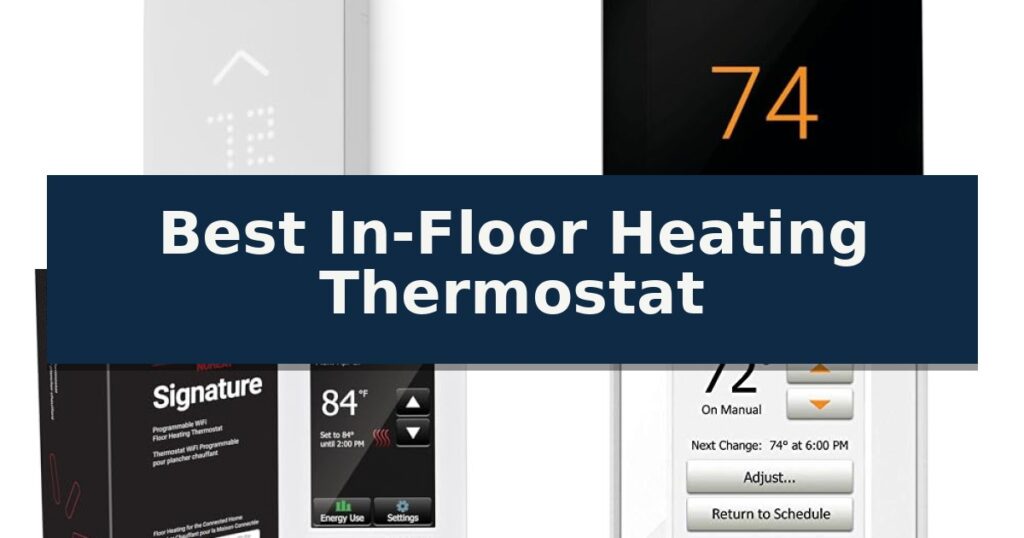
10 Best In-Floor Heating Thermostat in 2026 Reviews
Quick Comparison
| Product | Best For | Key Strength | Score |
|---|---|---|---|
| Mysa Smart In-Floor Thermostat | Best Overall | Smart home compatibility with HomeKit, Alexa, and Google Home. | 4.9 |
| SunTouch CommandPlus Wi-Fi Thermostat | Premium Large Touchscreen Interface | SmartStart technology for precise temperature scheduling | 4.3 |
| Nuheat Signature WiFi Thermostat | Reliable Smart Home Compatibility | Dual-voltage compatibility for 120V and 240V systems | 4.3 |
| Schluter Ditra-Heat-E-RT Thermostat | Optimized for Ditra-Heat Systems | Integrated GFCI for enhanced electrical safety. | 4.7 |
| OJ Microline UDG Programmable Thermostat | Intuitive Seven-Day Scheduling | Built-in Class A GFCI with self-testing for enhanced safety. | 4.3 |
| OJ Microline UTN4 Non-Programmable Thermostat | Simple Plug-and-Play Operation | Built-in Class A GFCI for essential safety compliance. | 4.5 |
| YeloDeer Rotary Floor Thermostat | Easiest Manual Dial Control | Simple manual rotary dial eliminates complex menus and app setup. | 4.8 |
| YeloDeer WiFi Radiant Floor Thermostat | Affordable App-Controlled Heating | Universal compatibility with 120V and 240V heating cables | 4.5 |
| QuietWarmth Non-Programmable Thermostat | Fast Five-Step Guided Setup | Integrated GFCI for enhanced safety in wet areas | 4.5 |
| SASWELL Programmable Floor Thermostat | Flexible Multi-Sensor Compatibility | Broad voltage compatibility supporting both 120V and 240V circuits. | 4.5 |
How We Chose
To determine the best in-floor heating thermostat, we analyze how each device manages the unique demands of radiant floor systems. Our review process prioritizes electrical safety, ease of installation, and the effectiveness of the control interface, ensuring that each recommendation provides reliable temperature regulation for various flooring types.
- Voltage Compatibility: Verifying support for 120V and 240V electric radiant systems.
- Smart Connectivity: Evaluating the reliability of Wi-Fi integration and mobile app functionality.
- Safety Standards: Confirming the presence of a built-in Class A GFCI for wet area compliance.
- Interface Design: Assessing the responsiveness of touchscreens and the ease of manual adjustments.
- Scheduling Flexibility: Comparing the granularity of programmable periods and energy-saving modes.
1 Mysa Smart In-Floor Thermostat — Best for Smart Home Integration
Maintaining consistent warmth for electric in-floor heating systems requires a controller that integrates seamlessly with modern home automation. The Mysa Smart In-Floor Thermostat provides a dedicated solution for high-voltage systems, offering remote management through a mobile app that eliminates the need for manual adjustments at the wall.
Engineered for North American climate conditions, this device supports 120V-240V systems and includes a built-in Class A GFCI for safety. Beyond basic temperature regulation, the unit features in-app scheduling, geofencing, and energy reports, allowing users to monitor consumption patterns and potentially reduce electricity costs. The hardware includes a sleek touch-control interface with adjustable brightness to suit different room environments.
Connectivity is a core strength, as the thermostat is designed to work with 2.4 GHz Wi-Fi networks and is compatible with MESH systems. It integrates with major smart home platforms including HomeKit, Alexa, and Google Home, enabling voice-activated climate control. For added security and peace of mind, the device includes temperature threshold alerts to help prevent potential issues.
Installation is supported by step-by-step video guidance, and the unit is designed to be a direct upgrade for existing line-voltage thermostats. While it offers robust smart features, it is important to note that this model is strictly for electric systems and does not support hydronic or water-based heating setups.
Best for: Homeowners looking to integrate electric in-floor heating into a broader smart home ecosystem using voice commands or mobile scheduling.
Skip if: Users with hydronic or water-based in-floor heating systems, as this thermostat is exclusively designed for electric high-voltage applications.
- Smart home compatibility with HomeKit, Alexa, and Google Home.
- Built-in Class A GFCI for enhanced safety in high-voltage setups.
- Comprehensive app features including geofencing and detailed energy reporting.
- Flexible connectivity supporting 2.4 GHz and MESH Wi-Fi networks.
- Not compatible with hydronic or water-based heating systems.
- Requires 2.4 GHz Wi-Fi for optimal connectivity.
2 SunTouch CommandPlus Wi-Fi Thermostat — Premium Large Touchscreen Interface
Managing radiant floor temperatures requires precision, and the SunTouch SunStat CommandPlus Wi-Fi Thermostat addresses this with its integrated SmartStart technology. This feature automatically calculates the necessary start time to ensure your floors reach the desired temperature exactly when scheduled, eliminating the guesswork often associated with radiant heating systems.
The unit features a 4.3-inch capacitive digital touchscreen housed in a sleek, thin-profile design. Beyond its visual interface, the device provides comprehensive control through floor and air sensing capabilities. Users can manage settings locally or via the Watts Home mobile app, which enables remote adjustments and energy use monitoring from anywhere with an internet connection.
Versatility is a core component of this model, offering a 7-day programmable schedule and an 'away' feature to optimize efficiency. To protect various flooring materials, it includes floor max settings, while additional conveniences like outdoor weather displays and e-mail alert notifications keep users informed of system status and environmental conditions.
Installation and daily operation are streamlined by the intuitive interface and the inclusion of warm weather shutdown functionality. This thermostat is designed to integrate into residential or commercial spaces, providing a sophisticated, connected solution for those seeking consistent comfort from their electric floor heating systems.
Best for: Homeowners who prioritize remote connectivity and intelligent scheduling for their electric radiant floor heating systems.
Skip if: Users who prefer a simple, non-connected manual dial interface or those who do not require Wi-Fi-enabled remote access.
- SmartStart technology for precise temperature scheduling
- Remote access via the Watts Home mobile app
- 4.3-inch capacitive touchscreen with a modern, thin profile
- Floor max settings to protect sensitive flooring materials
- Requires Wi-Fi connectivity to utilize full remote features
3 Nuheat Signature WiFi Thermostat — Reliable Smart Home Compatibility
Managing floor temperatures requires precision and connectivity, and the Nuheat nVent Signature AC0055 WiFi Programmable Floor Heating Thermostat addresses this with a 3½" color touchscreen interface. This unit serves as a centralized control point for radiant floor heating systems, offering a clear, intuitive way to manage daily thermal comfort.
The device is engineered for broad compatibility, featuring dual-voltage support for both 120V and 240V floor heating cables. This flexibility makes it a versatile choice for various residential heating setups, whether in a kitchen, bathroom, or living area. Safety is integrated through a built-in Class A GFCI, providing necessary protection for floor heating applications.
Connectivity is a primary focus, as the Nuheat Signature WiFi Thermostat integrates with modern smart home ecosystems. Users can manage schedules via a mobile app for iOS and Android or through a web browser. It supports a wide range of platforms including Amazon Alexa, Google Assistant, IFTTT, Control4, Crestron, Elan, and RTI, allowing for seamless inclusion into an existing smart home network.
Installation and scheduling are designed for user convenience, with a 7-day programmable feature that allows for personalized heating profiles. The interface is built to be accessible, ensuring that adjusting floor warmth remains straightforward regardless of the complexity of the heating schedule.
Best for: Homeowners seeking a smart, connected thermostat that integrates with major home automation platforms and supports dual-voltage heating systems.
Skip if: Users who prefer a simple, non-connected manual thermostat or those who do not require smart home ecosystem integration.
- Dual-voltage compatibility for 120V and 240V systems
- Extensive smart home integration including Alexa and Google Assistant
- Built-in Class A GFCI for enhanced safety
- 7-day programmable scheduling via mobile app or web browser
- Requires stable Wi-Fi network for remote functionality
- Touchscreen interface may be less preferred by those seeking physical dial controls
4 Schluter Ditra-Heat-E-RT Thermostat — Optimized for Ditra-Heat Systems
Maintaining consistent warmth across tiled surfaces requires precise control, and the Schluter Ditra-Heat-E-RT Thermostat provides this through a dedicated 3.5-inch touchscreen interface. This unit is designed to manage floor heating systems with a focus on both user-friendly programming and integrated safety features, offering a clear and responsive interface for daily adjustments.
The device offers significant versatility by supporting both 120V and 240V heating cables, making it adaptable to various room sizes and installation requirements. To assist with long-term utility management, the thermostat includes energy tracking capabilities, allowing users to monitor and log power consumption patterns directly from the interface to help optimize heating schedules.
Safety is a primary design consideration, as the unit features a built-in Ground Fault Circuit Interrupter (GFCI). This component is engineered to automatically cut power in the event of a ground fault, helping to prevent electrical shock and ensuring compliance with relevant electrical standards in residential settings.
Installation and long-term reliability are supported by a 3-year limited warranty, provided the unit is installed according to the official Schluter Installation Handbook and Technical Data Sheet. Adhering to these specific guidelines is essential for maintaining the warranty and ensuring the system operates within its intended parameters throughout its service life.
Best for: Homeowners seeking a dedicated, programmable touchscreen interface for managing 120V or 240V floor heating systems with integrated safety monitoring.
Skip if: Users who require smart home integration or remote mobile app control, as this model focuses on local, on-device touchscreen programming.
- Integrated GFCI for enhanced electrical safety.
- Versatile voltage support for both 120V and 240V systems.
- Energy tracking functionality to monitor power usage.
- Clear 3.5-inch touchscreen for intuitive programming.
- Local control only, lacking remote mobile app connectivity.
- Strict installation requirements to maintain the 3-year limited warranty.
5 OJ Microline UDG Programmable Thermostat — Intuitive Seven-Day Scheduling
Maintaining consistent floor temperatures requires precise control, and the OJ Microline UDG Programmable Thermostat offers a specialized solution for electric radiant heating systems. This unit integrates a Class A GFCI with a self-testing mode, ensuring safety compliance for wet room installations while providing dual-sensing capabilities for both air and floor temperature monitoring.
Designed for versatility, the thermostat operates on dual voltage (120V/240V) and is compatible with various flooring materials, including tile, marble, carpet, and engineered wood. Its 7-day programmable schedule allows users to customize heating cycles to their specific lifestyle, which can assist in managing energy usage throughout the week.
The interface includes practical features such as a child lock to prevent unauthorized adjustments and an energy consumption readout for monitoring usage. For installations involving laminate or engineered wood, the device provides temperature limiting features via the included floor sensor, protecting sensitive materials from excessive heat exposure.
Technical specifications include a 15-amp load capacity and the ability to control secondary relays, making it a robust choice for diverse heating configurations. The unit is C-UL-us Listed, confirming its certification for residential floor heating applications where reliable, programmable temperature management is required.
Best for: Homeowners seeking a programmable, safety-certified thermostat for electric radiant floor heating systems in wet or dry rooms.
Skip if: Users requiring smart home integration, Wi-Fi connectivity, or remote app control will find this model's manual programming interface insufficient.
- Built-in Class A GFCI with self-testing for enhanced safety.
- Dual sensing capability for both air and floor temperature accuracy.
- 7-day programmable scheduling for customized heating control.
- Includes temperature limiting to protect sensitive flooring like wood and laminate.
- Lacks Wi-Fi or smart home connectivity features.
- Requires manual programming rather than app-based configuration.
6 OJ Microline UTN4 Non-Programmable Thermostat — Simple Plug-and-Play Operation
Maintaining consistent warmth for radiant flooring requires a reliable control interface, and the OJ Microline UTN4 Non-Programmable Thermostat simplifies this process with its straightforward, plug-and-play operation. Designed for those who prefer direct manual control over complex scheduling, this unit removes the need for programming while ensuring your floor heating system remains responsive.
This dual voltage thermostat offers significant flexibility by connecting to 120v, 208v, and 240v circuits, making it compatible with a wide range of electric floor heating setups. Safety remains a priority, as the device features a built-in Class A GFCI, which is a mandatory requirement for underfloor heating systems to ensure proper ground fault protection.
Precision in temperature management is achieved through a dual sensor design that includes both a 10Kohm floor sensor and an integrated air sensor. Users can select from three distinct control modes: ambient temperature with floor protection, floor temperature with floor protection, or ambient temperature without floor protection. This adaptability allows the unit to function effectively across various flooring materials, including tile, stone, laminate, and engineered wood.
Technical specifications highlight its robust capacity, supporting a load of 15A—up to 1800w at 120v or 3600w at 240v—with the ability to manage secondary relays. The floor limit range spans +41 to +104°F, providing a controlled environment for your heating elements. Backed by a 3-year limited warranty, this thermostat is built to provide consistent performance for residential radiant heating applications.
Best for: Homeowners who prefer a simple, non-programmable interface for managing electric radiant floor heating systems.
Skip if: Users who require advanced scheduling, Wi-Fi connectivity, or smart home integration for their heating system.
- Built-in Class A GFCI for essential safety compliance.
- Dual voltage compatibility (120v/240v) for versatile installation.
- Dual sensor technology with three distinct control modes.
- Simple, non-programmable interface for immediate temperature adjustment.
- Lacks smart features such as Wi-Fi or programmable scheduling.
7 YeloDeer Rotary Floor Thermostat — Easiest Manual Dial Control
Maintaining consistent warmth across tile or stone flooring requires a reliable control interface that prioritizes simplicity over unnecessary digital complexity. The YeloDeer Simple Rotary Heated Floor Thermostat removes the learning curve associated with modern smart home devices by utilizing a straightforward manual rotary dial for temperature adjustment.
Designed specifically for electric radiant floor heating systems, this unit supports both 120V and 240V configurations with a maximum load capacity of 15A. Its internal electronic temperature sensing utilizes a 10kΩ NTC floor sensor, which provides more stable and precise thermal regulation compared to older mechanical alternatives.
Installation is streamlined for standard North American infrastructure, as the device is engineered to mount directly into standard wall boxes without requiring specialized adapters or custom modifications. This makes it a practical choice for retrofits or new construction where a dedicated, non-WiFi heating controller is preferred.
By avoiding app integration and complex menu structures, the YeloDeer Simple Rotary Heated Floor Thermostat offers an efficient, cost-effective solution for managing floor temperatures between 40°F and 100°F. It serves as a robust, no-nonsense interface for those who value immediate, tactile control over their radiant heating environment.
Best for: Homeowners seeking a straightforward, manual-dial interface for electric radiant floor heating that fits standard wall boxes.
Skip if: Users who require remote access, smartphone app integration, or programmable scheduling for their floor heating system.
- Simple manual rotary dial eliminates complex menus and app setup.
- Direct fit for standard North American wall boxes simplifies installation.
- 10kΩ NTC electronic sensor provides stable and accurate temperature control.
- Versatile voltage support for both 120V and 240V systems up to 15A.
- No programmable scheduling features for automated temperature changes.
- Lacks smart connectivity such as WiFi or mobile app control.
8 YeloDeer WiFi Radiant Floor Thermostat — Affordable App-Controlled Heating
Managing home climate control requires precision, and the YeloDeer WiFi Radiant Floor Thermostat offers a streamlined approach to maintaining comfortable surface temperatures. By integrating smart remote control capabilities, this device allows users to adjust their floor heating settings from anywhere using the "Smart Life" app. This connectivity ensures that floors are warmed to the desired level before you even step into a room, removing the need for manual adjustments at the wall unit.
Versatility is a core component of this system, as it features universal compatibility with both 120V and 240V floor heating cables. This dual-voltage design makes it a flexible solution for various residential radiant heating setups. To maintain consistent accuracy, the unit includes a 15 ft (4.55 m) floor sensor, which provides the necessary data for the thermostat to monitor and regulate heat output effectively across different flooring materials.
The device is built with a modern design that prioritizes both aesthetics and functionality. Its compact 4.7×3.0in footprint is paired with a responsive touchscreen LED display, allowing for clear visibility and simple navigation of settings. This interface supports 5+1+1 / 7-day four-period programming, which enables users to create highly customized schedules that align with specific daily routines, such as Wake, Work, Return, and Sleep modes.
Installation is supported by a clear manual, and the system offers voice-activated convenience through compatibility with Alexa and Google Assistant. While the compact display maintains a sleek look on the wall, users should note that the smaller screen size is a trade-off for its unobtrusive profile. This combination of remote accessibility and programmable efficiency provides a practical, evidence-based method for managing radiant floor heating systems.
Best for: Homeowners seeking a programmable, app-controlled interface for both 120V and 240V radiant floor heating systems.
Skip if: Users who prefer a purely analog, non-WiFi thermostat or those requiring a display size larger than 4.7×3.0 inches.
- Universal compatibility with 120V and 240V heating cables
- Smart remote control via the Smart Life app
- Flexible 7-day programming for energy-efficient scheduling
- Voice-activated convenience with Alexa and Google Assistant
- Compact 4.7×3.0in display may be too small for some users
9 QuietWarmth Non-Programmable Thermostat — Fast Five-Step Guided Setup
Managing floor temperature requires a reliable interface that balances precision with simplicity. The QuietWarmth Non-Programmable Floor Heating Thermostat simplifies climate control through a sleek LED touch display that offers intuitive dimming and responsive adjustments for your radiant heating system.
This unit is engineered specifically for electric radiant heating, making it a suitable choice for both floating and tile floor installations. It provides broad compatibility, capable of controlling up to 120 square feet of heating mats on a 120-Volt system or up to 240 square feet on a 240-Volt system, ensuring versatility for various room sizes.
Safety remains a core focus of the design, highlighted by an integrated GFCI that provides essential ground fault protection, allowing for secure operation in potentially damp environments. The installation process is streamlined by a 5-step guided setup wizard, which helps users configure their settings quickly without navigating complex menus.
While this model excels in straightforward, manual control, its non-programmable nature means it lacks the automated scheduling found in smart or Wi-Fi-enabled alternatives. It is a practical solution for those who prefer direct, tactile management of their floor warmth without the need for app connectivity or pre-set timers.
Best for: Homeowners seeking a simple, direct-touch interface for electric radiant floor heating with integrated safety features.
Skip if: Users who require automated temperature scheduling, remote app access, or Wi-Fi connectivity for their heating system.
- Integrated GFCI for enhanced safety in wet areas
- Sleek LED touch display with adjustable dimming
- 5-step guided setup for simplified installation
- Supports both 120V and 240V radiant heating systems
- Non-programmable design lacks automated scheduling capabilities
- No wireless or smart home connectivity
10 SASWELL Programmable Floor Thermostat — Flexible Multi-Sensor Compatibility
Maintaining consistent warmth in tiled or stone flooring requires precise regulation, and the SASWELL Programmable Floor Thermostat offers a versatile solution for both residential and commercial heating systems. By supporting 120V and 240V compatibility, this unit integrates into various electrical setups, providing a reliable interface for managing electric floor heating systems without requiring specialized hardware for different voltage requirements.
The device features a 5+2 programmable schedule, allowing users to define specific heating cycles for weekdays and weekends. This functionality helps balance comfort with energy efficiency by lowering output during off-peak hours, ensuring the floor is warm exactly when needed. For safety, the built-in GFCI detects electrical faults, an essential feature for moisture-prone areas like bathrooms or kitchens where electrical safety is a critical concern.
Flexibility in temperature management is achieved through three distinct modes: Floor Mode, Room Mode, and Dual Mode. These settings allow the system to prioritize floor surface temperature, ambient air temperature, or a combination of both, providing an integrated solution for optimal comfort. The unit is also compatible with 10K, 12K, and 100K NTC sensors, ensuring it can adapt to different sensor requirements for accurate thermal feedback and precise control over floor temperatures.
The SASWELL Programmable Floor Thermostat serves as a robust control center for electric heating, though it is designed for manual, scheduled operation. It lacks smart home connectivity or remote app-based control features, which is a trade-off for users who prioritize direct, hardwired programming over wireless or cloud-based management.
Best for: Homeowners and facility managers seeking a versatile, programmable thermostat with integrated safety features for electric floor heating systems.
Skip if: Users requiring smart home integration or Wi-Fi connectivity, as this model focuses on manual, scheduled programming.
- Broad voltage compatibility supporting both 120V and 240V circuits.
- Integrated GFCI for enhanced electrical safety in wet environments.
- Multi-sensor compatibility allowing use with 10K, 12K, and 100K NTC sensors.
- Three-mode operation for customized floor and room temperature control.
- Lacks smart home connectivity or remote app-based control features.
Best In-Floor Heating Thermostat Buying Guide
Understanding Voltage Requirements
Before selecting a thermostat, verify whether your heating system operates on 120V or 240V. Most modern smart thermostats are dual-voltage, but confirming this specification is critical to prevent damage to your heating cables.
Always check your existing wiring configuration. A mismatch between the thermostat's output and your floor heating mat's voltage can result in a complete system failure or a significant safety hazard.
The Importance of GFCI Protection
A built-in Class A Ground Fault Circuit Interrupter (GFCI) is a non-negotiable safety feature for any thermostat controlling floor heating in bathrooms or kitchens. This component detects electrical faults and cuts power instantly to prevent shock.
While some older or basic models might lack this, modern building codes typically mandate GFCI protection for radiant heat. Ensure your chosen unit includes this feature to maintain compliance and household safety.
Smart Features vs. Manual Simplicity
Smart thermostats offer remote access and energy usage reports, which can lead to long-term cost savings by optimizing heating schedules. These units are ideal for homeowners who want to adjust temperatures from their phones or via voice commands.
Conversely, non-programmable or rotary-dial thermostats provide a simple, plug-and-play experience. These are often preferred in guest rooms or rental properties where complex scheduling is unnecessary and ease of use is the primary goal.
Sensor Compatibility and Placement
Most floor heating thermostats use a floor sensor to monitor the actual temperature of the tile or laminate, rather than just the ambient air. Proper placement of this sensor during installation is essential for accurate temperature limiting.
If you are replacing an existing thermostat, check if the new unit is compatible with your current floor sensor's resistance rating. Using an incompatible sensor can lead to inaccurate readings and potential damage to sensitive flooring materials.
Energy Monitoring and Scheduling
Advanced thermostats provide detailed energy consumption data, allowing you to track how much electricity your floors are using. This visibility helps in adjusting your habits to lower monthly utility bills.
Look for models with flexible scheduling options, such as 5+2 or 7-day programming. These allow you to set different temperatures for weekdays and weekends, ensuring your floors are warm when you need them without wasting energy while you are away.
Frequently Asked Questions
Can I use these thermostats for water-based (hydronic) systems?
No. The thermostats listed here are designed specifically for electric radiant floor heating systems. Hydronic systems typically require different control mechanisms.
Do I need a neutral wire for installation?
Most smart in-floor thermostats require a neutral wire for power. Always consult the installation manual and your local electrical codes before beginning the setup.
What happens if my Wi-Fi goes down?
Most smart thermostats will continue to operate based on their last programmed schedule even without a Wi-Fi connection. You will simply lose remote control capabilities until the connection is restored.
Can I control multiple heating mats with one thermostat?
You can, provided the total amperage of the mats does not exceed the thermostat's maximum load rating, which is typically 15 amps.
Why is the floor sensor necessary?
The floor sensor prevents the floor from overheating, which is especially important for materials like laminate or engineered wood that can be damaged by excessive heat.
Conclusion: Our Top Pick
Our top pick is Mysa Smart In-Floor Thermostat. Choosing the right thermostat depends on your need for smart connectivity versus the desire for simple, manual control. High-end smart models offer significant advantages in energy tracking and remote management, while basic units provide reliable, low-maintenance operation.
Regardless of the model you select, prioritize safety by ensuring the unit includes a built-in GFCI and is compatible with your home's specific voltage and sensor requirements. Proper installation remains the most important factor in ensuring long-term comfort and system efficiency.