 critical cactus
Therm-a-Rest Z Lite Sol Sleeping Pad is our top choice for the Best Inexpensive Closed-Cell Sleeping Pads because it balances a proven, durable accordion-fold design with a heat-reflective coating that effectively boosts warmth without adding significant weight.
Closed-cell foam pads are favored by backpackers and mountaineers who prioritize reliability over the comfort of inflatable alternatives. Because these pads cannot puncture or deflate, they serve as a dependable foundation for sleeping on uneven or abrasive terrain, ensuring you remain insulated from the cold ground throughout the night.
When selecting a pad, consider how the foam density and surface texture influence both your insulation and your packability. While some models prioritize a plush feel through deeper nodes, others focus on a thinner, more compact profile that fits easily into or onto a standard hiking pack.
For those planning longer treks, our guide on the Best Inexpensive Backpacking Sleeping Pad provides further insight into balancing weight and comfort for multi-day trips. If you are looking for more options for car camping, our Best Inexpensive Camp Mattress guide covers larger, more cushioned alternatives.
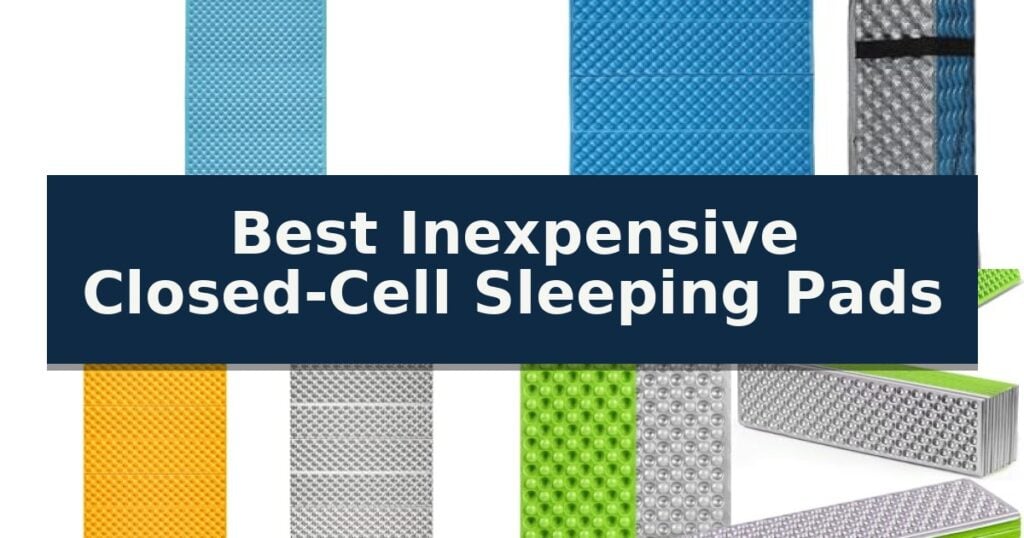
10 Best Inexpensive Closed-Cell Sleeping Pads in 2026 Reviews
Quick Comparison
| Product | Best For | Key Strength | Score |
|---|---|---|---|
| Therm-a-Rest Z Lite Sol Sleeping Pad | Best Overall | Accordion-style folding design for rapid setup and packability. | 4.9 |
| REDCAMP Foldable Foam Sleeping Pad | Versatile multi-season trail performer | Puncture-resistant closed-cell foam eliminates the risk of leaks common with inflatable pads. | 4.6 |
| Featherstone Outdoor El Cordion Sleeping Pad | Enhanced coverage with hexagonal nodes | Puncture-proof design ensures the pad will not deflate during use. | 4.9 |
| THINTON Foldable Foam Camping Mattress | Budget-friendly heat reflective design | Heat-reflective aluminum film enhances thermal insulation with a 2.1 rating. | 4.4 |
| Fitply Ultralight Foam Sleeping Pad | Lightweight choice for compact storage | Ultra-lightweight 0.7 lb design for easy transport. | 4.7 |
| Qunature Foam Camping Sleeping Pad | Plush egg-crate pressure relief | Puncture-proof closed-cell foam construction ensures no risk of deflation. | 4.5 |
| Stansport Pack Lite Sleeping Pad | Classic puncture-proof roll-up design | Waterproof and puncture-proof closed-cell foam construction | 4.6 |
| Wakeman Outdoors Foam Sleeping Pad | Thick cushioning for extra comfort | Waterproof NBR foam construction provides essential insulation from cold and damp ground. | 4.6 |
| FlexRest Foam Fold Sleeping Pad | Durable build for rugged conditions | Ultra-lightweight construction weighing less than 12 ounces. | 4.6 |
| FOCHIER F Foam Camping Pad | Efficient heat-reflecting surface | Aluminum film coating for enhanced heat reflection and warmth. | 4.5 |
How We Chose
Evaluating closed-cell sleeping pads requires a focus on material resilience and thermal performance. As an experienced reviewer, I prioritize pads that offer a consistent R-value and structural integrity under heavy use. By comparing foam density, node geometry, and weight, I identify which options provide the most reliable insulation for backcountry conditions without unnecessary bulk.
- Insulation efficiency measured by R-value ratings
- Weight-to-warmth ratio for long-distance portability
- Durability of foam material against compression and abrasion
- Packability and folding mechanism efficiency
- Surface texture and node design for pressure relief
1 Therm-a-Rest Z Lite Sol Sleeping Pad — Gold standard for reliable insulation
The Therm-a-Rest Z Lite Sol Sleeping Pad distinguishes itself through a unique accordion-style folding design that allows for rapid deployment and compact storage. This closed-cell foam mattress is engineered for backpackers and mountaineers who require a reliable, lightweight foundation for sleeping on the ground without the complexity of inflatable alternatives.
Performance is driven by the integration of a reflective ThermaCapture coating and specialized heat-trapping dimples. These features work in tandem to capture radiant body heat, which the manufacturer notes increases overall warmth by 20 percent, resulting in an R-Value of 2.0. The construction utilizes a dual-density foam approach: the top layer is softer for enhanced comfort, while the bottom layer is denser to provide durability and insulation against uneven or cold terrain.
Weighing only 14 ounces, the pad is designed for efficiency in the field. When fully expanded, it measures 72 x 20 inches, providing a standard surface area for most users. When folded, it collapses into a 20 x 5 x 5.5-inch package, making it easy to strap to the exterior of a pack. The product is manufactured in the USA and backed by a limited lifetime manufacturer warranty.
While the Therm-a-Rest Z Lite Sol Sleeping Pad offers a dependable, puncture-proof surface, users should note that its comfort profile is defined by its closed-cell foam structure rather than the plush feel of air-filled pads. It serves as a robust, maintenance-free option that eliminates concerns regarding leaks or valve failure during extended outdoor excursions.
Best for: Backpackers and mountaineers seeking a lightweight, puncture-proof, and reliable insulation layer for three-season use.
Skip if: Users who prioritize maximum cushioning or a plush sleeping surface will likely prefer an inflatable sleeping pad.
- Accordion-style folding design for rapid setup and packability.
- ThermaCapture reflective coating increases radiant heat retention.
- Dual-density foam construction balances comfort with ground protection.
- Puncture-proof closed-cell design requires no maintenance.
- Firm foam construction offers less cushioning than inflatable pads.
- Bulky folded footprint compared to ultralight inflatable alternatives.
2 REDCAMP Foldable Foam Sleeping Pad — Versatile multi-season trail performer
The REDCAMP Foldable Foam Sleeping Pad distinguishes itself through a triple-panel accordion design that allows for rapid deployment and compact storage, making it a practical choice for hikers who prioritize efficiency. Unlike inflatable options that require inflation time or risk puncture-related failure, this pad utilizes a closed-cell IXPE foam structure that remains functional even if the surface is scuffed or punctured by trail debris.
Engineered for versatile thermal management, the pad features an R-Value of 2.1, providing a reliable barrier against cold ground temperatures ranging from -5°C to 35°C. The surface is enhanced with ventilation grooves to promote airflow during warmer conditions, while the reflective heat-trapping layer works to retain body warmth when temperatures drop.
Beyond its primary use as a sleeping surface, the REDCAMP Foldable Foam Sleeping Pad offers significant utility through its waterproof and tear-resistant construction. It can function as a makeshift seat cushion or protective ground cover for gear repairs, and the modular side loops allow for secure attachment to backpacks or integration with other pads for group camping setups.
Designed to support up to 200 lbs without significant compression loss, the pad maintains its structural integrity over time. Its non-slip textured surface helps stabilize sleeping positions, while the UV-resistant material ensures the foam does not degrade prematurely when exposed to direct sun during long-distance treks.
Best for: Backpackers and campers seeking a lightweight, puncture-proof, and multi-functional insulation layer for three-season outdoor use.
Skip if: Users requiring a high R-value for extreme winter mountaineering or those who prioritize maximum cushioning over the firm support provided by closed-cell foam.
- Puncture-resistant closed-cell foam eliminates the risk of leaks common with inflatable pads.
- Triple-panel accordion folding allows for quick setup and efficient packing.
- Versatile multi-season thermal performance with an R-value of 2.1.
- Multipurpose design serves as a seat, ground cover, or gear protector.
- Firm foam construction may not provide the same level of plush cushioning as air-filled alternatives.
- Fixed dimensions of 72 inches by 22 inches may be restrictive for taller or larger users.
3 Featherstone Outdoor El Cordion Sleeping Pad — Enhanced coverage with hexagonal nodes
Reliability in the backcountry often comes down to gear that refuses to fail, and the Featherstone Outdoor El Cordion Sleeping Pad addresses this by utilizing a closed-cell foam design that eliminates the risk of mid-trip deflation. Unlike inflatable alternatives, this mat provides a consistent, puncture-proof barrier between you and the ground, ensuring that your sleep system remains functional even on jagged terrain where air pads might be compromised.
The pad features hexagonal nodes engineered to provide 40% more coverage and height than traditional egg-shell designs. This structural choice enhances support for the back while maintaining a plush feel, ensuring that the closed-cell foam remains resilient over extended use. By increasing the surface area and loft, these nodes help distribute weight more effectively, which can be a significant advantage for side sleepers or those who find standard flat foam mats too firm for comfort.
Thermal efficiency is managed through irradiation cross-linked polyethylene foam paired with a dual-density heat reflective film. This combination achieves an ASTM F3340 rated R-value of 2.1, which is specifically tested to trap and circulate body heat in varied backcountry conditions. This rating provides a standardized metric for warmth, allowing hikers to better predict the pad's performance in three-season environments compared to unrated alternatives.
Designed for portability, the mat weighs approximately 1 pound, making it a practical choice for ultralight backpacking and thru-hiking where every ounce counts. While the folded footprint is inherently bulkier than an inflatable pad, the trade-off is a setup that requires zero inflation time and offers immediate, reliable insulation. The manufacturer also includes a limited lifetime warranty, covering defects in materials and workmanship for the original owner, which underscores the brand's commitment to long-term product durability.
Best for: Backpackers and thru-hikers who prioritize gear reliability and puncture resistance over the compact packability of inflatable pads.
Skip if: Campers who require a higher R-value for extreme cold or those who prioritize a minimal packed size, as closed-cell foam pads remain bulky even when folded.
- Puncture-proof design ensures the pad will not deflate during use.
- ASTM F3340 rated R-value of 2.1 provides verified thermal insulation.
- Hexagonal node geometry offers increased loft and support compared to standard foam mats.
- Limited lifetime warranty covers manufacturing defects.
- Bulky folded footprint compared to inflatable sleeping pads.
- Fixed R-value of 2.1 may not be sufficient for sub-freezing winter camping.
4 THINTON Foldable Foam Camping Mattress — Budget-friendly heat reflective design
For those prioritizing weight savings and thermal efficiency, the THINTON Foldable Foam Camping Mattress offers a specialized design that leverages an aluminum-coated surface to enhance heat retention. By utilizing a closed-cell structure, this mat provides a consistent barrier against cold ground surfaces, making it a practical choice for backpackers who need to balance pack weight with insulation.
The THINTON Foldable Foam Camping Mattress is constructed from IXPE material and features an integrated heat-reflective aluminum film on the back. This combination is engineered to capture body heat and circulate warmth, resulting in a standard-tested insulation rating of 2.1. With an open size of 72.8 by 23.6 inches and a weight of approximately 396 grams, it is designed to support pressure points while remaining highly portable.
Usability is centered on its foldable architecture, which collapses into a compact 23.6 by 5.5 by 5.5-inch profile. This design choice allows for quick deployment and storage during trekking or outdoor excursions. The material is also noted for being waterproof, moisture-proof, and corrosion-resistant, ensuring it remains functional in various outdoor environments without absorbing water.
While the THINTON Foldable Foam Camping Mattress excels in portability and insulation, users should note its 0.7-inch thickness. This profile is optimized for weight-conscious travel rather than maximum plushness, representing a standard trade-off for ultralight closed-cell pads.
Best for: Ultralight backpackers and thru-hikers who require a lightweight, moisture-resistant pad with a reliable insulation rating for cold-ground sleeping.
Skip if: Campers who prioritize maximum cushioning or plush comfort over weight savings and packability, as the 0.7-inch thickness may not provide sufficient support for all sleeping positions.
- Heat-reflective aluminum film enhances thermal insulation with a 2.1 rating.
- Ultralight 396-gram weight minimizes pack load for long-distance trekking.
- Waterproof and moisture-proof IXPE material prevents water absorption.
- Foldable design allows for rapid setup and compact storage.
- Limited 0.7-inch thickness may be less comfortable for side sleepers compared to inflatable alternatives.
5 Fitply Ultralight Foam Sleeping Pad — Lightweight choice for compact storage
Reliable thermal management in the backcountry often hinges on the simplicity of your gear. The Fitply Ultralight Foam Sleeping Pad utilizes an XPE foam construction that eliminates the risk of deflation, ensuring a consistent barrier between you and the ground throughout your trip.
Designed with an ergonomic node pattern, this pad features alternating high and low sections that provide targeted support while allowing the mat to fold into a compact 23.6 x 5.6 x 4.9-inch footprint. This folding design is specifically engineered for efficient packing, making it a practical choice for hikers who prioritize space-saving equipment.
The pad incorporates a heat-reflective aluminum film bonded to the foam, which works to reflect body heat back toward the sleeper. With a tested insulation rating of 2.1, it offers a functional level of thermal resistance for three-season camping, effectively blocking ground moisture and cold.
Weighing only 0.7 lbs, the Fitply Ultralight Foam Sleeping Pad is built for portability. Its moisture-proof surface and durable foam core provide a stress-free alternative to inflatable mattresses, as it requires no setup time and remains functional even if the surface is punctured or scuffed during rugged use.
Best for: Backpackers and campers who require a lightweight, puncture-proof sleeping surface that offers reliable insulation and rapid setup.
Skip if: Users who prioritize maximum cushioning or a plush sleeping surface will likely find the 0.36-inch thickness of this closed-cell foam pad insufficient compared to thicker air-filled mattresses.
- Ultra-lightweight 0.7 lb design for easy transport.
- Heat-reflective aluminum film improves thermal efficiency.
- Puncture-proof XPE foam construction prevents deflation issues.
- Compact folding design allows for efficient storage.
- Thin 0.36-inch profile offers less cushioning than inflatable alternatives.
- Fixed dimensions may not accommodate all sleeping styles or tent footprints.
6 Qunature Foam Camping Sleeping Pad — Plush egg-crate pressure relief
Reliability in the backcountry often comes down to simplicity, and the Qunature Foam Camping Sleeping Pad prioritizes this by utilizing a closed-cell XPE foam construction that eliminates the risk of deflation common with air-filled alternatives. This design choice ensures consistent insulation and structural integrity, making it a dependable choice for hikers who need gear that performs on rugged or damp terrain without requiring maintenance.
The pad features an egg-crate pattern that provides 20mm of plush support, creating a series of peaks and valleys designed to distribute weight and relieve pressure points. This structural design is particularly beneficial for side sleepers who require additional cushioning to maintain comfort throughout the night. With an R-value of 1.8, the mat is engineered for three-season use, offering sufficient thermal resistance to reduce heat loss on cool ground while remaining breathable enough to prevent overheating.
Portability is a primary advantage of this model, as it weighs only 337g and utilizes a foldable design for rapid deployment and storage. Its moisture-proof surface allows it to be used directly on damp ground, serving as a versatile piece of equipment that functions equally well as a tent mattress, a yoga mat, or a picnic cushion. The manufacturer includes a 2-year warranty, underscoring the durability of the materials used in its construction.
While the pad excels in weight and reliability, its physical dimensions and foam-based comfort profile represent a distinct trade-off compared to inflatable mattresses. Users should consider that the folded footprint, while compact, remains fixed in size and does not compress as small as a vacuum-packed air pad, which may influence packing strategies for those with limited backpack volume.
Best for: Backpackers and campers seeking a lightweight, puncture-proof, and low-maintenance sleeping surface for three-season use.
Skip if: Users who require a high-loft, plush sleeping surface or those who need an extremely compact, packable form factor that fits inside small internal-frame packs.
- Puncture-proof closed-cell foam construction ensures no risk of deflation.
- Ultralight 337g weight makes it ideal for long-distance backpacking.
- Egg-crate pattern provides effective pressure relief for side sleepers.
- Moisture-proof material allows for reliable use on damp ground.
- Fixed folded dimensions occupy more external pack space than inflatable alternatives.
- R-value of 1.8 is limited to three-season use and may not provide enough insulation for extreme winter conditions.
7 Stansport Pack Lite Sleeping Pad — Classic puncture-proof roll-up design
Reliable thermal management in the backcountry often comes down to the simplicity of closed-cell foam, and the Stansport Pack Lite Sleeping Pad offers a straightforward solution for insulating against cold and damp ground. Designed with a focus on portability, this mat provides a consistent barrier between the sleeper and the surface, ensuring that ground temperatures do not compromise overnight comfort.
Measuring 72 by 19 by 3/8 inches, this pad provides a full-length surface area suitable for most backpackers. Because it is constructed from closed-cell foam insulation, the material is inherently waterproof and puncture-proof, eliminating the risk of leaks that can plague inflatable alternatives. This design choice ensures that the pad remains functional even if it encounters sharp rocks or debris on the trail.
The Stansport Pack Lite Sleeping Pad features a roll-up portable design, making it easy to secure to the exterior of a pack. The inclusion of dedicated straps simplifies storage and transit, keeping the pad tightly coiled when not in use. This lightweight construction is intended for hikers who prioritize gear that is easy to manage and maintain during long treks.
Backed by a one-year warranty against manufacturer defects, this pad serves as a durable, low-maintenance option for outdoor enthusiasts. While it lacks the plush thickness of air-filled mattresses, its primary strength lies in its ability to provide reliable, consistent insulation without the need for inflation or complex setup.
Best for: Backpackers and hikers who need a lightweight, puncture-proof, and low-maintenance insulation layer for sleeping on uneven or damp terrain.
Skip if: Users who prioritize a soft, cushioned sleeping surface or those who require a highly compact, compressible pad that fits inside a small daypack.
- Waterproof and puncture-proof closed-cell foam construction
- Lightweight and portable roll-up design
- Includes integrated straps for easy transport
- Provides reliable insulation from cold and dampness
- Fixed 3/8-inch thickness offers less cushioning than inflatable pads
8 Wakeman Outdoors Foam Sleeping Pad — Thick cushioning for extra comfort
The Wakeman Outdoors Foam Sleeping Pad provides a foundational layer of insulation for outdoor sleeping, utilizing a 0.75-inch-thick NBR foam construction to separate the user from cold or damp ground surfaces. This closed-cell design is inherently waterproof, preventing moisture absorption while maintaining thermal efficiency during overnight stays in tents or on cots.
Measuring 72 inches in length and 24 inches in width, the pad offers a standard footprint suitable for various sleeping arrangements. The material features a non-slip texture designed to stabilize the pad during use, reducing movement on smooth surfaces like RV floors or gym mats. When not in use, the pad rolls into a compact 9-inch-tall cylinder, weighing only 3 pounds for easier transport.
Versatility remains a core design element, as the pad functions effectively as a standalone floor mat, a base for camping, or an added layer of cushioning for RV mattresses. The included carrying strap secures the rolled foam, facilitating storage and portability for those moving between campsites or fitness activities.
While the 0.75-inch thickness provides a barrier against hard surfaces, it is optimized for portability rather than extreme plushness. Users should note that as a foam-based product, its primary utility is providing a consistent, insulating surface rather than the high-loft support found in inflatable alternatives.
Best for: Outdoor enthusiasts and campers seeking a lightweight, waterproof, and versatile insulation layer for use on cots, in tents, or as a portable exercise mat.
Skip if: Individuals requiring significant thickness or high-loft cushioning for pressure-point relief may find this 0.75-inch foam pad insufficient compared to thicker inflatable or self-inflating mattresses.
- Waterproof NBR foam construction provides essential insulation from cold and damp ground.
- Non-slip texture enhances stability on various surfaces including cots and tent floors.
- Lightweight and portable design rolls to 9 inches for convenient storage and transport.
- Multipurpose utility suitable for camping, RV mattress topping, or fitness activities.
- Limited thickness of 0.75 inches may not provide enough cushioning for those seeking high-loft comfort.
9 FlexRest Foam Fold Sleeping Pad — Durable build for rugged conditions
Finding reliable insulation against cold, uneven ground is essential for a comfortable night outdoors, and the FlexRest Foam Fold Sleeping Pad addresses this by utilizing high-density closed-cell XPE foam. This material choice provides a consistent barrier between your body and the terrain, ensuring that you remain insulated from the chill of the earth regardless of the season. The pad is engineered for versatility, featuring a water-resistant design that maintains its structural integrity even during rugged outdoor use.
Portability is a central design focus for this gear, as the pad folds down quickly for efficient packing and transport. Weighing less than 12 ounces, it is built to minimize your total pack weight without sacrificing the necessary support required for camping or backpacking. This lightweight profile makes it a practical choice for those who need to move quickly on the trail while still maintaining a dependable sleep system that can withstand repeated use in demanding environments.
Measuring 73 inches in length and 23.7 inches in width, the FlexRest Foam Fold Sleeping Pad offers a substantial surface area for rest. Its 0.78-inch thickness provides a functional cushion that balances comfort with a compact, low-profile footprint. This pad serves as a straightforward, no-nonsense solution for hikers and campers who prioritize weight savings and long-term durability over the bulkier, more complex setup of inflatable alternatives.
Best for: Backpackers and campers who prioritize an ultra-lightweight, durable, and reliable insulation layer for all-season use.
Skip if: Users who require a thick, inflatable pad for maximum cushioning or those who prefer a compact roll-up design over a folding configuration.
- Ultra-lightweight construction weighing less than 12 ounces.
- High-density closed-cell XPE foam provides effective insulation.
- Durable, water-resistant design suitable for rugged conditions.
- Quick-folding format for efficient packing and storage.
- Fixed 0.78-inch thickness may be too firm for some users compared to inflatable options.
10 FOCHIER F Foam Camping Pad — Efficient heat-reflecting surface
The FOCHIER F Foam Camping Pad utilizes an integrated aluminum film coating to act as an efficient heat reflector, significantly enhancing thermal retention during outdoor use without adding unnecessary weight. This design choice addresses the primary need for insulation in lightweight sleeping systems while maintaining a compact, portable form factor.
Engineered with a Peanut shape and an accordion-style folding mechanism, this pad is designed for space-efficient storage. The peaks and valleys of the surface are structured to nest together when folded, which helps in reducing the overall volume of the gear when packed into a backpack.
Constructed from lightweight IXPE foam, the material provides a cushioned surface that supports pressure points during sleep. Unlike inflatable alternatives, this closed-cell construction ensures the pad will not deflate, offering a dependable, puncture-resistant foundation for camping, hammock use, or as an additional layer of protection for an inflatable mattress.
This moisture-proof mat is built for durability and ease of maintenance. The aluminum-coated surface is designed to be more moisture-resistant and easier to clean than traditional foam models, making it a practical choice for various outdoor environments where ground moisture is a concern.
Best for: Backpackers and campers seeking a lightweight, puncture-proof, and moisture-resistant sleeping surface that provides reliable insulation.
Skip if: Users who require the plush, adjustable comfort of an inflatable air mattress or those who need a thicker profile for sleeping on extremely uneven or rocky terrain.
- Aluminum film coating for enhanced heat reflection and warmth.
- Closed-cell IXPE foam construction that cannot deflate.
- Accordion-style folding design for space-saving storage.
- Moisture-proof surface that is easy to clean.
- Fixed-thickness foam design may not provide the same cushioning as inflatable pads.
Best Inexpensive Closed-Cell Sleeping Pads Buying Guide
Understanding R-Value in Foam
The R-value represents a pad's ability to resist heat flow, which is critical when sleeping on cold ground. Most closed-cell foam pads provide modest insulation, typically ranging from 1.8 to 2.1, which is sufficient for three-season use.
Reflective coatings, often made of aluminum film, significantly enhance this performance by bouncing body heat back toward the sleeper. This simple addition allows thinner pads to provide warmth comparable to much bulkier alternatives.
Material Density and Comfort
Closed-cell foam is inherently firmer than air-filled mattresses, providing a stable surface that does not shift or bounce. High-density foam is preferred for its ability to maintain its shape over time, resisting the compression that often plagues cheaper, softer materials.
The surface texture, often referred to as an egg-crate or node design, is essential for comfort. These peaks and valleys create air pockets that trap warmth and provide a degree of pressure relief for your shoulders and hips.
Portability and Folding Mechanisms
Accordion-style folding pads are generally more compact than traditional roll-up designs. They allow for quick setup and breakdown, and the folded shape often fits more securely against the exterior of a backpack.
Roll-up pads are a classic alternative that can be more durable due to their simple, one-piece construction. While they may be slightly more cumbersome to strap to a pack, they offer a continuous surface without the potential for hinge wear.
Weight Considerations for Backpacking
Every ounce counts on the trail, and closed-cell pads are among the lightest options available. Most standard-length pads weigh between 10 and 15 ounces, making them an excellent choice for weight-conscious hikers.
When comparing weights, ensure you are looking at the full-length version. Some ultra-lightweight options achieve their low weight by being shorter, which may require you to use your pack or extra clothing to support your feet.
Durability and Maintenance
One of the primary benefits of closed-cell foam is its near-indestructibility. Unlike inflatable pads, these will not fail if they encounter a sharp rock or thorn, making them the most reliable choice for rugged environments.
Maintenance is minimal, requiring only an occasional wipe-down to remove dirt and moisture. Because the foam is closed-cell, it does not absorb water, which prevents the pad from becoming heavy or developing mildew after exposure to damp conditions.
Frequently Asked Questions
Do closed-cell pads provide enough comfort for side sleepers?
While firmer than air pads, many modern foam pads use egg-crate or hexagonal node designs to provide enough cushioning for side sleepers. However, those who require significant plushness may find them less forgiving.
Can I use a closed-cell pad in winter?
Most closed-cell pads are designed for three-season use. In deep winter, they are often used as a base layer underneath an inflatable pad to provide both extra insulation and a puncture-proof barrier.
How do I clean my foam sleeping pad?
Simply wipe the surface with a damp cloth and mild soap if necessary. Avoid using harsh chemicals or abrasive brushes that could damage the foam or the reflective coating.
Are these pads waterproof?
Yes, the closed-cell structure prevents the material from absorbing water, making them naturally moisture-proof and ideal for use on damp ground or snow.
What is the advantage of the accordion fold over rolling?
The accordion fold allows the pad to pack into a smaller, more rectangular shape that is easier to manage. It also allows the pad to nest its own nodes, which protects the surface from wear during transport.
Conclusion: Our Top Pick
Our top pick is Therm-a-Rest Z Lite Sol Sleeping Pad. Selecting the right closed-cell pad comes down to balancing your need for thermal insulation with the physical constraints of your pack. For most hikers, a pad with a reflective coating and a durable, high-density foam construction offers the best return on investment.
By choosing a model that fits your specific terrain needs, you gain a piece of gear that will last for years. These pads remain the most reliable insurance policy against a cold, uncomfortable night in the backcountry.