 critical cactus
TerraMaster F2-212 NAS earns our recommendation for the Best Large Backup Storage Solutions thanks to its robust integration with diverse backup applications and cross-platform file services that simplify data management for home and SOHO environments.
For users requiring direct-attached expansion, the TerraMaster D5-310 HDD Enclosure provides a high-capacity hardware RAID solution that supports up to 120TB, while the OWC Express 1M2 80G NVMe SSD serves those needing extreme transfer speeds for professional creative workflows.
Selecting the right storage involves balancing capacity needs against your specific network or direct-connection requirements. While NAS units offer centralized access for multiple users, direct-attached enclosures prioritize raw speed and simple, driver-free operation for individual workstations.
If you are managing your storage through a computer, you may also be interested in Best Laptops with Upgradeable Storage to ensure your primary machine can keep pace with your data growth.
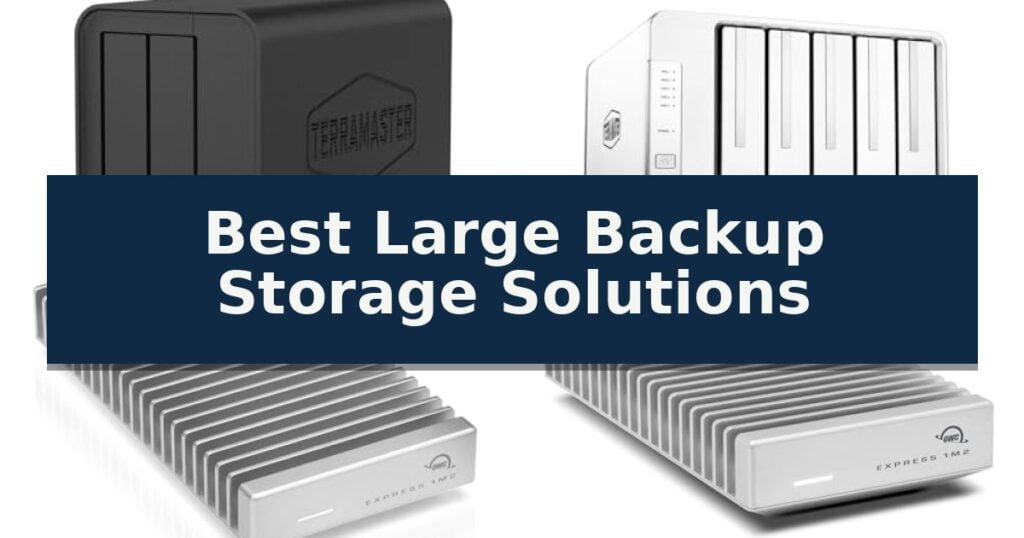
8 Best Large Backup Storage Solutions in 2026 Reviews
Quick Comparison
| Product | Best For | Key Strength | Score |
|---|---|---|---|
| TerraMaster F2-212 NAS | Best Overall | Powerful 4K video hardware decoding for multimedia streaming. | 4.9 |
| TerraMaster D5-310 HDD Enclosure | Massive Multi-Drive Direct Storage | Massive 120TB capacity support using five drive bays. | 4.3 |
| OWC Express 1M2 NVMe SSD | Ultra-Fast Portable Data Transfers | Patented heat-dissipating design for consistent performance. | 4.3 |
| OWC Express 1M2 80G NVMe SSD | Pro-Level Speed for Creative Work | Peak speeds exceeding 6000MB/s for rapid data transfer. | 4.9 |
| ThePhotoStick Omni Backup Drive | Automated Multi-Device Photo Archiving | Multi-device compatibility with integrated USBA, USBC, microUSB, and Lightning ports. | 4.3 |
| Picture Keeper Connect Backup Drive | Simple Mobile Media Preservation | Multi-device compatibility with Lightning, USB-C, Micro USB, and USB connectors. | 4.7 |
| Skiddrive Dual USB Flash Drive | Compact Cross-Platform File Backup | Dual USB-A and Type-C connectors for cross-platform compatibility. | 4.7 |
| Generic Portable External SSD | Budget-Friendly Everyday Data Storage | Wide compatibility across Windows, macOS, Linux, and Android OTG devices. | 4.8 |
How We Chose
When evaluating storage for large-scale data archiving, an experienced reviewer prioritizes hardware reliability and software flexibility. We analyze these devices based on their ability to handle massive file volumes, the efficiency of their RAID management systems, and how seamlessly they integrate into existing network or workstation environments to ensure consistent, long-term data protection.
- Total storage capacity and drive bay scalability
- Interface speed and connection compatibility
- RAID configuration support and data redundancy
- Software integration for automated backup scheduling
- Cross-platform compatibility across Windows, macOS, and Linux
1 TerraMaster F2-212 NAS — Private Cloud for Home Backups
Managing digital assets requires a reliable foundation, and the TerraMaster F2-212 NAS offers a dedicated home network storage solution designed for efficiency. Built with an ARM v8 quad-core 1.7GHz CPU and 1GB of RAM, this unit provides the necessary processing power to serve as a centralized multimedia hub, featuring 4K video hardware decoding and compatibility with uPnP/DLNA protocols.
This 2-bay system is engineered for versatility, supporting a wide range of SATA HDD and SSD configurations. With support for up to 24TB per bay, users can achieve a total capacity of 64TB in RAID 0, making it a substantial option for those needing significant space. The device runs on the TOS 7 operating system, which simplifies management through a visual interface.
For data protection, the TerraMaster F2-212 NAS integrates with multiple backup applications, including Duple Backup, TSSS, TFM Backup, and CloudSync. These tools provide robust methods to secure information across various network environments. The system also supports comprehensive across-platform file services, such as SMB, NFS, SFTP/FTP, AFP, iSCSI, and WebDAV, ensuring broad compatibility with different operating systems.
Installation is streamlined through online tutorials and a Default mode that automatically configures the system for home use. While the hardware is optimized for performance, the 1GB RAM is not upgradeable, which is a trade-off to consider for users anticipating future expansion of their software workload. The unit remains compact, measuring approximately 8.7 inches in length and weighing 4.6 pounds, allowing it to fit easily into most home office setups.
Best for: Home and SOHO users looking for a centralized, high-capacity private cloud storage solution with robust backup integration.
Skip if: Users who require upgradeable RAM or high-performance computing power for intensive virtualization or heavy multitasking workloads.
- Powerful 4K video hardware decoding for multimedia streaming.
- Extensive backup application support including Duple Backup and CloudSync.
- High storage capacity supporting up to 64TB in RAID 0.
- Broad file service compatibility across SMB, NFS, and iSCSI protocols.
- Non-upgradeable 1GB RAM limits future performance scaling.
- Diskless design requires separate purchase of compatible hard drives.
2 TerraMaster D5-310 HDD Enclosure — Massive Multi-Drive Direct Storage
Managing massive datasets requires reliable hardware, and the TerraMaster D5-310 HDD Enclosure simplifies this by offering a 5-bay hardware RAID system that supports up to 120TB of total storage. By utilizing a dedicated physical knob on the rear of the unit, users can switch between RAID 5, 0, 1, 10, and Single modes without relying on software-based configurations, ensuring consistent performance and simplified management.
Data transfer speeds are a primary focus for this unit, which utilizes a USB 3.1 Gen 1 interface to achieve transfer rates up to 5Gbps. With actual read and write speeds reaching 220MB/s, the device is engineered to handle demanding workflows, allowing for the rapid movement of large files. The enclosure is designed for broad compatibility, functioning seamlessly with Windows, macOS, and Linux systems without the need for additional drivers.
The physical design prioritizes both convenience and long-term hardware health. It features tool-free drive bays that accommodate 3.5-inch SATA HDDs, 2.5-inch SATA HDDs, and SSDs, making drive installation or replacement straightforward. To maintain operational efficiency, the unit includes temperature-controlled fans and a hard drive sleep mode, which help manage thermal output and power consumption during extended use.
For users focused on data redundancy, the hot spare disk feature provides an automated layer of security by replacing failed drives in RAID 1, 5, or 10 configurations. Additionally, the package includes TPC Backupper, a tool designed for Windows environments that supports scheduled, incremental, and differential backups, providing a comprehensive solution for maintaining data integrity.
Best for: Users requiring a high-capacity, multi-drive storage solution with hardware-level RAID for cross-platform compatibility.
Skip if: Users who require network-attached storage (NAS) functionality or remote access capabilities, as this is a direct-attached storage device.
- Massive 120TB capacity support using five drive bays.
- Hardware RAID control via a dedicated physical knob.
- Tool-free drive installation for quick setup and maintenance.
- Broad OS compatibility across Windows, macOS, and Linux.
- Direct-attached storage only, lacking network connectivity features.
3 OWC Express 1M2 NVMe SSD — Ultra-Fast Portable Data Transfers
The OWC Express 1M2 2TB USB4 40Gb/s Portable NVMe SSD Storage Solution distinguishes itself with a patented heat-dissipating design that maintains consistent performance while protecting the internal drive. This palm-sized storage unit is engineered for high-speed data transfers, reaching real-world speeds of up to 3836MB/s, which is notably faster than standard Thunderbolt portable enclosures.
Designed for versatility, this solution is compatible with USB4, Thunderbolt, and USB-C devices. The enclosure is built from solid aluminum, which serves the dual purpose of providing rugged physical protection and acting as a passive cooling system to prevent thermal throttling during intensive file operations.
The OWC Express 1M2 NVMe SSD features a flexible DIY approach, allowing users to install their preferred NVMe M.2 2280, 2242, or 2230 SSDs. The package includes a 40Gb/s USB-C cable and the necessary screwdriver, ensuring that the setup process is straightforward for those who prefer to manage their own storage media.
As a bus-powered device, it eliminates the need for external power adapters, making it a highly portable option for users who require large-capacity storage on the go. The product is backed by a 2-year warranty for the enclosure or a 3-year warranty when purchased as a complete solution.
Best for: Professionals and creators who require high-speed, portable NVMe storage that supports multiple connection standards like USB4 and Thunderbolt.
Skip if: Users who do not have devices with USB4 or Thunderbolt ports will not be able to utilize the full speed capabilities of this enclosure.
- Patented heat-dissipating design for consistent performance.
- Broad compatibility with USB4, Thunderbolt, and USB-C.
- Flexible DIY support for various M.2 SSD form factors.
- Bus-powered portability in a compact aluminum chassis.
- Performance limited by the host device's connection standard.
- Requires manual assembly for users choosing their own SSD.
4 OWC Express 1M2 80G NVMe SSD — Pro-Level Speed for Creative Work
The OWC Express 1M2 80G 2TB USB4 80Gb/s Portable NVMe SSD Storage Solution is engineered for high-demand data environments, delivering peak real-world speeds exceeding 6000MB/s. This performance is achieved through a bus-powered design that leverages USB4 and Thunderbolt connectivity, making it a capable tool for both daily data management and professional creative workflows.
Designed with a focus on thermal management, the drive features a patented heat-dissipating aluminum chassis. This structure provides rugged protection for the internal SSD while maintaining silent operation, ensuring consistent speed during sustained read and write operations. The unit is compact, measuring approximately 5.2 inches in length and weighing less than a pound, which aids in portability without sacrificing structural integrity.
Flexibility is a core component of the drive's architecture, as it supports PCIe Gen 3.0, 4.0, and 5.0 NVMe M.2 SSDs. Users can opt for a ready-to-run configuration or a DIY approach, with the ability to future-proof the device by upgrading to higher capacity or faster 2280 or 2242 form factor drives. Compatibility extends across various platforms, including Macs, PCs, iPad Pros, Chromebooks, and Surface devices.
The drive is backed by a 5-year limited warranty, reflecting its construction and intended use in professional settings. While it supports high-performance PCIe Gen 5 SSDs, users should note that these drives require careful selection to remain within the bus-power limits of host computers and hubs, with a recommended power consumption of 11 watts or less during sustained use.
Best for: Creative professionals and power users requiring high-speed, portable NVMe storage that is easily upgradeable.
Skip if: Users who do not have USB4 or Thunderbolt-compatible hardware or those who require massive multi-terabyte capacity beyond current M.2 SSD limits.
- Peak speeds exceeding 6000MB/s for rapid data transfer.
- Patented silent cooling design using solid aluminum for thermal management.
- Future-proof upgradeability supporting PCIe Gen 3.0, 4.0, and 5.0 NVMe M.2 SSDs.
- Broad compatibility with Macs, PCs, iPad Pros, and other modern host devices.
- Bus-power limitations require careful selection of high-performance PCIe Gen 5 SSDs to ensure stability.
5 ThePhotoStick Omni Backup Drive — Automated Multi-Device Photo Archiving
Managing a growing collection of digital media across multiple platforms requires a streamlined approach to data preservation. The ThePhotoStick Omni Backup Drive simplifies this process by automatically identifying and securing photos, videos, and various files from your devices, ensuring your digital library remains organized and accessible.
Designed for broad compatibility, this storage solution supports PC, Mac, iPhone, iPad, and most Android devices. It includes integrated USBA, USBC, microUSB, and Lightning connections, allowing it to bridge the gap between different hardware ecosystems without needing multiple cables or complex transfer software.
With a 128GB capacity, this drive is capable of holding over 51,000 images and videos. The system utilizes a dedicated app to guide users through the backup process, supporting common file formats including JPEG, PNG, HEIC, GIF, MOV, and MPEG4 to ensure your diverse media collection is captured effectively.
The device is built for portability and ease of use, measuring just 4 inches in length and weighing a fraction of a pound. Whether you are archiving seasonal family events or consolidating files from various tablets and phones, it provides a centralized repository for your digital milestones.
Best for: Users who need a single, portable storage device to consolidate and back up media from a mix of mobile devices and computers.
Skip if: Users requiring high-performance, high-capacity network-attached storage (NAS) or those needing terabytes of space for professional-grade video editing projects.
- Multi-device compatibility with integrated USBA, USBC, microUSB, and Lightning ports.
- Automatic backup functionality via a dedicated app.
- Supports a broad range of file formats including HEIC and MOV.
- Compact and lightweight design for easy transport.
- 128GB capacity may be insufficient for users with massive high-resolution video libraries.
- Requires specific OS versions (Android 8.0+, iOS 13.0+, Windows 7 SP1+, or macOS 10.13+) for operation.
6 Picture Keeper Connect Backup Drive — Simple Mobile Media Preservation
Managing digital clutter across multiple devices often requires a streamlined approach to data preservation. The Picture Keeper Connect Backup Drive addresses this by providing a dedicated hardware solution that functions across iPhone, Android, Mac, and PC platforms without requiring an internet connection or cloud subscription.
This 128GB external storage device simplifies the backup process through a three-step application interface. By utilizing a multi-connector design featuring Lightning, USB-C, Micro USB, and standard USB interfaces, it facilitates direct transfers from mobile devices and computers. The system is engineered to store up to 32,000 photos, effectively acting as a bridge to free up internal device memory.
Beyond basic file storage, the drive includes integrated software tools designed for media management. These features include AI-powered batch scanning for digitizing physical memories and a Magic Erase function intended to remove unwanted objects from images. The setup process is entirely local, ensuring that backups remain on the physical drive rather than being uploaded to remote servers.
Compatibility is broad, supporting iOS 12 and newer, Android 5 and newer, Windows 7 and newer, and Mac OS 10.3 and newer. The unit is backed by a 1-year manufacturer warranty, providing a standardized support window for the hardware. This device is suited for users seeking a physical, offline method to consolidate media libraries from disparate hardware ecosystems.
Best for: Users who need an offline, multi-platform backup solution to transfer and store photos and contacts from mobile devices and computers.
Skip if: Users who require massive storage capacities exceeding 128GB or those who prefer automated, continuous cloud-based synchronization services.
- Multi-device compatibility with Lightning, USB-C, Micro USB, and USB connectors.
- No internet or cloud required for operation, ensuring local data control.
- Integrated AI-powered batch scanning and image editing tools.
- Simple three-step backup process via the dedicated app.
- 128GB fixed capacity may be insufficient for users with extremely large high-resolution video libraries.
- Requires manual initiation of the backup process rather than background automation.
7 Skiddrive Dual USB Flash Drive — Compact Cross-Platform File Backup
Managing digital files across multiple platforms requires a versatile approach, and the Skiddrive 512GB USB Flash Drive offers a practical solution by integrating both USB-A and USB Type-C connectors into a single, compact housing. This dual-interface design allows for seamless file transfers between modern smartphones, tablets, and traditional desktop computers without the need for additional adapters.
Engineered for everyday utility, this thumb drive provides read speeds of up to 150MB/s and write speeds of up to 70MB/s. These specifications facilitate the efficient movement of photos, videos, and documents across various operating systems, including support for iOS 12.1 or later, Android devices with OTG functionality, Windows, and Mac environments.
The physical construction features a premium zinc alloy housing with a swivel protective design, which helps shield the connectors from damage during transport. Its lightweight, portable form factor is intended to fit easily into pockets or bags, making it a functional accessory for users who need to maintain organized backups while traveling or working between different locations.
Security and capacity are central to its design, with the drive offering up to 512GB of storage to accommodate large media libraries. Users can also utilize built-in file encryption to secure sensitive documents or personal media, providing an added layer of data protection for files stored on the device.
Best for: Users who frequently transfer and back up files between mobile devices with USB-C ports and computers with USB-A ports.
Skip if: Users requiring high-speed data transfer for professional-grade video editing or those who need massive multi-terabyte storage capacity.
- Dual USB-A and Type-C connectors for cross-platform compatibility.
- Premium zinc alloy housing provides a durable and sleek exterior.
- Built-in file encryption for enhanced data security.
- Compact, swivel design protects connectors during travel.
- Actual available storage is lower than the labeled capacity due to formatting standards.
- Performance speeds are dependent on the host device and file transfer conditions.
8 Generic Portable External SSD — Budget-Friendly Everyday Data Storage
The 1TB-128TB Portable External SSD Hard Drive USB-C Solid State Drive provides a streamlined approach to expanding digital storage for laptops, desktops, and mobile devices. By utilizing USB-C connectivity, this drive facilitates data transfer and storage expansion for users needing to manage photos, videos, documents, and work files across multiple platforms.
Engineered for versatility, this storage device maintains wide compatibility with Windows 10/11, macOS 10.14+, Linux, and Android devices equipped with OTG support. The unit relies on USB 3.0 or higher ports to achieve its intended performance levels, ensuring that users can access their data efficiently across different hardware environments.
The compact, lightweight design is specifically tailored for portability, allowing the drive to fit easily into backpacks, laptop bags, or pockets. This makes it a practical solution for maintaining backup copies of important data while traveling or working between home and office locations.
As a solid state drive, it offers a reliable medium for safeguarding personal memories and media collections. While it serves as an effective tool for everyday storage needs, users should ensure their host devices meet the necessary USB interface requirements to support the drive's connectivity features.
Best for: Users needing a compact, portable storage expansion for cross-platform file management between laptops, desktops, and OTG-enabled mobile devices.
Skip if: Users requiring specific high-speed data transfer protocols or those who need a drive with a manufacturer-backed warranty, as this model includes no warranty.
- Wide compatibility across Windows, macOS, Linux, and Android OTG devices.
- Compact and lightweight form factor for easy transport.
- USB-C connectivity for modern device integration.
- Practical for everyday storage of documents, media, and backups.
- No warranty provided with the device.
- Requires USB 3.0 or higher ports for optimum performance.
Best Large Backup Storage Solutions Buying Guide
Network Attached Storage vs. Direct Attached Storage
Network Attached Storage (NAS) devices function as private clouds, allowing multiple users to access and back up data simultaneously over a local network. They are ideal for households or small offices where centralized file management and remote access are primary requirements.
Direct Attached Storage (DAS) connects directly to a single computer via USB or Thunderbolt. These solutions are generally faster and simpler to set up, making them the preferred choice for creative professionals who need high-speed access to large media files or local backups.
Understanding RAID Configurations
RAID (Redundant Array of Independent Disks) is essential for data protection. RAID 1 mirrors data across two drives, ensuring that if one fails, your information remains safe on the other. This is a fundamental feature for any reliable backup strategy.
For those needing more capacity, RAID 5 or 10 provides a balance between storage space and fault tolerance. These modes require at least three or four drives but offer faster performance and the ability to survive a single drive failure without losing data.
The Importance of Backup Software
Hardware is only as effective as the software managing it. Look for devices that include or support automated backup tools capable of performing incremental and differential backups, which save time by only copying files that have changed since the last session.
Integrated software suites often provide visual interfaces that simplify the recovery process. Whether you are using a NAS with built-in cloud synchronization or a DAS with dedicated backup utilities, ensure the system supports scheduled tasks to maintain consistent data integrity.
Drive Compatibility and Scalability
Before purchasing, verify the maximum drive capacity supported by each bay. Modern enclosures often support high-capacity 24TB drives, but older or budget models may have lower limits that restrict your future expansion potential.
Consider whether the enclosure supports mixed drive types, such as 2.5-inch SSDs for speed and 3.5-inch HDDs for mass storage. Flexibility in drive selection allows you to optimize your storage array as your data needs evolve over time.
Thermal Management and Reliability
Large storage arrays generate significant heat, which can degrade drive performance and lifespan. Look for units with temperature-controlled fans and efficient heat-dissipating designs to keep your drives running within safe operating parameters.
Smart features like drive sleep mode and power-on recovery are also valuable. These functions reduce energy consumption during periods of inactivity and ensure that your storage system automatically resumes operation after a power interruption, protecting your data from corruption.
Frequently Asked Questions
Can I use different brands of hard drives in my NAS?
Yes, most NAS systems are compatible with various hard drive brands. However, it is generally recommended to use NAS-specific drives for better reliability and vibration resistance in multi-bay configurations.
Do I need an internet connection to use a DAS?
No, a Direct Attached Storage device connects directly to your computer via a cable and does not require an internet connection, making it a secure option for offline backups.
What happens if a drive fails in a RAID 5 array?
In a RAID 5 configuration, the system can continue to operate if one drive fails. You can replace the failed drive, and the system will rebuild the data using the parity information stored on the remaining drives.
Is it possible to upgrade the RAM in my NAS?
Some NAS models allow for RAM upgrades, but many entry-level units, such as the TerraMaster F2-212, feature fixed memory. Always check the specific model specifications before purchase if you anticipate needing more memory for intensive tasks.
Are portable SSDs suitable for long-term backup?
Portable SSDs are excellent for fast, frequent backups and portability. However, for massive, long-term archival storage, high-capacity HDDs in a RAID-enabled enclosure are typically more cost-effective and durable.
Conclusion: Our Top Pick
Our top pick is TerraMaster F2-212 NAS. Choosing the right backup solution depends on your specific workflow. If you need a centralized system for multiple devices, a NAS like the TerraMaster F2-212 is an excellent starting point. For high-speed, individual workstation backups, a DAS or high-performance SSD is often more efficient.
Regardless of the hardware you choose, always maintain a secondary backup copy of your most critical data. Combining reliable hardware with a consistent backup schedule is the most effective way to protect your digital assets from unexpected loss.