 critical cactus
DigitPro A4 Slide Viewer Light Box is our pick for the Best Light Table for Photography because its expansive A4 surface and three-level brightness control provide the most efficient workspace for digitizing large archives of film negatives. For those prioritizing extreme portability, the KODAK RODLLP5X4 Light Box offers a compact 5×4-inch footprint ideal for travel, while the HSK 9×13 LED Light Pad excels for users needing high-intensity 6000 Lux illumination for detailed tracing or complex scanning tasks.
Selecting the right light table involves balancing surface area with light consistency to ensure your digital captures remain accurate and free of glare. An ideal unit should offer flicker-free performance to prevent banding in your final images, along with enough brightness to penetrate dense, underexposed film negatives during the scanning process.
If you are specifically focused on archival projects, our guide to the Best Light Table for Photographing Negatives and Slides provides deeper insights into optimizing your scanning setup. For those using professional camera gear, we also cover the Best Light Table for DSLR Scanning to help you achieve studio-quality results.
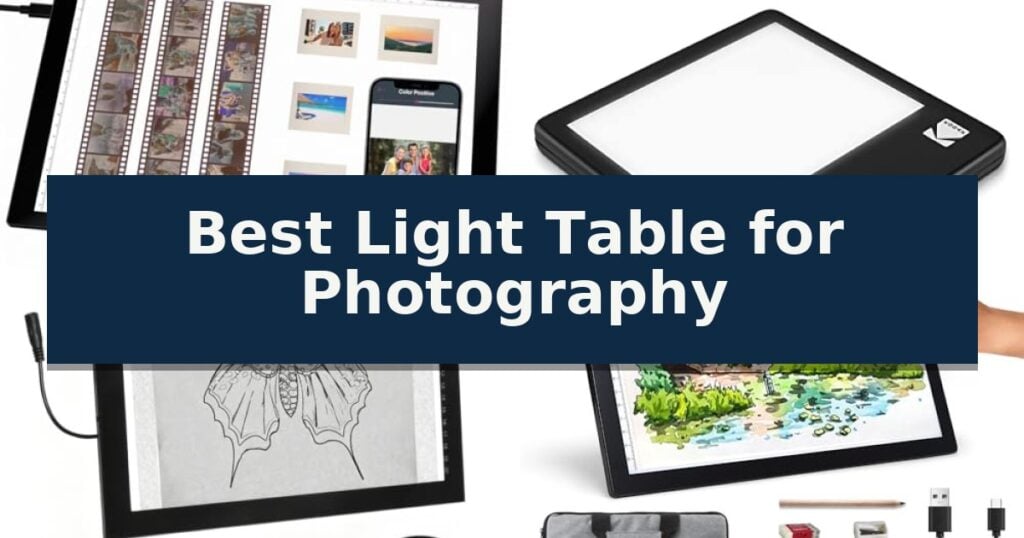
5 Best Light Table for Photography in 2026 Reviews
Quick Comparison
| Product | Best For | Key Strength | Score |
|---|---|---|---|
| DigitPro A4 Slide Viewer Light Box | Best Overall | Extra-large A4 viewing area allows for efficient sorting of multiple slides at once. | 4.9 |
| KODAK RODLLP5X4 Light Box | Compact Pick for Portable Scanning | 98% color restoration for accurate archival viewing | 4.8 |
| HSK 9×13 LED Light Pad | High-Brightness Tracing Surface | 6000 Lux high-brightness output for clear visibility | 4.8 |
| Zocelight Rechargeable A4 Light Box | Wireless Freedom for On-the-Go | Wireless operation via a rechargeable battery for enhanced portability. | 4.5 |
| ME456 A4 LED Light Box | Simple Reliable Tracing Tool | Dimmable touch technology for customizable brightness levels. | 4.4 |
How We Chose
When evaluating the best light table for photography, we focus on technical performance and practical utility for digitizing analog media. We analyze light uniformity, dimming precision, and physical dimensions to ensure the tool effectively supports high-resolution smartphone or DSLR scanning without introducing glare or eye strain during long sessions.
- Illumination consistency and flicker-free performance
- Surface area dimensions relative to film format
- Brightness adjustability for varying negative densities
- Power source versatility and cable management
- Build profile and portability for storage
1 DigitPro A4 Slide Viewer Light Box — Best for Digitizing Old Film
Preserving family history often starts with digitizing physical media, and the DigitPro A4 Slide Viewer Light Box provides a straightforward solution for this task. By offering a consistent, illuminated surface, it allows users to easily view 35mm slides and film negatives, which can then be captured using a smartphone for digital sharing.
The device features an extra-large A4 viewing area, which is significantly more efficient than traditional, small-format viewers. This spacious surface enables the organization of multiple film strips or dozens of slides simultaneously, streamlining the process of sorting through large family archives or wedding albums without the need for constant manual switching.
Usability is enhanced by 3-level adjustable brightness settings, controlled via a simple touch interface. This allows for precise light calibration to accommodate varying densities in old negatives. Furthermore, the flicker-free LED technology is engineered to minimize eye strain during extended sessions of reminiscing or scanning.
Designed for portability, the unit is ultra-thin at only 0.2 inches and lightweight, making it easy to store in a laptop bag or drawer. It is USB powered, offering flexible connectivity options including laptops, power banks, or standard wall chargers, which facilitates use in various settings from the kitchen table to the living room.
Beyond its primary function as a film viewer, this versatile tool serves as an artist light pad suitable for tracing, sketching, calligraphy, and diamond painting. This multi-purpose design provides utility for both family historians and creative hobbyists alike.
Best for: Individuals looking to digitize and organize large collections of 35mm slides and film negatives using a smartphone.
Skip if: Users who require a dedicated high-resolution film scanner with integrated software for automatic image processing.
- Extra-large A4 viewing area allows for efficient sorting of multiple slides at once.
- 3-level adjustable brightness ensures clear visibility for negatives of varying quality.
- Ultra-thin and portable design makes it easy to store and transport.
- Versatile functionality supports tracing, sketching, and other creative hobbies.
- Requires external power source via USB, limiting standalone operation.
- Lacks integrated scanning software, relying on external smartphone camera capture.
2 KODAK RODLLP5X4 Light Box — Compact Pick for Portable Scanning
The KODAK RODLLP5X4 Light Box provides a specialized solution for photographers needing precise color accuracy, featuring 98% color restoration to ensure slides and negatives appear with true-to-life detail. Designed for both archival viewing and product photography, this compact tool eliminates the guesswork often associated with digitizing film.
Engineered for versatility, the device offers dual power options—either via USB or six AAA batteries—allowing for seamless operation at home or during travel. Its flicker-free, glare-free illumination ensures a consistent, professional-grade workspace without the distraction of hot spots, making it highly effective for both tracing tasks and detailed film inspection.
Measuring just 5" x 4", the light pad is built for portability, fitting easily into standard camera bags or backpacks. This compact form factor does not compromise functionality, as it remains fully compatible with smartphone scanning apps, providing a straightforward method for hobbyists to convert physical media into digital files for gift-making or preservation.
The unit arrives as a ready-to-use creative tool, including a USB cable and user guide to facilitate immediate setup. By combining high-fidelity light output with a travel-friendly design, it serves as a practical asset for photographers looking to manage seasonal projects or digitize collections on the go.
Best for: Photographers and hobbyists requiring a highly portable, color-accurate light source for digitizing slides, negatives, or performing detailed tracing work.
Skip if: Users who require a large-format surface for scanning multiple documents simultaneously or those who need a permanent, studio-mounted light table will find the 5"x4" dimensions too restrictive.
- 98% color restoration for accurate archival viewing
- Dual power flexibility via USB or AAA batteries
- Flicker-free, glare-free illumination prevents hot spots
- Ultra-compact, travel-friendly design
- Small 5" x 4" surface area limits the size of media that can be processed at once
3 HSK 9×13 LED Light Pad — High-Brightness Tracing Surface
Achieving precise detail in photography and art projects requires a reliable, consistent light source, and the HSK 9×13 LED Light Pad provides exactly that with its super bright 6000 Lux illumination. This ultra-thin device is built with a sturdy aluminum frame and a specialized light guide board designed to ensure perfectly even, flicker-free light across the entire surface, which is essential for tasks like tracing, sketching, and viewing X-rays.
Usability is a core focus of this model, featuring a simple touch-button interface for power and brightness adjustments. To prevent accidental setting changes during delicate work, the device includes a dedicated lock button; holding the dimmer buttons for three seconds toggles this mode, ensuring your chosen intensity remains constant throughout your project.
The 13-inch by 9-inch footprint offers a generous 12-inch by 8.27-inch visual area, making it a versatile tool for varied applications ranging from 2D animation and calligraphy to diamond painting and sewing projects. The unit is powered via a standard USB cable, providing a straightforward setup for any workspace.
Designed for durability and long-term use, this light box comes with a two-year warranty. Its lightweight construction, weighing less than one pound, ensures it remains portable without sacrificing the structural integrity provided by its aluminum frame.
Best for: Artists and photographers requiring a portable, high-brightness surface for tracing, sketching, or viewing transparencies.
Skip if: Users who require a significantly larger surface area for architectural drafting or large-format photography negatives.
- 6000 Lux high-brightness output for clear visibility
- Lock button prevents accidental brightness adjustments
- Even, flicker-free illumination across the entire visual area
- Sturdy aluminum frame in a super-thin profile
- Fixed 9×13 inch size may be limiting for large-scale projects
4 Zocelight Rechargeable A4 Light Box — Wireless Freedom for On-the-Go
Achieving consistent illumination for detailed creative projects requires a reliable surface that minimizes eye strain. The Zocelight Rechargeable A4 Light Box provides this through its 6 levels of brightness and stepless dimming capabilities, allowing users to fine-tune the light output between 3000K and 6500K for various tracing and drawing tasks.
Designed for portability, this unit features a rechargeable battery that supports 4-6 hours of wireless operation after a 2-hour charge via its Type-C port. The included padded carry bag protects the screen during transport, while the built-in stand offers an ergonomic angle to help reduce fatigue during extended sessions.
The device includes a fasten top clip to secure canvases or paper, making it suitable for diamond painting, sketching, and animation. With a visible working area of 12.25" x 8.59", it offers sufficient space for standard A4 projects. The package also bundles essential accessories, including a pencil, eraser, and tracing papers, to support immediate use.
While the integrated stand improves comfort, it is limited to a single fixed angle, which may not suit every user's preferred posture. The device relies on a 5V 2A adapter (not included) for charging, so users should ensure they have a compatible power source on hand to maintain the battery's performance.
Best for: Artists and hobbyists who require a portable, battery-powered light surface for tracing, diamond painting, or sketching on the go.
Skip if: Users who require a large-format light table for architectural blueprints or professional-grade drafting will find the A4 surface area too restrictive.
- Wireless operation via a rechargeable battery for enhanced portability.
- Versatile dimming options with both 6-level and stepless adjustments.
- Ergonomic design featuring a built-in stand and protective padded case.
- Comprehensive accessory kit included for immediate project start.
- Single-angle stand limits ergonomic customization.
- Power adapter not included in the package.
5 ME456 A4 LED Light Box — Simple Reliable Tracing Tool
Achieving precise detail in artistic projects often requires a consistent, shadow-free light source, which is exactly what the ME456 A4 LED Light Box provides. This ultra-thin tracing pad is engineered with dimmable touch technology, allowing users to adjust the brightness to match their specific environment and medium, whether they are working on intricate stenciling, calligraphy, or diamond art painting.
The device features an eyesight-protected design that eliminates glare and shadows, creating a comfortable workspace for extended sessions. Its energy-efficient LED lamps are rated for up to 50,000 hours of use, ensuring long-term reliability for both professional designers and hobbyists. The surface includes a printing scale for accurate measurements, which simplifies the process of aligning sketches or technical drawings.
Designed for portability, this 14-inch light pad is exceptionally thin and lightweight, making it easy to transport between classrooms or home studios. It operates via USB power, offering a flexible connection for various setups. By providing a flicker-free, uniform illumination, the unit supports a wide range of creative tasks including 2D animation, scrapbooking, and sewing projects.
While the ME456 A4 LED Light Box offers significant versatility for various artistic applications, users should note its specific dimensions. Measuring 14.2 by 10.6 inches, it is optimized for A4-sized projects, which may limit its utility for larger-format drafting or expansive architectural layouts.
Best for: Artists and hobbyists who require a portable, dimmable, and flicker-free light source for small-scale tracing and design projects.
Skip if: Users who need a large-format surface for architectural drafting or projects exceeding standard A4 dimensions.
- Dimmable touch technology for customizable brightness levels.
- Eyesight-protected design to reduce glare and shadow.
- Energy-efficient LED lamps with a 50,000-hour lifespan.
- Integrated printing scale for precise measurement and alignment.
- A4 size constraint limits the workspace for larger projects.
Best Light Table for Photography Buying Guide
Surface Area and Film Capacity
The physical dimensions of your light table dictate how many slides or negatives you can process at once. An A4-sized surface is generally preferred for photographers managing large collections, as it allows for the simultaneous layout of multiple film strips, significantly speeding up the digitizing workflow.
Smaller, compact models are better suited for occasional use or travel. While they save desk space, they may require more frequent manual adjustments, which can be tedious when you are working through hundreds of vintage slides or negatives.
Brightness Control and Light Quality
Consistent, flicker-free LED lighting is essential for preventing artifacts in your digital scans. Look for tables that offer multiple brightness levels or stepless dimming, as this allows you to match the light intensity to the density of the specific film stock you are photographing.
High-quality light boxes should provide even illumination across the entire surface. Avoid units that exhibit hot spots, as these can cause uneven exposure in your photos, making it difficult to achieve a uniform look during post-processing.
Power and Connectivity Options
Most modern light tables are powered via USB, offering excellent flexibility for home setups. Being able to connect your light pad to a laptop, power bank, or standard wall adapter means you can easily move your scanning station to wherever you have the best ambient lighting.
Some specialized units include battery-powered options, which are advantageous if you need to work in areas without convenient electrical outlets. Always verify the cable length and port type to ensure it reaches your workspace comfortably without creating clutter.
Build Quality and Ergonomics
A slim, lightweight profile is ideal for storage, allowing you to slide the unit into a drawer or laptop bag when not in use. Aluminum frames often provide better durability and heat dissipation than plastic alternatives, which is a consideration for long-term reliability.
Look for features like non-slip bases or integrated stands if you plan to use the table for extended periods. These ergonomic additions can help reduce neck and wrist strain, making the archival process more comfortable and sustainable.
Versatility Beyond Photography
While your primary goal may be digitizing film, a high-quality light table is a versatile tool for other creative projects. Many photography-focused light boxes double as excellent surfaces for tracing, calligraphy, or diamond painting, providing extra value for your investment.
Consider whether the unit includes accessories like clips or protective cases, which can be helpful for both photography and art applications. A multifunctional tool that fits your secondary hobbies as well as your primary scanning needs is often the most practical choice.
Frequently Asked Questions
Can I use any light table for digitizing negatives?
While many light tables can illuminate film, you should prioritize models with flicker-free LED technology to avoid banding artifacts when capturing images with a digital camera or smartphone.
Does the brightness level matter for scanning?
Yes, adjustable brightness is crucial. Denser, underexposed negatives require higher light intensity to reveal detail, whereas thinner negatives may require lower brightness to prevent overexposure.
Is an A4 size necessary for photography?
It is not strictly necessary, but it is recommended for efficiency. An A4 surface allows you to organize and scan multiple slides or strips at once, reducing the time spent swapping film.
How do I prevent glare when photographing slides?
Ensure your room lighting is dimmed and consider using a matte-finish light table or placing a thin piece of diffusion material over the surface to soften the light and minimize reflections.
Are battery-powered light tables reliable?
Battery-powered units offer great portability, but ensure the battery capacity matches your project size. For large archives, a USB-powered unit connected to a reliable power source is generally more consistent.
Conclusion: Our Top Pick
Our top pick is DigitPro A4 Slide Viewer Light Box. Choosing the right light table depends on the volume of your film collection and your need for portability. For most photographers, an A4-sized, USB-powered light box provides the best balance of workspace and convenience, allowing for efficient digitization of large archives.
By focusing on flicker-free performance and adjustable brightness, you can ensure your vintage film is captured with the clarity it deserves. Select a model that fits your specific workflow, whether that involves high-volume scanning or occasional, travel-friendly projects.