 critical cactus
Seagate IronWolf Pro NAS Hard Drive is our top choice for the Best Long-Term Data Storage Devices, offering high-capacity reliability designed specifically for multi-user, 24-bay server environments.
Selecting the right storage medium requires balancing longevity, data accessibility, and the specific nature of the files being preserved. While high-capacity hard drives excel in active server environments, other formats like optical discs or portable flash memory serve distinct roles for cold storage or quick, localized transfers.
Understanding the difference between active storage for frequent access and archival storage for infrequent retrieval is essential. Our evaluation focuses on technical specifications that ensure data remains intact over extended periods, helping you determine which hardware best aligns with your specific backup requirements.
For a broader look at how different media types compare for archival purposes, our guide on Best Long-Term Data Storage provides additional context on selecting the right technology for your specific needs.
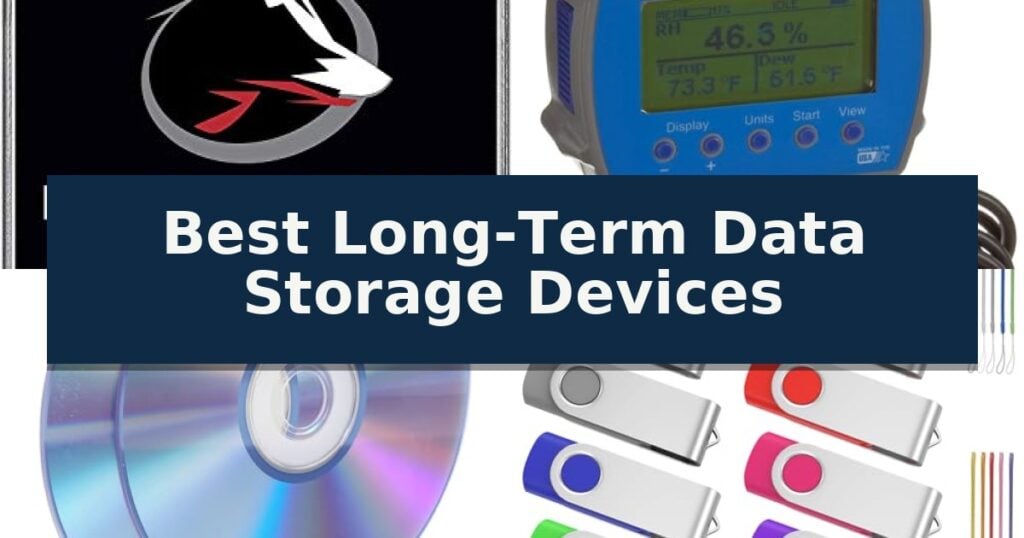
5 Best Long-Term Data Storage Devices in 2026 Honest Reviews
Quick Comparison
| Product | Best For | Key Strength | Score |
|---|---|---|---|
| Seagate IronWolf Pro NAS Hard Drive | Best Overall | 12TB ultra-high capacity for extensive archival storage. | 4.9 |
| Supco Temperature and Humidity Data Logger | Reliable Environmental Trend Tracking | High-capacity storage for over 40,000 data points. | 4.6 |
| FUNOMOCYA Blank Recordable Discs | Classic Physical Media Archiving | Professional-grade recording performance for clear audio and data stability. | 4.4 |
| ABLAZE USB Flash Drive | Compact Portable File Storage | 10-pack bundle with included lanyards for high-volume organization. | 4.6 |
| Top-Longer Video Capture Card | Digitize Legacy Analog Media | Plug-and-play setup requires no manual driver installation. | 4.8 |
How We Chose
When evaluating the best long-term data storage devices, we prioritize hardware that balances capacity with long-term stability. An experienced reviewer examines technical specifications like MTBF ratings, interface compatibility, and built-in health management tools to distinguish professional-grade solutions from standard consumer hardware, ensuring your data remains accessible and secure over time.
- Data density and total storage capacity for long-term scalability
- Hardware reliability metrics such as Mean Time Between Failures (MTBF)
- Compatibility with existing backup infrastructure and RAID configurations
- Data protection features including health monitoring and recovery services
- Physical durability and environmental resistance for stationary versus mobile use
1 Seagate IronWolf Pro NAS Hard Drive — Best for High-Capacity Archiving
Reliable, high-capacity data management requires hardware engineered for constant operation, and the Seagate IronWolf Pro 12TB NAS Internal Hard Drive is built specifically for demanding 24-bay, multi-user NAS environments. This drive utilizes a 7200 RPM spindle speed and a 256MB cache to achieve data transfer speeds up to 250MB/s, ensuring that large-scale file sharing and business-critical tasks remain efficient.
Beyond raw speed, this drive integrates the IronWolf Health Management system, allowing users to monitor drive status proactively. It is designed to minimize noise and vibration, which helps reduce mechanical wear over time. With a Mean Time Between Failures (MTBF) rating of 1.2 million hours, it is engineered for long-term operational stability in server racks or personal storage arrays.
The drive includes a five-year limited warranty and three years of Rescue Data Recovery Services, providing a layer of protection against unexpected data loss. Its SATA 6Gb/s interface ensures compatibility with standard NAS hardware, while the 12TB capacity provides significant headroom for growing archival needs.
While this drive excels in high-density storage, it is a specialized component intended for NAS enclosures rather than standard desktop use. Users should ensure their system supports the physical dimensions and power requirements of this 3.5-inch drive to maintain optimal performance and longevity.
Best for: Business and personal users requiring high-capacity, reliable storage for multi-bay NAS server environments.
Skip if: Users seeking a drive for standard desktop PCs or those who do not require the specialized vibration-dampening and health monitoring features of a NAS-specific drive.
- 12TB ultra-high capacity for extensive archival storage.
- Integrated IronWolf Health Management for proactive drive monitoring.
- Three-year Rescue Data Recovery Services included for added protection.
- 1.2M hours MTBF for long-term reliability.
- Specialized NAS-focused design may be overkill for simple desktop storage needs.
- High-performance 7200 RPM operation requires adequate ventilation in dense server environments.
2 Supco Temperature and Humidity Data Logger — Reliable Environmental Trend Tracking
Maintaining precise environmental conditions is critical for sensitive storage, and the Supco Temperature and Humidity Data Logger simplifies this with its integrated graphic display. This compact device, measuring 4 x 3.05 x 1.5 inches, provides immediate visual feedback, allowing users to monitor fluctuations in real time without needing to connect to external hardware.
Engineered for accuracy, the unit features a high-performance sensor capable of tracking temperature with +/-1°F (0.5°C) precision and humidity levels across the full 0% to 99% RH range. This level of sensitivity makes it a reliable choice for environments where stability is paramount, such as greenhouses, cold storage, or specialized inventory rooms.
For those requiring long-term trend analysis, the device offers a high-capacity internal memory capable of storing over 40,000 data points. Users can easily transfer this information to a PC using the included software, which facilitates organized reporting and detailed review of environmental history through scrolling graphs.
The system is designed to be proactive rather than just reactive, incorporating alarm alerts that notify users when conditions deviate from set parameters. By combining real-time tracking with robust data logging, the Supco Temperature and Humidity Data Logger serves as a comprehensive tool for maintaining consistent storage standards.
Best for: Users needing a compact, standalone device for continuous environmental monitoring and long-term data logging in sensitive storage areas.
Skip if: Users who require wireless connectivity or cloud-based remote access, as this model relies on PC-based software for data export.
- High-capacity storage for over 40,000 data points.
- Precise sensor accuracy within +/-1°F and 0-99% RH.
- Integrated graphic display for instant, real-time monitoring.
- Proactive alarm alerts for environmental deviations.
- Wired data transfer requires a PC connection for analysis.
- No wireless or remote cloud monitoring capabilities.
3 FUNOMOCYA Blank Recordable Discs — Classic Physical Media Archiving
Preserving digital assets requires a reliable physical medium, and the FUNOMOCYA Blank Recordable Discs offer a classic solution for long-term archiving. These discs are designed with a smooth polished surface that provides a stable foundation for writing data, music, or digital photos, ensuring your files remain accessible for future retrieval.
Engineered for professional-grade recording performance, these discs deliver clear and stable sound reproduction, making them a suitable choice for audio CD creation. The plastic construction is built to withstand standard handling, while the compatibility with various DVD and CD recording devices allows for seamless data transfer across different hardware setups.
Whether you are managing backups in a home office or organizing professional studio recordings, the FUNOMOCYA Blank Recordable Discs provide a versatile storage format. Their ability to efficiently manage and back up recordings helps maintain a structured digital library without the need for complex software or cloud-based dependencies.
While these discs offer a straightforward method for data preservation, they are best utilized for static storage rather than frequent read/write cycles. The high-capacity storage capability makes them an effective tool for archiving specific projects or collections that you want to keep secure and offline.
Best for: Users seeking a physical, offline storage medium for archiving music, digital photos, and data files.
Skip if: Users requiring massive storage capacities or frequent data updates, as modern solid-state drives or cloud services are more efficient for those workflows.
- Professional-grade recording performance for clear audio and data stability.
- Smooth polished surface designed for reliable writing.
- Versatile compatibility with various DVD and CD recording devices.
- Durable plastic construction suitable for long-term archiving.
- Fixed storage capacity limited by standard CD/DVD formats.
- No warranty provided for the media.
4 ABLAZE USB Flash Drive — Compact Portable File Storage
The ABLAZE USB Flash Drive provides a practical solution for users requiring multiple, low-capacity storage units for organizing specific programs or files. This 10-pack set features a convenient metal swivel protector that eliminates the risk of losing a cap, while the integrated hole allows for easy attachment to lanyards or keychains.
Engineered for broad compatibility, these drives utilize USB 2.0 technology and support a wide range of operating systems, including Windows, Mac OS, and Chrome. The plug and play design ensures that no additional software installation is required, allowing for immediate use across various devices such as computers, notebooks, and car audio systems.
Each unit is equipped with an LED indicator light that illuminates upon connection, providing visual confirmation of power status. To assist with organization, the drives are designed with color-coded aesthetics, which help users distinguish between different stored programs or data sets efficiently.
The package includes 10 lanyards, making these drives suitable for users who need to keep their storage media accessible and portable. By utilizing proven stable storage technology, these drives are double-tested before shipping to ensure they meet standard operational requirements for data transfer.
Best for: Users who need multiple, low-capacity drives for organizing distinct sets of files or programs across various USB-compatible devices.
Skip if: Users requiring high-speed data transfer for large media files or those needing significant storage capacity beyond 512MB per unit.
- 10-pack bundle with included lanyards for high-volume organization.
- Metal swivel protector design prevents loss of the drive cover.
- Broad compatibility with multiple operating systems and USB 2.0 devices.
- LED indicator provides clear visual status when plugged in.
- Limited 512MB capacity is insufficient for modern high-definition media or large software files.
- USB 2.0 interface offers slower transfer speeds compared to newer USB 3.0 or 3.1 standards.
5 Top-Longer Video Capture Card — Digitize Legacy Analog Media
Preserving aging media requires reliable hardware that bridges the gap between legacy analog formats and modern digital archives. The Top-Longer USB 2.0 Video Capture Card serves as a direct interface for transferring footage from VHS tapes, Hi8, VCRs, and camcorders onto contemporary computer systems. By utilizing a plug-and-play architecture, this device eliminates the need for complex driver installations on Windows 10, 11, or macOS, allowing users to initiate the digitization process immediately after connecting their source equipment.
The hardware supports high-resolution output at 720×480 (NTSC) or 720×576 (PAL), facilitating the creation of digital files suitable for archiving or further video editing. This resolution is standard for analog-to-digital conversion, ensuring that the integrity of the original source material is maintained during the transfer. Its compact design is intended for portability, allowing for use in various home environments without requiring a permanent, space-consuming setup.
To begin the transfer, users connect an RCA or S-Video source to the capture card and plug the USB interface into a computer. The device includes software to assist with the conversion process, ensuring a seamless workflow for those looking to create digital archives of home movies or gaming footage. This setup is specifically designed for users who possess functional analog playback devices, as the card acts strictly as a bridge between the analog signal and the digital file format.
While the unit provides a straightforward pathway for digitizing legacy recordings, users should verify their source equipment's output compatibility before starting. The inclusion of an 18-month warranty provides a baseline for support, ensuring the device remains a functional tool for long-term data preservation projects. This combination of broad compatibility and simple connectivity makes it a practical choice for those managing analog media collections.
Best for: Users looking to digitize analog home movies from VHS, Hi8, or camcorders onto modern Windows or Mac computers.
Skip if: Users requiring professional-grade broadcast capture or those who lack a functional analog playback device like a VCR or camcorder.
- Plug-and-play setup requires no manual driver installation.
- Broad compatibility with Windows 10/11 and macOS.
- Supports both RCA and S-Video input connections.
- Compact, portable design for easy storage.
- Requires a separate, functional analog playback device to operate.
- Limited to standard definition 720×480/576 resolution.
Best Long-Term Data Storage Devices Buying Guide
Understanding Storage Longevity
Long-term storage is not a one-size-fits-all solution; it depends heavily on how often you need to access your files. Active storage, such as NAS-optimized hard drives, is designed for constant operation and frequent read/write cycles, making them ideal for home or business servers.
Conversely, archival storage focuses on data integrity during periods of inactivity. Devices like optical discs or dedicated cold-storage drives are better suited for files that are rarely opened but must remain preserved for years without degradation.
Capacity and Scalability
For users with massive digital libraries, capacity is the primary constraint. High-capacity hard drives allow for consolidated storage, reducing the number of physical devices you need to manage and track over time.
Smaller, portable storage options like flash drives are effective for specific, smaller projects but become difficult to manage when scaling up. Always calculate your current data volume and projected growth before committing to a specific storage architecture.
Data Integrity and Health Monitoring
Advanced storage devices often include built-in health management systems that alert you to potential drive failures before they happen. These tools are critical for long-term storage, as they allow for proactive data migration to new media.
Without these monitoring capabilities, you risk silent data corruption or total drive failure. Always prioritize hardware that provides clear, actionable data regarding its internal health and operational status.
Environmental Considerations
The physical environment where you store your data plays a significant role in device lifespan. Hard drives are sensitive to vibration and temperature fluctuations, requiring stable, climate-controlled environments for maximum longevity.
If your storage needs involve harsher conditions, such as monitoring equipment in greenhouses or industrial spaces, specialized data loggers designed for environmental resilience are necessary to ensure the device itself survives the conditions it is recording.
Recovery and Redundancy
No storage device is immune to failure, which is why redundancy is the cornerstone of long-term data management. Utilizing RAID configurations or maintaining off-site backups ensures that a single hardware failure does not result in permanent data loss.
Look for devices that include professional recovery services or warranties that cover data retrieval. These features provide a safety net, offering a professional path to data restoration if your primary storage medium fails.
Frequently Asked Questions
How often should I refresh my long-term storage?
It is generally recommended to migrate data to new storage media every 3 to 5 years to mitigate the risk of hardware degradation and to take advantage of newer, more reliable technology.
Are hard drives better than flash drives for long-term storage?
Hard drives are generally superior for large-scale, long-term storage due to their higher capacity and better suitability for continuous operation, whereas flash drives are better for short-term, portable file transfers.
What is the role of MTBF in choosing a drive?
Mean Time Between Failures (MTBF) provides an estimate of the drive's reliability. A higher MTBF indicates a more robust design, which is crucial for devices intended to run for extended periods.
Can I use a standard desktop drive for a NAS?
While technically possible, it is not recommended. NAS-specific drives are engineered to handle the vibration and thermal stress of multi-drive enclosures, which standard desktop drives are not designed for.
Is cloud storage a substitute for physical storage?
Cloud storage is an excellent complement to physical storage, providing an off-site backup. However, a robust long-term strategy should include both local physical copies and cloud redundancy.
Conclusion: Our Top Pick
Our top pick is Seagate IronWolf Pro NAS Hard Drive. Choosing the right long-term storage device requires a clear understanding of your data volume, access frequency, and the environment in which the hardware will reside. Prioritizing reliability and health monitoring features will significantly reduce the risk of data loss over the long term.
By investing in purpose-built hardware and maintaining a redundant backup strategy, you ensure that your digital assets remain secure and accessible for years to come. Evaluate your specific needs against these criteria to build a resilient storage foundation.