
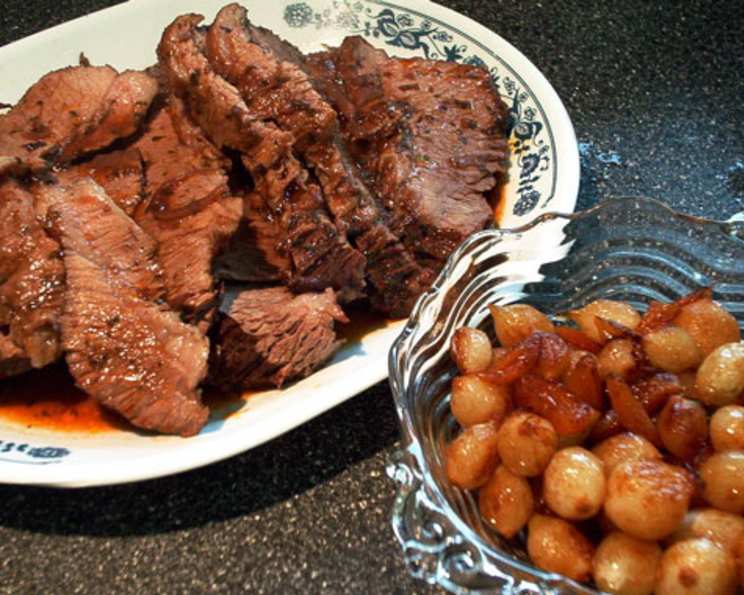
Wine-Braised Brisket of Beef With Caramelized Pearl Onions
There are some dishes that, with a single whiff, transport you back in time. For me, this Wine-Braised Brisket of Beef is one of those culinary anchors. I remember my grandmother, a woman whose hands seemed perpetually dusted with flour and whose kitchen was the heart of our home, slowly coaxing this magnificent cut of beef into submission. The aroma that wafted from her oven on a Sunday afternoon – a rich tapestry of red wine, savory beef, and sweet caramelized aromatics – was the signal that a truly special meal was on its way. It wasn’t just food; it was an embrace, a testament to the power of slow cooking and the magic that happens when simple ingredients are treated with patience and love.
Recipe Overview
- Prep Time: 2 hours 15 minutes (includes marinating time)
- Cook Time: 2 hours 30 minutes to 3 hours
- Total Time: 4 hours 45 minutes to 5 hours 15 minutes
- Servings: 8
- Yield: Serves 8
- Dietary Type: Not Specified
Ingredients
- 5 lbs beef brisket
- 2 tablespoons kosher salt
- 1 tablespoon fresh ground black pepper
- 1 (750 ml) bottle red wine
- All-purpose flour (for dusting)
- 2 tablespoons vegetable oil
- 2 tablespoons vegetable oil
- 10 garlic cloves, peeled and smashed
- 6 large shallots, peeled and thinly sliced
- 2 medium carrots, peeled, cut into 1-inch chunks
- 2 celery ribs, cut into 1-inch chunks
- 1 medium leek, white part only, cut into 1-inch chunks
- 1 cup dried apricot
- 6 sprigs fresh Italian parsley
- 2 sprigs fresh thyme
- 2 bay leaves
- 2 tablespoons tomato paste
- 2 quarts homemade beef stock or 2 quarts good-quality canned beef broth
- 1/4 cup homemade beef stock or 1/4 cup good-quality canned beef broth
- 1 cup white pearl onion
- Minced parsley (for garnish)
Equipment Needed
- Heavy-bottomed Dutch oven with a tight-fitting lid
- Platter
- Medium saucepan
- Sharp knife
- Small sauté pan
- Fine-mesh strainer
- Heated serving plates or a heated platter
- Aluminum foil
Instructions
-
Begin by preparing the beef brisket. Season the brisket evenly on both sides with kosher salt and fresh ground black pepper. Cover the brisket and refrigerate for at least 2 hours. This allows the salt and pepper to penetrate the meat, enhancing its flavor and tenderness.
-
While the brisket is marinating, it’s time to concentrate our red wine. In a medium saucepan, bring the entire bottle of red wine to a boil. Continue boiling until the wine reduces to half its original volume. This process will take approximately 15 to 20 minutes, and it intensifies the wine’s flavor, creating a rich base for our braising liquid. Set the reduced wine aside.
-
Preheat your oven to 350°F (175°C).
-
Now, prepare the brisket for searing. Evenly sprinkle the brisket all over with all-purpose flour, shaking off any excess. This light coating of flour will help to create a beautiful crust and slightly thicken the braising liquid as it cooks.
-
Heat a heavy Dutch oven over high heat. Add 2 tablespoons of vegetable oil. When the oil is almost smoking, turn the heat to medium-high. Carefully add the brisket to the hot Dutch oven. Sear the brisket until it is well browned on all sides, about 5 minutes per side. This searing step is crucial for developing deep, complex flavors through the Maillard reaction.
-
Once seared, transfer the brisket to a platter. Pour off the rendered fat from the Dutch oven, leaving behind any flavorful fond. Add another 2 tablespoons of vegetable oil to the same Dutch oven.
-
Add the smashed garlic cloves, thinly sliced shallots, carrots, celery, and leek to the Dutch oven. Sauté these aromatics until they are glossy and lightly browned, which should take about 5 minutes. These vegetables will form the aromatic foundation of our sauce.
-
Next, stir in half of the dried apricots, all of the fresh Italian parsley sprigs, fresh thyme sprigs, bay leaves, and tomato paste. Continue to cook for 1 minute more, stirring constantly. The tomato paste will caramelize slightly, adding another layer of depth.
-
Return the browned brisket to the Dutch oven, nestling it amongst the sautéed vegetables. Add the reduced red wine and 2 quarts of beef stock or broth. Ensure the brisket is completely covered with liquid. If it isn’t, add enough extra stock, broth, or water to cover it fully.
-
Bring the liquid to a simmer on the stovetop. Once simmering, cover the pot tightly with its lid and carefully place it in the preheated oven.
-
Cook until the brisket is fork tender. This will take approximately 2 to 2½ hours. The exact time can vary depending on the thickness and quality of the brisket, so check for tenderness by inserting a fork into the thickest part.
-
While the brisket is braising, prepare the pearl onions. Blanch and peel the white pearl onions as instructed in the tips below, leaving them whole. Cut the remaining dried apricots into 1/4-inch strips.
-
In a small sauté pan, heat the remaining 2 tablespoons of vegetable oil over medium-high heat. Sauté the pearl onions until they are lightly golden, which should take about 5 to 7 minutes.
-
Add the apricot strips to the sauté pan with the onions. Pour in the remaining 1/4 cup of beef stock or broth. Stir and scrape the bottom of the pan with a wooden spoon to deglaze, lifting any flavorful browned bits. Reduce the heat and simmer gently until the onions and apricots are tender, about 5 minutes. Cover the pan and keep warm.
-
Once the brisket is done and fork tender, carefully transfer it to a heated platter. Cover loosely with aluminum foil to keep it warm while you finish the sauce.
-
Return the Dutch oven containing the braising liquid to the stovetop. Boil the liquid over medium-high heat until it thickens and reduces to about 1 quart. This will take approximately 15 to 20 minutes.
-
Pour the reduced braising liquid through a fine-mesh strainer into a bowl. Taste the sauce and adjust the seasonings if necessary with more salt and pepper.
-
To serve, use a sharp knife to cut the brisket across the grain into 1/4-inch slices. Arrange the slices on heated serving plates or on a heated platter.
-
Spoon about half of the sauce over the brisket slices. Garnish with the caramelized pearl onions and apricots. Sprinkle with minced parsley and pass the remaining sauce on the side.
Expert Tips & Tricks
- Blanching Pearl Onions: To easily peel pearl onions, bring a small pot of water to a boil. Add the pearl onions and boil for 30 seconds. Drain and immediately plunge them into an ice bath. Once cool, the skins should slip off easily with a gentle squeeze.
- Achieving Fork Tenderness: The key to fork-tender brisket is patience. Don’t rush the braising process. If the meat isn’t tender after 2.5 hours, continue to cook, checking every 20-30 minutes, until it yields easily to a fork.
- Making Ahead: This dish is a chef’s best friend because it improves with age. You can braise the brisket a day in advance. Let it cool completely in its liquid, then refrigerate. The fat will solidify on top and can be easily skimmed off before reheating. Reheat gently in its strained sauce.
- Sauce Consistency: If your sauce is too thin after reducing, you can thicken it further by making a beurre manié (equal parts softened butter and flour kneaded together) and whisking small amounts into the simmering sauce until the desired consistency is reached.
- Cutting Across the Grain: This is perhaps the most critical step for tender brisket. Always identify the direction of the muscle fibers and slice perpendicular to them. This shortens the fibers, making the meat easier to chew.
Serving & Storage Suggestions
This Wine-Braised Brisket is a hearty and elegant dish that shines when served with classic accompaniments. Think creamy mashed potatoes, a simple green salad with a sharp vinaigrette, or crusty bread to soak up every last drop of that luscious sauce. For a more refined presentation, arrange the sliced brisket in overlapping layers on a warm platter, artfully spooning the sauce over the top and dotting with the caramelized onions and apricots.
Leftovers are a true gift! Once cooled, store the brisket and sauce separately in airtight containers in the refrigerator for up to 3-4 days. The flavors will meld and deepen beautifully. To reheat, gently warm the brisket slices in the sauce over low heat on the stovetop or in a covered dish in a 325°F oven until heated through. Avoid microwaving if possible, as it can dry out the meat. Freezing is also an option for longer storage, for up to 2-3 months, but again, thawing and reheating gently is key to preserving texture.
Nutritional Information
| Nutrient | Amount per Serving | % Daily Value |
|---|---|---|
| Calories | 679 kcal | |
| Calories from Fat | ||
| Total Fat | 28.5 g | 43% |
| Saturated Fat | 8.6 g | 42% |
| Cholesterol | 175.8 mg | 58% |
| Sodium | 2956.9 mg | 123% |
| Total Carbohydrate | 23 g | 7% |
| Dietary Fiber | 2.8 g | 11% |
| Sugars | 12 g | 47% |
| Protein | 63.7 g | 127% |
Note: Nutritional information is an estimate and can vary based on specific ingredients and preparation methods.
Variations & Substitutions
While this recipe is a classic for a reason, there’s always room for a little culinary exploration. For a richer, more robust wine flavor, consider using a Cabernet Sauvignon or a Merlot. If you prefer a lighter touch, a dry Pinot Noir would also work beautifully. For those seeking a slightly different aromatic profile, a few star anise pods or a cinnamon stick can be added to the braising liquid during the cooking process, but be mindful not to overpower the delicate flavors.
Should you find yourself without pearl onions, shallots or even baby cipollini onions can be used as a substitute, though the cooking time may need slight adjustment. And for a truly decadent finish, a splash of cognac or brandy added to the sautéed aromatics before deglazing can elevate the dish even further.
FAQs
Q: Can I use a different cut of beef for this recipe?
A: While brisket is ideal for braising due to its connective tissue, a well-marbled chuck roast or even short ribs could be substituted, though cooking times may vary.
Q: My sauce is too thin. How can I thicken it?
A: You can reduce it further on the stovetop over medium-high heat, or create a beurre manié (equal parts softened butter and flour kneaded together) and whisk small amounts into the simmering sauce until thickened.
Q: How long can I marinate the brisket?
A: While 2 hours is sufficient for seasoning, you can marinate the brisket in the salt and pepper for up to 24 hours in the refrigerator for a more deeply seasoned result.
Q: Can I cook this brisket in a slow cooker?
A: Yes, you can adapt this recipe for a slow cooker. Sear the brisket and sauté the aromatics as directed, then transfer everything to the slow cooker. Cook on low for 6-8 hours or on high for 4-5 hours until tender. You will need to reduce the braising liquid separately on the stovetop afterwards to achieve a sauce consistency.
Q: What if I don’t have beef stock?
A: Good-quality vegetable broth or even chicken broth can be used in a pinch, though the final flavor will be slightly different.
Final Thoughts
There’s a profound satisfaction that comes from creating a dish like this Wine-Braised Brisket of Beef. It’s a culinary journey that rewards patience with unparalleled flavor and tenderness. The deep, resonant notes of the reduced wine, the earthy sweetness of the caramelized onions and apricots, and the melt-in-your-mouth texture of the slow-cooked brisket combine to create a meal that is both comforting and sophisticated. I encourage you to embark on this delicious endeavor, to let the aromas fill your home, and to share this magnificent dish with those you love. It’s more than just a meal; it’s an experience, a memory in the making, and a testament to the enduring magic of slow cooking. Enjoy every slow, savory bite.